Understanding the Application for Tax Type Registration
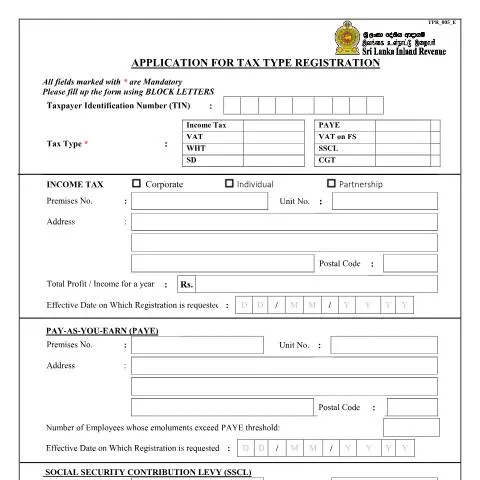
In Sri Lanka, the Application for Tax Type Registration (Form TPR_005) plays a vital role in the tax compliance system. This document is not merely a form; it is an essential gateway for businesses and individuals to officially declare their tax obligations to the Department of Inland Revenue (IRD). The application enables taxpayers to register for various tax types, including Income Tax, Value Added Tax (VAT), and others, thereby ensuring they adhere to the legal requirements under Sri Lankan tax law.
Navigating the Tax Registration Process: A Step-by-Step Guide
Completing the Application for Tax Type Registration involves several steps, each crucial to ensuring compliance and avoiding potential penalties. Here’s a breakdown of the process:
- Gather Required Information: It is essential to collect all necessary information, including your Taxpayer Identification Number (TIN), business details, and financial data. This information will facilitate a smooth application process.
- Choose the Appropriate Tax Type: The application allows you to select the tax type relevant to your business or income, which includes categories such as PAYE (Pay-As-You-Earn), VAT, Withholding Tax (WHT), and more. Make sure to understand which category applies to your situation.
- Complete the Form Accurately: Use block letters to fill out the form clearly. Each mandatory field must be completed to prevent delays in processing.
- Submit the Application: The completed form should be submitted to the nearest IRD branch along with any supporting documents, ensuring it reaches the Help Desk for processing.
Who Should File the Application for Tax Type Registration?
Understanding the profile of individuals and businesses that must submit this application is crucial. This includes:
- Individuals: Those who are self-employed or earning income that requires they register for Income Tax.
- Corporations: Companies that must register for taxes applicable to corporate income.
- Partnerships: Business partnerships requiring tax registration due to their income-generating activities.
- Employers: Businesses that have employees whose earnings exceed the PAYE threshold.
Special Cases: Unique Circumstances in Tax Registration
There are specific scenarios in which taxpayers may face unique challenges while filling out the Application for Tax Type Registration:
Foreign Nationals and Non-Residents
Individuals who are not citizens of Sri Lanka and are earning income within the country must register for a TIN and complete the application. They may need to provide additional documentation proving their residency status and the nature of their income.
Minors and Dependents
Minors may not typically file for tax registration themselves; however, guardians or parents may need to file on their behalf if they earn income surpassing the threshold.
Complex Business Structures
For businesses with complex structures, such as those involving multiple partnerships or international operations, additional documentation may be required to clarify ownership and revenue streams.
Deadlines and Timeframes for Registration
Timing plays a significant role in the registration process. The application requests an effective date for registration, which can impact tax obligations. Here are some key points to consider:
- Effective Date: The effective date on which you wish the registration to commence must be accurately filled in. This date can affect your tax reporting period.
- Submission Timeline: It is advisable to submit your application well in advance of the effective date to ensure adequate processing time.
- Tax Year Considerations: Be aware of the fiscal calendar in Sri Lanka, as it can impact your registration and subsequent tax returns.
Documentation: Ensuring You Have Everything Prepared
Submitting the Application for Tax Type Registration requires careful preparation of supporting documents. Depending on your situation, different documents may be necessary:
| Tax Type | Required Documents |
|---|---|
| Income Tax | Identification (NIC or Passport), proof of income, business registration documents |
| VAT | Business registration details, estimated turnover sheets, proof of taxable supplies |
| PAYE | Employee details, salary scale, business registration |
| WHT | Details of payments made, agreements on service provision |
Submission Methods: Online, Paper, and In-Person Options
Taxpayers have multiple options for submitting their applications, each with its own advantages:
Online Submission
Taxpayers can utilize the online platform available through www.forms.gov.lk, which offers a user-friendly interface for filling out and submitting the application electronically. This method enhances convenience and efficiency, allowing for quicker processing times.
Paper Submission
For those preferring a traditional approach, paper submissions can be made directly to the nearest IRD branch. It is crucial to ensure that the application reaches the Help Desk for processing.
In-Person Submission
In-person submissions allow taxpayers to clarify any uncertainties with IRD officials. This method can be particularly beneficial for complex cases requiring additional explanations or documents.
Tracking Your Application: What to Expect After Submission
Once the Application for Tax Type Registration is submitted, taxpayers need to be proactive in tracking the status of their application:
- Processing Time: Typically, the IRD processes applications within a specific timeframe, although this can vary based on the complexity and completeness of the submitted documents.
- Follow-Up: If you have not received confirmation of your registration within the expected period, it is advisable to follow up directly with the IRD, either by phone or in person.
- Receiving Your TIN: Upon successful registration, you will be issued a Taxpayer Identification Number, which is crucial for all subsequent tax-related activities.
Conclusion: Vital Steps for Successful Tax Type Registration
The Application for Tax Type Registration is a critical document for compliance with Sri Lankan tax laws. By understanding the procedures, requirements, and nuances involved, taxpayers can navigate the process more effectively. It is essential to approach this registration with diligence and attention to detail, ensuring all fields are accurately completed and necessary documents are attached. In doing so, you will secure your compliance status while positioning your business or personal income for future growth and success within the Sri Lankan economic landscape.
Understanding the Tax Registration Process in Sri Lanka
The process of tax registration in Sri Lanka is crucial for individuals and entities who wish to operate within the legal framework. The Taxpayer Registration system, administered by the Department of Inland Revenue (DIR), requires all residents, including foreign nationals who earn income within the country, to register for a Tax Identification Number (TIN). This process ensures that everyone contributes fairly to the nation’s revenue system and helps streamline tax administration.
To initiate the registration, applicants must gather necessary documentation, which typically includes a valid National Identity Card (NIC) for individuals or a certificate of incorporation for businesses. Additionally, proof of address, such as utility bills or lease agreements, may be required. Depending on the applicant's profile, there may be specific requirements; for example, self-employed individuals and companies might need to present different forms of financial documentation.
The application can be completed online through the official DIR website or submitted via paper forms at any local office of the Department of Inland Revenue. Online applications are encouraged due to the efficiency they offer, and applicants can track their application status through the e-services portal provided by the ICTA. This digital shift is part of a broader government initiative to enhance efficiency, reduce tax evasion, and improve public administration services.
Tax Types and Implications for Different Sectors
In Sri Lanka, there are several types of taxes that individuals and businesses must be aware of, each with its own registration requirements and implications. The primary tax types include Income Tax, Value Added Tax (VAT), and Economic Service Charge (ESC). Each of these taxes has specific thresholds and conditions under which they apply.
For instance, individuals earning above a certain threshold must register for Income Tax, which is assessed annually. Businesses, on the other hand, must consider whether to register for VAT based on their annual turnover. The current threshold for VAT registration is LKR 3 million, and businesses exceeding this figure are mandated to register, collect, and remit VAT accordingly.
The Economic Service Charge applies to businesses with a turnover above LKR 50 million, necessitating another layer of compliance. Each of these tax types comes with its own set of implications in terms of filing deadlines, documentation requirements, and payment schedules. Failure to comply with registration and filing can result in penalties and interest, making thorough understanding and adherence to these regulations essential for all taxpayers.
The Role of Digital Platforms in Streamlining Tax Registration
In recent years, the Sri Lankan government has emphasized the importance of digital platforms in streamlining administrative processes, particularly in tax registration. The implementation of the Electronic Transaction Act has paved the way for online registration, enabling taxpayers to complete forms such as the Application for Tax Type Registration without the need for in-person visits to government offices.
On the platform provided by the ICTA, users can access a variety of tax-related services, including real-time updates on their application status and the ability to submit supporting documents electronically. This transition to digital not only increases accessibility but also enhances the speed of processing applications. For instance, applicants can typically expect to receive their TIN within a few business days if all documentation is in order.
Moreover, the integration of these digital services also aids in data accuracy and reduces paperwork, contributing to a more efficient tax administration system. It is essential for applicants to familiarize themselves with the digital submission process, including how to navigate the website and what information is required, to avoid any delays in their registration.