Understanding the Schedules to Return of Value Added Tax on Supply of Financial Services
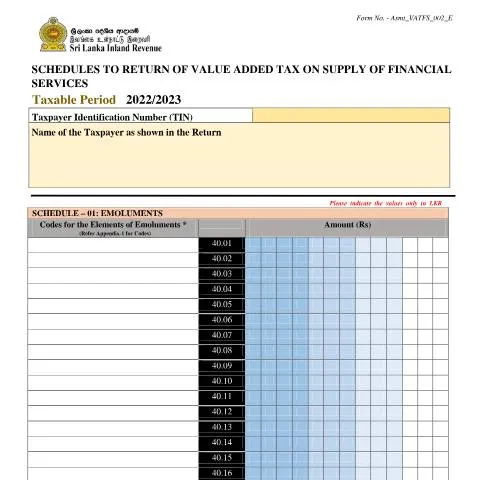
When managing the financial landscape of Sri Lanka, the Value Added Tax on Supply of Financial Services (VATFS) plays a crucial role in ensuring compliance and facilitating revenue collection. The Schedules to Return of Value Added Tax on Supply of Financial Services, identified by the code Asmt_VATFS_002_2223, presents a structured format for taxpayers to report their emoluments, economic depreciation, and classification of turnover. For financial entities, accurately completing this document is not just a regulatory requirement but a crucial element of financial planning and forecasting.
The Significance of Timely Submission
Failure to file the VATFS schedules on time can lead to significant legal repercussions and financial setbacks. Taxpayers are obligated to submit their returns within the stipulated timeline as outlined by the Department of Inland Revenue. Non-compliance may result in fines, penalties, or further legal action. Thus, understanding the intricacies of the form and adhering to its requirements is imperative for any taxpayer engaged in the supply of financial services.
Consequences of Omissions and Late Filing
- Financial Penalties: Late submissions can incur financial penalties, with specific rates dependent on the duration of delay.
- Legal Implications: Continued non-compliance can attract legal scrutiny and potential audit by the Department of Inland Revenue.
- Impact on Business Operations: Delays in filing may disrupt financial reporting cycles, affecting stakeholder confidence.
Navigating the Structure of the Document
The form is segmented into various schedules, each addressing a specific aspect of the taxable financial activities. This structured approach allows officials to easily analyze the submitted data.
Breakdown of Each Schedule
- Schedule 01: Emoluments
- Focuses on the declared values of emoluments, requiring precise coding as per Appendix-1. Errors in reporting can lead to miscalculations in tax assessments.
- Schedule 02: Economic Depreciation
- This section captures the economic depreciation of assets, which is critical for calculating the net profit. Each asset type has a designated depreciation rate, making accuracy vital for compliance.
- Schedule 03: Classification of Turnover
- This part classifies turnover into various categories, assisting in proper reporting of the taxable turnover in accordance with the Value Added Tax Act. It’s essential to differentiate between local and foreign transactions.
Who Needs to Complete This Document?
Any entity engaged in providing financial services that fall under the VATFS category is mandated to complete the return. This includes, but is not limited to:
- Commercial banks
- Non-banking financial institutions (NBFIs)
- Insurance companies
- Investment firms
Each taxpayer must ensure their Taxpayer Identification Number (TIN) is correctly reflected on the document, as it links the submission to their tax profile.
Channels for Submission: Options and Their Implications
The authorities provide multiple channels for submitting the VATFS schedules, each with distinct advantages and considerations.
Submission Methods Explained
| Channel | Description | Advantages | Considerations |
|---|---|---|---|
| Online Submission | Form submission via the e-services portal managed by ICTA. | Fast Processing: Immediate acknowledgment of receipt; Reduced Paperwork: Digital records. | Requires access to a reliable internet connection; Users must be familiar with the digital submission process. |
| Paper Submission | Physical submission at the local tax office or designated authority. | Personal Interaction: Opportunity for immediate clarification on any doubts. | Longer processing times; risk of loss or misplacement of documents. |
| Through Third-party Agents | Engaging authorized agents to handle submission on behalf of the taxpayer. | Expertise: Professional handling of documentation; Convenience: Reduces the burden on the taxpayer. | Fees associated with hiring agents; potential miscommunication if not properly briefed. |
The Filling Process: Attention to Detail Matters
Completing the Schedules to Return of Value Added Tax on Supply of Financial Services requires meticulous attention to detail. Each section must be filled out in compliance with the guidelines provided.
Common Pitfalls When Completing the Form
- Error in Emolument Codes: Each code aligns with specific types of remuneration. Incorrect coding may lead to audits.
- Inaccurate Depreciation Rates: Ensure the correct rates are applied to the relevant asset categories.
- Failure to Follow Instructions: Adhering strictly to the instructions in the appendices is essential for a successful submission.
Post-Submission Processing and Follow-Up
Once the return is submitted, it enters the review process by the Department of Inland Revenue. This phase is critical for ensuring compliance and identifying any discrepancies.
Tracking the Status of Your Submission
Taxpayers can monitor the status of their submissions through the same platform used for submission, allowing for transparency and timely responses to any queries raised by the tax authorities.
Special Scenarios: Unique Cases and Complex Situations
There are instances where taxpayers may encounter unique circumstances necessitating additional considerations when submitting the VATFS schedules.
Case Studies of Exception
- Foreign Taxpayers: Foreign entities providing financial services to Sri Lankan clients may have specific guidelines and exemptions. Understanding these nuances is crucial to ensure compliance without incurring unnecessary liabilities.
- Complex Corporate Structures: Companies with multiple subsidiaries may face challenges in consolidating their returns. Each branch's financial activities must be accurately reported to avoid misrepresentation.
- Emergent Situations: In instances of natural disasters or other emergencies, the authorities may provide extensions or special considerations. Keep abreast of announcements from the Department of Inland Revenue.
In navigating the intricacies of the Schedules to Return of Value Added Tax on Supply of Financial Services, adherence to guidelines and prompt submission are paramount. Understanding the role and importance of each element within this form not only ensures compliance but can also contribute to the strategic financial management of the entity.
Understanding the Value Added Tax on Supply of Financial Services
The Value Added Tax on Supply of Financial Services (VATFS) is a significant aspect of the tax regime in Sri Lanka, primarily designed to streamline the tax obligations of financial institutions while ensuring compliance with the broader VAT framework. The VATFS applies specifically to the supply of financial services, a category that includes banking, insurance, and investment services. Understanding the nuances of this tax is essential for stakeholders involved in the financial sector, including banks, insurance companies, and other financial service providers.
Financial services are generally exempt from standard VAT; however, specific services under this category may still attract VAT. The VATFS framework outlines which services are taxable, with an emphasis on maintaining transparency in tax calculations. For instance, service providers must identify taxable and exempt supplies to accurately file their VAT returns, ensuring that they adhere to the stipulations set forth by the Department of Inland Revenue.
Compliance and Filings: Key Considerations
Compliance with VATFS entails not only accurate reporting but also an understanding of the deadlines associated with filing returns. The filing of the Schedule to Return of Value Added Tax on Supply of Financial Services [Asmt_VATFS_002_E] form is a pivotal part of this process. Financial institutions are required to submit this schedule periodically, detailing the VAT collected and the input tax credits claimed. This ensures that all transactions are captured accurately, allowing the Department of Inland Revenue to assess the institution's tax obligations effectively.
It is critical for financial service providers to maintain meticulous records of all transactions involving VAT, as this facilitates the accurate completion of the required schedules. Failure to comply with these regulations may result in penalties or interest charges, emphasizing the importance of adherence to the filing timeline. The standard intervals for submission may correspond with the financial institution’s fiscal year, and understanding the specific deadlines is crucial for maintaining compliance.
Exemptions and Special Cases in VATFS
While the VATFS framework is largely structured, there are instances where exemptions and special considerations apply. Certain financial services may qualify for exemptions or reduced taxation rates. For example, services related to loans secured by mortgages or those provided to government entities may fall under exempt categories. Understanding these nuances is crucial for financial institutions, as misclassification could lead to compliance issues.
Furthermore, it is vital to note that the interpretation of taxable versus exempt services can evolve as new regulations or precedents are established. Financial institutions must stay informed on any changes to ensure they are correctly categorizing their services. Engaging with legal or tax professionals who specialize in VATFS can provide valuable insights and help navigate the complex landscape of taxation in financial services, ensuring that institutions remain compliant while optimizing their tax obligations.