The Crucial Role of the Interim Estimate of Value Added Tax on Financial Services
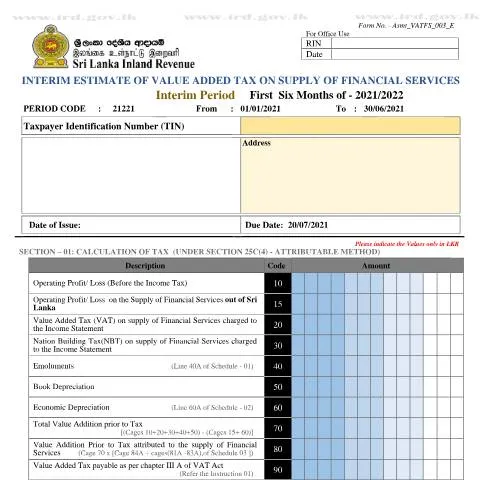
The Interim Estimate of Value Added Tax on Supply of Financial Services (Asmt_VATFS_003) document serves an essential purpose in the financial landscape of Sri Lanka. It enables financial service providers to estimate their Value Added Tax (VAT) liabilities during the initial six months of a financial year. Specifically, for the period of 01 January 2021 to 30 June 2021, this estimate must be submitted by 20 July 2021 to comply with the VAT Act No. 14 of 2002 as amended.
Understanding the Legal Framework
The requirement for the Interim Estimate of VAT concludes from the VAT Act No. 14 of 2002, which governs the assessment and collection of VAT on various financial services. According to the provisions outlined in Section 25C of the VAT Act, businesses engaged in financial services must submit this interim estimate as a condition for their annual tax return to be considered duly submitted. This legal imperative emphasizes the importance of accurate and timely submission, especially to avoid penalties or additional scrutiny.
Who is Responsible for Submission?
This document must be filed by any registered taxpayer who provides financial services in Sri Lanka and holds a Taxpayer Identification Number (TIN). The onus lies on managing directors, secretaries, or principal officers of such businesses to ensure the document is filled out accurately. Failing to comply with submission requirements can result in penalties and affect the legitimacy of the tax returns, thus compelling organizations to understand their obligations thoroughly.
Consequences of Non-Submission
Failure to submit the Interim Estimate on time could lead to various consequences:
- Increased Penalties: The Commissioner General of Inland Revenue may impose fines for late submission.
- Audit Risks: Non-compliance increases the likelihood of audits, which can be both time-consuming and costly.
- Loss of Tax Credits: Not submitting the estimate timely could mean losing potential tax credits that offset future liabilities.
Diving Deep into the Form: Sections Breakdown
The form contains two primary sections that require careful attention. Each segment has specific fields that must be populated accurately to facilitate the correct assessment of VAT.
Section 01: Calculation of Tax (Attributable Method)
This section is crucial for determining the VAT payable. Taxpayers must report their operating profit/loss, breaks down into various categories, including:
- Operating Profit/Loss (Before Income Tax): Here, enter the total profit or loss before taxation.
- Operating Profit/Loss on the Supply of Financial Services out of Sri Lanka: This reflects income derived from services provided outside the local jurisdiction.
- Value Added Tax and Nation Building Tax: Report the relevant VAT and NBT amounts charged to the income statement.
- Total Value Addition Prior to Tax: This box will have calculations based on the previous entries, demanding precision to ensure compliance.
The calculations conclude with the net VAT amount that will be payable or refundable. Each component must be calculated with utmost care to avoid errors that could lead to discrepancies in the final tax assessment.
Section 02: Supplies of Goods & Services Other Than Financial Services
This segment addresses the VAT payable on all taxable supplies outside the realm of financial services.
- Taxable Supplies: Include various supply categories, with rates of 8% and 0% as applicable.
- Exempt Supplies: List any services that are exempt from VAT to ensure that they do not incur additional tax liabilities.
- Interest Income from Leasing: Specific conditions apply, especially for agreements entered before a set date.
Submission Pathways: Online vs. Paper vs. In-Person
There are multiple pathways for submitting the Interim Estimate, facilitated by the Inland Revenue Department of Sri Lanka. Each method carries unique requirements and characteristics:
| Submission Method | Requirements | Pros & Cons |
|---|---|---|
| Online Submission via forms.gov.lk | Fill in the electronic form and upload required documents. | Pros: Quick processing, immediate confirmation. Cons: Requires reliable internet access. |
| Paper Submission | Complete the form and mail it to the Inland Revenue Department. | Pros: Good for those uncomfortable with digital forms. Cons: Takes longer for processing. |
| In-Person Submission | Visit the local tax office with completed forms. | Pros: Ability to ask questions directly. Cons: Long wait times, inconvenience of travel. |
Chronology of the Submission Process
The submission process follows a series of critical steps, commencing from the moment the financial period ends until the taxpayer receives confirmation of submission:
- End of Financial Period: Mark your calendar for the end of the interim period.
- Gather Financial Data: Collect relevant financial documents, including profit/loss statements.
- Complete the Interim Estimate Form: Fill out all sections meticulously, checking for errors.
- Submit the Form: Utilize your preferred method of submission before the deadline.
- Receive Acknowledgment: Ensure you receive a confirmation of submission to substantiate compliance.
Each of these steps is crucial, and any oversight at any stage can lead to compliance issues or penalties, underscoring the importance of diligence and timely action.
Special Considerations for Unique Circumstances
There are particular situations that may affect how taxpayers approach the Interim Estimate, especially for individuals or entities with unique characteristics:
- Foreign Taxpayers: Entities registered outside Sri Lanka must ensure compliance with local VAT rules and may need to consult with a tax professional to accurately file their estimates.
- Minors or Incompetent Persons: The legal guardian or representative must fulfill the submission responsibility on behalf of the minor or incompetent individual.
- Urgent Requests: Should there be an urgent necessity to amend a previously submitted estimate, tax authorities provide guidance on how to proceed efficiently.
Engaging with the Administration: Follow-ups and Monitoring
After submission, taxpayers may wish to monitor the status of their filings and any subsequent correspondence from the Inland Revenue Department. The following steps can aid in effective engagement:
- Keep Copies: Retain copies of all submitted documents for reference.
- Follow Up: Contact the Inland Revenue Department after a reasonable time to confirm receipt and address any queries.
- Stay Informed: Regularly check announcements from the tax department regarding changes in policies or procedures that may affect your obligations.
Engaging proactively with the tax authorities fosters a cooperative relationship and may provide insights into any potential issues before they escalate.
Conclusion: The Importance of Compliance
The Interim Estimate of Value Added Tax on Supply of Financial Services is more than just a form; it is a critical component of a taxpayer’s obligation to the Sri Lankan government. Understanding its intricacies can save time, money, and potential legal troubles. By ensuring timely and correct submissions, entities navigate their financial responsibilities more effectively while contributing to the broader economic landscape of Sri Lanka.
Understanding the Interim Estimate of Value Added Tax on Financial Services
The Interim Estimate of Value Added Tax (VAT) on the Supply of Financial Services in Sri Lanka is a pivotal report used for assessing the efficiency and compliance of financial institutions concerning VAT obligations. This estimate is particularly important for taxpayers in the financial sector, as it provides insights into the expected VAT liabilities for the first half of the financial year 2021/2022. The process is designed to ensure that financial service providers accurately report their taxable supplies and maintain compliance with the regulations set forth by the Department of Inland Revenue (DIR).
Financial services, which include banking, insurance, and other financial intermediaries, are generally exempt from VAT under the VAT Act. However, an interim estimate is crucial for maintaining transparency and compliance. The report helps financial service providers in forecasting their VAT obligations and ensures that they have made adequate provisions in their financial statements. It also serves as a mechanism for the DIR to evaluate the overall collection of VAT revenues in the financial services sector, ultimately influencing policy decisions and administrative practices.
Key Considerations and Compliance Requirements
To ensure compliance with the Interim Estimate of VAT on the Supply of Financial Services, stakeholders must pay attention to several key factors:
- Accuracy of Reporting: Financial institutions are required to provide accurate information regarding their taxable supplies. The Interim Estimate (Form Asmt_VATFS_003_E) requires detailed disclosures about the nature of financial services supplied, including the value of supplies made during the assessment period.
- Documentation: Supportive documentation must be maintained to substantiate claims made in the interim estimate. This includes contracts, invoices, and correspondence that relate to the financial services provided, ensuring that the data reported aligns with the respective financial institution's books.
- Timelines: Observing the deadlines set by the DIR is crucial. Failure to submit the interim estimate on time can result in penalties, including fines and interest on unpaid taxes. It's advisable for institutions to set internal deadlines that precede the official deadline to account for any unforeseen delays.
- Review and Reconciliation: Institutions should establish a routine review process to reconcile their financial records with the interim estimate. It is essential to ensure that all financial transactions and VAT-related calculations are accurately reflected in the report.
- Skills Development: The financial services sector should invest in training personnel to understand VAT regulations and the implications of the interim estimate. This enhances compliance and reduces the risk of errors in reporting.
Ultimately, maintaining compliance with the interim estimate not only bolsters the institution's credibility but also contributes to the overall goal of improving VAT revenue collection for the government.
The Role of Digital Transformation in VAT Reporting
With the advent of digital technologies, the process of filing the Interim Estimate of VAT has evolved significantly. The ICTA (Information and Communication Technology Agency) has made strides toward digitizing government forms and e-services, including tax-related submissions. These digital transformations have streamlined the filing process, enabling financial institutions to submit their interim estimates online through the dedicated platform at forms.gov.lk.
This digital approach offers several advantages:
- Increased Efficiency: Digital submissions reduce the time and resources spent on paperwork, allowing financial institutions to focus on their core services. The online platform provides a user-friendly interface for uploading necessary documents and data, significantly speeding up the process.
- Real-time Updates: Financial institutions can receive real-time feedback on their submissions, allowing them to promptly address any discrepancies or errors. This instant communication channel enhances transparency and fosters a collaborative environment between the DIR and taxpayers.
- Enhanced Data Security: The digital platform is equipped with encryption and security protocols to protect sensitive financial information. This security feature is critical in ensuring the confidentiality of financial records and taxpayer information, ultimately fostering trust in the reporting process.
- Comprehensive Analytics: By utilizing digital systems, the DIR can gather analytics on VAT compliance trends across the financial services sector. This data can inform policy adjustments and targeted initiatives to improve VAT collection efficiency.
In conclusion, as financial service providers leverage technology for compliance with the Interim Estimate of VAT, it is essential for them to stay abreast of updates on digital services offered by the government. Regular workshops and training sessions focused on these digital tools can empower institutions to optimize their reporting processes while ensuring compliance with regulatory requirements.