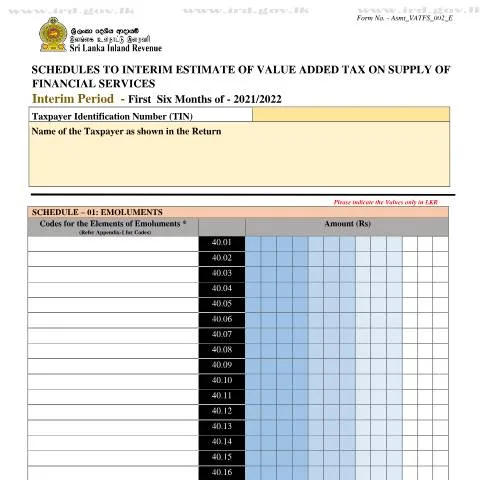
Understanding the Role of the Schedules to Interim Estimate of Value Added Tax on Supply of Financial Services
The Schedules to Interim Estimate of Value Added Tax on Supply of Financial Services, designated as Asmt_VATFS_002_E, is a critical document in the financial landscape of Sri Lanka, particularly for entities operating within the financial services sector. This form serves as a vital tool for calculating the Value Added Tax (VAT) applicable to various financial services provided during the first six months of the fiscal year 2021/2022.
Filing this document is not merely about compliance; it is about ensuring that the financial obligations of a company are accurately reflected and reported to the Department of Inland Revenue (DIR). Non-compliance or inaccuracies in this form can lead to significant penalties and loss of credibility with the tax authorities.
Who Needs to Submit the Form?
The responsibility to submit this form primarily rests with registered taxpayers within the financial services sector, particularly those whose operations fall under the purview of the VAT Act. This includes, but is not limited to:
- Banks and financial institutions
- Insurance companies
- Investment firms
- Other entities that provide taxable financial services
Each entity must hold a valid Taxpayer Identification Number (TIN), which is essential not just for identification purposes but also for the accuracy of records maintained by the DIR.
Structuring the Submission: Sections of the Form
The form is divided into several schedules, each addressing different aspects of VAT calculation. Understanding each section is crucial for accurate completion and submission.
Schedule 01: Emoluments
This section requires taxpayers to declare various emoluments paid during the interim period. The codes for the elements of emoluments are detailed in an appendix, ensuring taxpayers have accurate references for reporting:
- 40.01 - Salaries
- 40.02 - Allowances
- 40.03 - Bonuses
- 40.04 - Over Time
Taxpayers must be meticulous in entering the correct amounts, as errors can result in significant discrepancies and further investigations.
Schedule 02: Economic Depreciation
In this part of the form, taxpayers report economic depreciation of assets used in their business operations. The form requires details such as:
| Type of Assets | Year of Purchase | Cost (Rs) | Rate (%) | Charge for the Year (Rs) |
|---|---|---|---|---|
| Data Processing Equipment | 2021 | 500,000 | 25 | 125,000 |
| Motor Vehicles | 2020 | 1,000,000 | 20 | 200,000 |
Schedule 03: Classification of Turnover
Arguably one of the most critical sections, this schedule requires taxpayers to classify different elements of turnover as per the guidelines outlined in Appendix-2. The classification helps in determining the VAT payable on specific financial services supplied during the period. It is essential to differentiate between:
- Total turnover as per financial statements
- Turnover arising from services rendered out of Sri Lanka
- Turnover applicable for VAT calculation
Navigating Common Pitfalls and Errors
Filing the Schedules to Interim Estimate of Value Added Tax on Supply of Financial Services can be daunting, and errors could lead to significant repercussions. Here are some common pitfalls that filers should avoid:
- Misreporting Emoluments: Ensure that all amounts reported match the payroll records precisely. Consulting with the finance department may prevent discrepancies.
- Incorrect Asset Depreciation: Familiarize yourself with the depreciation rates as specified in the tax code. Mistakes here can lead to audits and penalties.
- Turnover Classification Errors: Be vigilant when classifying turnover; misclassification can result in an incorrect VAT calculation, leading to potential fines.
What to Do in Case of Refusal or Missing Documents
Upon submission, it is crucial to monitor the status of your application. If the DIR raises objections or requests further information, follow these steps:
- Review the feedback from the DIR carefully. Understand the specific reasons for refusal or requests for additional information.
- If corrections are needed, gather the necessary documentation. This may include financial statements, invoices, or supplementary appraisal reports as required.
- Respond promptly with the corrected information and any requested documents. Timely submissions often resolve issues more favorably.
Filing Process: A Step-by-Step Guide
Submitting the Schedules to Interim Estimate of Value Added Tax involves a structured process. Here is a detailed guide to ensure that your submission is smooth:
1. Collect Necessary Documents
Before proceeding, ensure you have all relevant documents, including:
- Financial statements for the period
- Payroll records for the reported emoluments
- Asset purchase records for depreciation calculations
2. Complete the Schedules
Accurately fill out each section of the form, referencing the appendices for proper codes and classifications.
3. Submit the Form
The form can be submitted through various channels, each with its benefits:
- Online Submission: Via the official ICTA e-services platform. This method is often quicker and allows for immediate confirmation.
- Paper Submission: Manually submit the form at the designated DIR office. Ensure you retain a copy for your records.
- Submission via Guichet: In-person submission at a service counter can allow for direct interaction with tax officials, enabling immediate clarification of doubts.
The Implications of Non-Compliance
Failing to submit the Schedules to Interim Estimate of Value Added Tax not only breaches regulatory requirements but can also have significant financial repercussions for the taxpayer. The consequences may include:
- Imposition of penalties
- Interest on late payments
- Increased scrutiny on future submissions
In severe cases, continued non-compliance could lead to legal proceedings or revocation of business licenses.
Leveraging Digital Tools for Efficient Filing
The transition towards digital filing through platforms such as forms.gov.lk has simplified the submission process. Benefits include:
- Improved accuracy through electronic validation checks
- Faster processing times
- Better record-keeping capabilities
Taxpayers are encouraged to utilize these digital resources to enhance compliance and reduce the likelihood of errors.
Understanding the Schedules under the Interim Estimate of Value Added Tax on Supply of Financial Services
The Schedules associated with the Interim Estimate of Value Added Tax (VAT) on Supply of Financial Services in Sri Lanka provide a structured framework for both taxpayers and the authorities to understand tax obligations clearly. The schedules detail the specific financial services that are subject to VAT, exemptions granted, and the procedures for compliance. Each schedule is aimed at ensuring transparency and ease of compliance for entities engaging in financial services.
One of the key schedules outlines the categories of financial services that are taxable under the Interim Estimate of VAT. These categories include, but are not limited to, banking services, insurance services, and financial advising. It is critical for businesses operating in these sectors to familiarize themselves with the specific services that the VAT applies to, as misinterpretation can lead to non-compliance and potential penalties.
Moreover, the schedules also delineate the exemptions applicable to certain financial services. For instance, specific services provided to vulnerable populations or those that are mandated by law may be exempt from VAT. Understanding these exemptions can be particularly beneficial for organizations that aim to serve low-income clients or operate in a non-profit capacity. The schedules serve not only as a guide for compliance but also as a roadmap for companies seeking to optimize their tax structure in line with legal obligations.
Compliance Mechanisms and Reporting Obligations
Compliance with the Interim Estimate of VAT on Supply of Financial Services entails a thorough understanding of reporting obligations. Taxpayers are required to file periodic VAT returns that incorporate the transactions conducted within the reporting period. The schedules clarify the format and particulars that must be included in these returns to ensure conformity with the regulations set forth by the Department of Inland Revenue (DIR).
For example, taxpayers must categorize their financial service transactions accurately, indicating whether they are subject to VAT or qualify for exemption. This level of detail is crucial as it directly impacts the calculation of VAT payable or reclaimable. Failing to categorize transactions correctly can lead to discrepancies and can trigger audits by the DIR.
Additionally, the schedules outline the necessary documentation that taxpayers must maintain to support their VAT returns. This documentation includes invoices, contracts, and any correspondence related to financial transactions. Maintaining organized records not only facilitates compliance but also provides a safety net in case of queries from the tax authority. Furthermore, businesses should be proactive in staying informed about updates or changes to the VAT regulations, as these can arise with minimal notice, affecting compliance strategies.
Digital Compliance and Technological Integration in VAT Reporting
As Sri Lanka moves towards a digital economy, the integration of technology in the compliance process for the Interim Estimate of VAT on Supply of Financial Services has gained significant prominence. The Electronic Transaction Act enables businesses to utilize digital forms, which simplifies the process of filing VAT returns. Taxpayers can access the necessary forms through platforms like forms.gov.lk, ensuring they have the latest versions of required documentation.
The digital compliance framework is designed to reduce the administrative burden on taxpayers, allowing for more efficient record-keeping and reporting. Businesses can leverage software solutions that integrate directly with financial systems to ensure that transactions are recorded accurately and timely. These systems can also automate reminders for filing deadlines, thus minimizing the risk of late submissions and associated penalties.
Moreover, the implementation of digital tools enhances transparency and accountability in the VAT collection process. The use of electronic records can facilitate real-time monitoring by tax authorities, enabling them to identify trends and address compliance issues proactively. For businesses, embracing digital solutions not only meets regulatory requirements but also positions them competitively in an increasingly data-driven market.