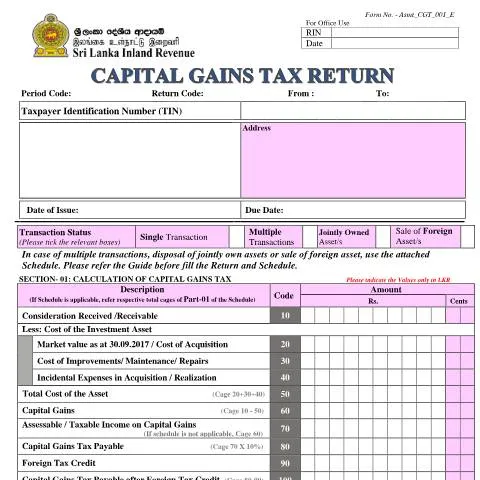
Understanding the Capital Gains Tax Return Form - Asmt_CGT_001_E
In Sri Lanka, taxation on capital gains plays a critical role in the country's financial ecosystem. Investors—both individual and corporate—who engage in transactions involving the sale of assets are mandated to report their capital gains through the Capital Gains Tax Return Form, identified by the reference Asmt_CGT_001_E. This specific form is not merely a bureaucratic necessity but rather a gateway for ensuring compliance with the Capital Gains Tax (CGT) regulations as stipulated under the Inland Revenue Act No. 24 of 2017. Proper completion and submission of this form are crucial for accurate tax assessment and subsequent obligation fulfilment.
The Lifecycle of the Form: From Trigger to Submission
The process begins when a transaction occurs that results in a capital gain. This may involve selling property, stocks, or other significant investments. It is imperative to note that failure to correctly report these transactions can lead to severe penalties, including fines and interest on unpaid taxes.
- Identify the Transaction: Recognize that a capital gain has occurred upon the sale of an asset.
- Documentation: Gather all necessary documents related to the acquisition and sale of the asset, including receipts, contracts, and proof of payment.
- Complete the Form: Fill out the Capital Gains Tax Return Form accurately, referring to the relevant sections and ensuring all values are expressed in LKR (Sri Lankan Rupees).
- Submission: Submit the completed form through the appropriate channel, either electronically via forms.gov.lk or through physical submission at designated Inland Revenue Department offices.
- Await Confirmation: Upon submission, the Inland Revenue Department will process the form, determining the tax liability or any refund due.
Navigating the Form: A Detailed Breakdown of Sections
The Capital Gains Tax Return Form comprises several critical sections, each serving a unique purpose. Understanding these sections and the common pitfalls is essential for successful completion.
Section 01: Calculation of Capital Gains Tax
| Description | Code | Amount (Rs. Cents) |
|---|---|---|
| Consideration Received / Receivable | 10 | |
| Less: Cost of the Investment Asset | 20 | |
| Market value as at 30.09.2017 / Cost of Acquisition | 20 | |
| Cost of Improvements / Maintenance / Repairs | 30 | |
| Incidental Expenses in Acquisition / Realization | 40 | |
| Total Cost of the Asset | 50 | |
| Capital Gains | 60 | |
| Assessable / Taxable Income on Capital Gains | 70 | |
| Capital Gains Tax Payable | 80 |
While calculating capital gains, ensure that you accurately report the consideration received, costs incurred, and any improvements made on the property. Each of these components plays a pivotal role in determining the final capital gains tax payable. It is vital to cross-check your values against the attached Schedule if applicable.
Section 02: Payments
Within this section, taxpayers are required to list all payments made towards capital gains tax. This section necessitates precision as it directly affects the overall tax liability.
- Record the payment date and corresponding amounts in LKR.
- Ensure that all entries are accurate to avoid discrepancies in tax liability calculations.
Who Should Complete the Capital Gains Tax Return?
The requirement to submit a Capital Gains Tax Return applies to various categories of taxpayers, including:
- Individuals: Those who sell personal or investment assets.
- Entities: Companies and partnerships involved in asset disposal.
- Foreign Nationals: Non-resident sellers may also be liable to file returns under certain circumstances.
Specific exemptions may apply, such as transactions below certain thresholds or those involving primary residences. It is advisable for potential filers to consult with a tax professional to ascertain their specific obligations.
Special Cases: What to Know About Foreign Transactions and Joint Ownership
Transactions involving foreign assets or jointly owned properties introduce additional complexities to the Capital Gains Tax Return process. When filing in such contexts, consider the following:
Foreign Assets
For sales involving foreign assets, filers must adhere to both the local tax laws and any relevant international tax agreements. Proper documentation proving the asset's original purchase price and sales agreement is crucial.
Jointly Owned Assets
When multiple parties own an asset, each owner must report their share of the capital gains on their tax return. Accurate apportioning of the proceeds and costs associated with the asset is essential to prevent double taxation or underreporting.
Understanding the Regulatory Framework Behind the Form
The Capital Gains Tax Return Form is governed by Sri Lanka's Inland Revenue Act No. 24 of 2017. This legislation lays the groundwork for taxation on capital gains, setting forth the conditions under which capital gains tax is assessed, reported, and collected. The Inland Revenue Department oversees compliance and enforcement, ensuring that taxpayers meet their obligations. A regulatory backdrop of this nature is essential for maintaining the integrity of the taxation system.
Can You File Online? A Comparison of Submission Methods
With the Sri Lankan government pushing for digital services, taxpayers can now choose between various submission methods for their Capital Gains Tax Return. Below, we outline the key differences:
| Method | Advantages | Considerations |
|---|---|---|
| Online Submission (forms.gov.lk) |
|
Requires internet access and familiarity with digital forms. |
| Paper Submission |
|
Longer processing times and potential for mailing delays. |
Choosing the right submission method will depend on individual preferences, technological capability, and urgency of processing.
Post-Submission: What Happens Next?
Once the Capital Gains Tax Return Form is submitted, the Inland Revenue Department will process it, usually within a specified timeframe. Taxpayers can expect to receive notifications regarding their tax assessments, including any amounts due or refunds owed.
In instances where discrepancies are noted or additional information is required, taxpayers may be contacted for clarification. It is prudent for individuals and entities to retain all relevant documentation, as this will facilitate any follow-up inquiries from tax authorities.
Staying informed and compliant regarding capital gains tax obligations is not merely a statutory requirement; it is an essential aspect of responsible financial planning in Sri Lanka. Ensuring accurate reporting, timely submission, and diligent record-keeping will aid taxpayers in navigating the complexities of the tax landscape effectively.
Understanding the Capital Gains Tax Framework in Sri Lanka
The Capital Gains Tax (CGT) in Sri Lanka operates under a framework that is primarily governed by the provisions set forth in the Inland Revenue Act No. 24 of 2017. This Act delineates how capital gains are to be calculated, the applicable rates, and the types of assets that may be subject to taxation. The understanding of this framework is vital for individuals and entities alike to comply with tax obligations effectively.
Capital gains arise from the sale of capital assets, which can include properties, shares, or other investments. The profit realized from the sale of these assets is what's subject to CGT. It's important to note that not all assets are subjected to this tax. For instance, certain exemptions are in place for government bonds and investments in specified business sectors as defined under the relevant legislative framework.
Exemptions and Deductions under the Capital Gains Tax Regulations
One of the critical aspects of the Capital Gains Tax regulations in Sri Lanka is the availability of exemptions and deductions. Understanding these can significantly impact your tax liability when filing the Capital Gains Tax Return.
For example, capital gains derived from the sale of an individual's primary residence may be exempt from taxation, provided certain conditions are met. The property must be owned and occupied by the seller for a specified minimum duration, and the sale should not exceed a defined monetary threshold.
Additionally, costs incurred in improving the asset can often be deducted from the total capital gain, which can include renovation costs, legal fees, and other associated expenses. However, it's crucial to maintain comprehensive records and receipts of all expenses claimed as deductions to ensure compliance during audits.
Filing Requirements and Deadlines for Capital Gains Tax Returns
Filing Capital Gains Tax Returns (Asmt_CGT_001_E) is a critical part of the compliance process for taxpayers in Sri Lanka. The deadline for filing these returns generally coincides with the end of the fiscal year, which is 31st March. Accordingly, taxpayers are required to submit their returns by the stipulated date to avoid penalties.
There are several key requirements when preparing to file a Capital Gains Tax Return. Taxpayers must ensure they have accurate records of the acquisition and disposal of assets, the purchase price, and any additional costs that may affect the gain calculation. Furthermore, the completion of the return form necessitates the inclusion of National Identity Card (NIC) numbers to ensure proper identification and processing.
The filing process has been simplified with the introduction of electronic submissions via platforms managed by the Inland Revenue Department. Taxpayers are encouraged to make use of these digital services as they not only facilitate a more efficient filing process but also provide real-time updates on the status of submitted returns.