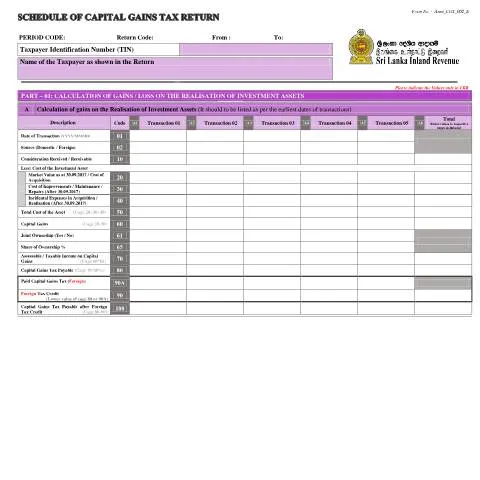
The Role of the Schedule of Capital Gains Tax Return - Asmt_CGT_002_E in Sri Lanka's Taxation Framework
Within the Sri Lankan tax system, the Schedule of Capital Gains Tax Return (Asmt_CGT_002_E) plays a pivotal role in ensuring compliance with tax obligations regarding capital gains from investments. This document is not merely a formality; it represents a critical tool for taxpayers to accurately report their capital gains or losses arising from the disposal of investment assets.
The necessity of this schedule arises from the requirement to compute and report capital gains, which are often subject to taxation under the Capital Gains Tax (CGT). This tax is levied on the profits made from the sale of certain assets, including real estate and other investments. Failure to accurately complete and submit this form can result in significant penalties, including fines and interest on unpaid taxes.
Who is Required to Submit the Schedule?
Typically, any individual or entity that has realized capital gains from the disposal of investment assets must complete the Asmt_CGT_002_E form. This includes, but is not limited to:
- Individuals who sell property or other assets.
- Companies that engage in trading or investment.
- Joint owners of investment assets, where the gains must be allocated according to ownership percentage.
It is essential to note that there are specific exceptions to who must file, particularly concerning tax-exempt entities or specific categories of sales which might not be subject to capital gains tax. For instance, transactions involving primary residences may have different treatment under the law.
A Step-by-Step Guide to Completing the Form
Filing the Schedule of Capital Gains Tax Return requires careful attention to detail. Here’s a structured approach to ensure compliance:
-
Gather Necessary Information:
- Taxpayer Identification Number (TIN)
- Name as registered with the relevant authorities
- Details of each transaction (dates, consideration received, costs involved)
-
Complete Part 1: Calculation of Gains/Losses:
In this section, you will need to itemize each transaction's details, including:
- Description of the asset sold
- Date of transaction
- Consideration received
- Cost of acquisition and any improvements
- Calculation of net gain or loss
-
Proceed to Part 2: Calculation of Losses:
Similar to Part 1, this section focuses on any losses incurred. This is crucial for offsetting gains and minimizing tax liabilities.
-
Fill in Part 3: Exempt Gains:
Identify any gains that are exempt from capital gains tax according to the Income Tax Act provisions.
-
Review and Verify:
Before submission, verify all entries for accuracy to avoid complications. Errors can lead to delays or rejections.
Timelines and Deadlines for Submission
The financial year in Sri Lanka typically aligns with the calendar year, making the reporting timeline crucial. The Schedule of Capital Gains Tax Return should be submitted by the specified deadline, which generally falls within 30 days after the end of the financial year. For instance, for gains realized in 2022, submissions would need to be completed by April 30, 2023.
Consequences of Non-Compliance or Errors
Failure to submit the Asmt_CGT_002_E can lead to severe repercussions, including:
- Financial penalties based on the amount of tax omitted.
- Interest charges on unpaid capital gains tax.
- Potential legal actions by the tax authorities for severe non-compliance.
In the case of errors detected post-submission, it is advisable to quickly file an amended return. This can mitigate some penalties and demonstrate a good-faith effort to comply with tax regulations.
Understanding the Historical Context of the Capital Gains Tax in Sri Lanka
The implementation of capital gains tax in Sri Lanka serves as a mechanism to regulate and tax profits from financial transactions involving asset disposals. Based on English common law principles, the CGT framework has undergone various amendments to align with international standards and local economic conditions. The current form, Asmt_CGT_002_E, was established to provide a structured approach for taxpayers to report their investment returns accurately.
The effectiveness of the CGT is closely monitored, as it directly impacts governmental revenue and economic stability. The continual revisions of the Income Tax Act ensure that the regime remains relevant and effective in addressing contemporary financial transactions.
The Place of Asmt_CGT_002_E in Broader Tax Obligations
The Schedule of Capital Gains Tax Return is integral to an individual or entity’s overall tax compliance strategy. It fits within the larger framework of income tax returns and related documentation that taxpayers must file annually. Understanding the interplay between different tax obligations aids in better financial planning and compliance.
Preparation of Supporting Documents
Completing the Asmt_CGT_002_E requires a suite of supporting documents, which may vary depending on the complexity of transactions. Commonly required documents include:
| Document Type | Description | Relevance |
|---|---|---|
| Sale Agreement | Document detailing the sale of the asset | Proof of transaction |
| Cost Estimates | Documentation of acquisition costs and improvements | Calculating gains/losses |
| Receipts | Proof of incidental expenses | Validating claims for deductions |
| Joint Ownership Proof | Evidence of ownership share in transactions | Accurate gain allocation |
Accurate preparation of these documents not only facilitates a smoother filing process but also reduces the risk of audits or disputes with tax authorities.
Conclusion: Navigating the Capital Gains Tax Landscape
Completing the Schedule of Capital Gains Tax Return (Asmt_CGT_002_E) is a vital process that enables individuals and entities to fulfill their tax obligations in Sri Lanka. By understanding the intricacies of this form—from gathering necessary documentation to comprehending the timelines and potential repercussions of errors—taxpayers can navigate the capital gains tax landscape effectively.
As the regulatory environment continues to evolve, staying informed and prepared remains essential for all taxpayers. This proactive approach not only ensures compliance but also promotes broader economic health by contributing to the national revenue framework.
Understanding the Capital Gains Tax Return: Key Components
The Schedule of Capital Gains Tax Return, referred to as [Asmt_CGT_002_E], is a crucial document for individuals and entities engaged in trading and investments within Sri Lanka. This form captures the details of capital gains accruing from the disposal of capital assets, which are generally subject to taxation under the Income Tax Act. Below are the key components of this Schedule that taxpayers must comprehend to ensure accurate reporting and compliance.
Identification of the Taxpayer
At the top of the [Asmt_CGT_002_E], taxpayers are required to furnish their National Identity Card (NIC) number, which serves as a unique identifier within the tax system of Sri Lanka. This ensures that the information is accurately matched with the records maintained by the Department of Inland Revenue (DIR).
Assets Disposed
Taxpayers must list all capital assets disposed during the assessment year, including real estate, stocks, bonds, and other investments. It is critical to specify the nature of the asset, the date of acquisition, the date of disposal, and the consideration received. The DIR provides detailed guidelines on how to classify these assets to avoid misreporting.
Calculation of Capital Gains
This section requires taxpayers to calculate the capital gains realized from each asset disposed of. The gain is generally computed as the difference between the sale price and the cost price of the asset, adjusted for any allowable expenses incurred during the acquisition and disposal process. Specific deductions, such as improvements made to the asset or commissions paid to brokers, can be included for accurate representation.
Exemptions and Allowable Deductions
Understanding the exemptions available is crucial for accurate reporting on the Schedule of Capital Gains Tax Return. Certain transactions may qualify for exemptions under specific provisions of the Income Tax Act. For instance, properties held for a designated period or involved in specific development activities may be exempt from CGT. Taxpayers are encouraged to stay updated on these provisions as they can significantly affect the taxation outcome.
Filing Deadlines and Penalties: Navigating Timelines
In Sri Lanka, adhering to deadlines for filing the Schedule of Capital Gains Tax Return is imperative to avoid penalties. The Department of Inland Revenue typically sets a deadline which aligns with the fiscal calendar. Taxpayers must submit their returns by the specified date, usually falling at the end of the financial year, which runs from April 1 to March 31.
Statutory Deadlines
Generally, the returns must be filed within three months following the end of the relevant financial year. For instance, for capital gains realized between April 1, 2022, and March 31, 2023, the due date would typically be June 30, 2023. Failure to meet this deadline may lead to penalties, and interest may accrue on any unpaid tax liabilities.
Penalties for Late Submission
Late submissions of the [Asmt_CGT_002_E] can incur financial penalties according to the provisions outlined in the Income Tax Act. The penalties are tiered based on how late the submission is: submissions up to one month late may incur a nominal fee, while those exceeding three months can attract more severe penalties which may include fines and interest on the outstanding tax amounts. Furthermore, chronic late filers may find themselves subject to additional scrutiny from the DIR, potentially triggering audits or further investigations.
Appeals Process for Penalties
Taxpayers who believe they have received an unfair penalty for late submission can initiate an appeals process through the DIR. This process needs to be formally documented and should include valid justifications for the late filing, such as unforeseen circumstances or errors in the filing process. The appeals must be filed within a specified period, generally within thirty days of the penalty notice being served.
Common Missteps in Filing the Capital Gains Tax Return
In the realm of tax compliance, particularly regarding the Schedule of Capital Gains Tax Return, taxpayers frequently make errors that could lead to complications. Awareness of these common missteps can aid in filing accurate returns and maintaining good standing with the tax authorities.
Inaccurate Reporting of Asset Disposals
One prevalent error is the inaccurate reporting of asset disposals. Taxpayers often fail to include all disposed assets or misstate their acquisition and disposal dates. This can lead to discrepancies in calculating capital gains and result in penalties. It is recommended that taxpayers maintain meticulous records of all transactions related to asset disposals, including purchase agreements, sales contracts, and any correspondence related to the transactions.
Neglecting to Include Allowable Deductions
Another frequent pitfall is the neglect to include all allowable deductions. Many taxpayers are unaware of which expenses can be deducted as part of the cost basis for capital assets. Consulting the DIR’s guidelines or seeking professional advice can help identify permissible deductions and ensure they are accurately reflected on the return.
Failure to Update Personal Information
Taxpayers must ensure that their contact information and NIC details are current and accurately reflected in the DIR records. Failure to update this information can lead to miscommunication and delays in processing the Schedule of Capital Gains Tax Return. It’s advisable to verify personal information periodically, especially prior to filing taxes.
Ignoring Digital Filing Options
Lastly, many taxpayers overlook the benefits of filing digitally through the e-services provided by the ICTA. The digital platform not only simplifies the filing process but also reduces the chances of clerical errors. Utilizing these services can provide a more streamlined experience for taxpayers and may even expedite the processing of their returns.