Navigating the Complexities of Withholding Tax Schedules in Sri Lanka
Understanding the significance of Schedule 1 and Schedule 4 within the domain of Withholding Tax (WHT) is essential for individuals and entities engaged in financial transactions in Sri Lanka. These documents play a crucial role in the Advance Income Tax (AIT) system, aiding in the systematic collection of taxes on various forms of income such as interest and discounts. Their accurate completion and timely submission are not merely bureaucratic tasks; they are essential components of compliance with Sri Lankan tax regulations.
A Deep Dive into Schedule 1: Key Elements Explained
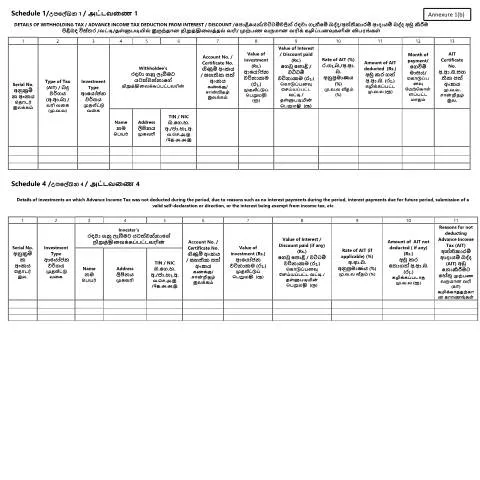
Schedule 1 is primarily focused on detailing the specifics of withholding taxes that have been deducted from interest payments or discounts. Each box within the schedule serves a vital purpose, and understanding these can help mitigate common errors in tax reporting.
Serial Number and Type of Tax
The first two fields require careful attention. The serial number is a unique identifier for each entry, while the type of tax should reflect whether it pertains to WHT or AIT. Mislabeling can lead to administrative delays.
Investment Type and Withholdee Details
In the next sections, taxpayers must specify the investment type and the details of the withholdee. It is imperative to provide accurate information about the investment, as this will influence the calculation of tax liabilities.
Important Financial Figures
| Field | Description |
|---|---|
| Value of Investment | Total value of the investment in Sri Lankan Rupees (Rs.) |
| Value of Interest/Discount Paid | Total interest or discount paid during the period in Rs. |
| Rate of AIT (%) | Applicable rate for Advance Income Tax |
| Amount of AIT Deducted (Rs.) | Total amount of tax deducted from the payment |
Each of these figures must be meticulously verified against financial records to avoid discrepancies. Missing or incorrect values can lead to penalties or complications with tax filings.
Submission Channels: From Paper to Digital
In recent years, the Sri Lankan government has made significant strides towards digitizing administrative processes. Submission channels for the WHT forms reflect this transition.
Online Submission Through Digital Portals
Submitting Schedule 1 and Schedule 4 online is encouraged, as it provides immediate confirmation of receipt. The system, managed by the Information and Communication Technology Agency (ICTA), allows users to fill out digital forms effortlessly. This method usually leads to faster processing times.
Traditional Methods: Paper and In-Person Submissions
For those who prefer traditional methods, forms can still be completed on paper and submitted at designated tax offices. However, this method often leads to longer processing times, and there is a risk of delays if forms are not filled out correctly. It’s advisable to keep copies of all submitted forms and any supporting documents.
Complex Scenarios: Special Considerations
Some taxpayers may find themselves in unique situations that complicate the filing process. Here are a few examples:
Foreign Entities
Foreign investors earning income in Sri Lanka need to understand the implications of withholding tax differently. If the foreign entity does not have a permanent establishment in Sri Lanka, the AIT may not apply, but proper documentation is essential to substantiate this claim.
Minors and Dependents
Tax obligations for minors can also be convoluted, as their investments often require guardian oversight. It is crucial for guardians to ensure that all information is correctly entered and that any applicable tax benefits or exemptions are claimed.
From Submission to Outcome: The Lifecycle of Your Tax Declaration
Once the forms are submitted, the journey of your tax declaration is just beginning. The administrative handling of your application is systematic, yet the timeline and responses may vary.
Processing Timeframes
Upon submission, the tax department typically processes WHT forms within a defined period. However, taxpayers should remain vigilant, as delays can occur. Setting up a tracking mechanism through the tax portal can be advantageous.
Potential Outcomes of Your Submission
- Approval: Upon successful processing, the taxpayer will receive an acknowledgment, confirming compliance.
- Request for Clarification: If the tax office finds discrepancies, they may request additional information or clarification.
- Rejection: In cases where entries are significantly flawed, rejections can occur, necessitating a complete resubmission.
Addressing Issues: What To Do Next?
In instances where a submission is met with rejection or requests for further information, prompt action is crucial. Here’s how to address potential issues:
Responding to Clarification Requests
When the tax office requests additional documents or clarifications, it is vital to respond swiftly. Ensure that any supplementary documents are accurate and submitted through the same channel as the original filing.
What to Do in Case of Rejection
If a submission is rejected, the notice will typically include reasons for rejection. Assess these carefully and take corrective measures before resubmitting. Maintaining a record of communications with the tax office can also be beneficial.
The Importance of Schedules in Broader Tax Compliance
Understanding how Schedule 1 and Schedule 4 fit into the larger framework of Sri Lankan tax compliance is essential for maintaining good standing with the tax authorities. These documents serve as critical proof of tax compliance and can be scrutinized during audits.
Legal Context and Compliance Requirements
The legal foundation for these forms lies within the broader context of Sri Lankan tax law, underpinned by English common law principles. Being proactive in filing and ensuring accuracy can guard against future legal issues.
Final Remarks on Filing Schedules
The implications of correct withholding tax reporting stretch beyond immediate compliance. They contribute to the larger effort of tax governance and fiscal responsibility within the nation. Engaging with this process knowledgeably allows taxpayers to fulfil their obligations while minimizing the potential for complications.
Understanding Schedule 1 and Schedule 4 Tax Regulations
In Sri Lanka, the tax system is governed by the Income Tax Act, which delineates various schedules that classify different income types and tax obligations. Specifically, Schedule 1 refers to the tax rates applicable to individuals and corporations, while Schedule 4 pertains to the taxation of specific income sources. Understanding these schedules is crucial for both residents and non-residents who engage in income-generating activities within the country.
Schedule 1 outlines the progressive tax rates for individual taxpayers. For residents, the rates are structured to increase with income levels, ensuring that higher earners contribute a larger share of their income to the national treasury. Non-residents, however, are subject to a flat rate on income sourced within Sri Lanka, regardless of their global income. This differentiation is significant for expatriates and foreign investors, as it influences their overall tax liability.
On the other hand, Schedule 4 focuses on specific types of income, such as rental income, dividends, and interest. Understanding the intricacies of this schedule is essential, especially in light of the Withholding Tax (WHT) regulations that often require payers to deduct tax at the source before remitting payments. For instance, rental income might be subjected to a fixed percentage based on the tenant's classification, and dividends may attract varying rates depending on whether they are distributed by listed or unlisted companies.
Moreover, both schedules are subject to periodic adjustments by the government, so it is vital to stay updated with any changes in tax rates or applicable exemptions. Taxpayers can consult the official gazettes or the Sri Lanka Tax Department's website for the most current information. Engaging a tax professional can also help navigate these complexities and ensure compliance with the law.
The Role of the Department of Inland Revenue in Enforcing Tax Compliance
The Department of Inland Revenue (DIR) plays a pivotal role in the enforcement of tax regulations related to Schedule 1 and Schedule 4. As the primary authority for tax administration in Sri Lanka, the DIR is responsible for assessing, collecting, and managing taxes as per the Income Tax Act. It is imperative for taxpayers to understand the functions of the DIR, as it not only sets the regulatory framework but also provides guidance and support for taxpayers seeking to comply with their obligations.
One of the main responsibilities of the DIR is to ensure that all taxpayers accurately report their income and any deductions or credits they may be entitled to claim under Schedules 1 and 4. This includes the issuance of tax identification numbers (TINs), which are essential for filing tax returns. Taxpayers must apply for a TIN through the DIR's online portal or at their local office, facilitating a smoother process for compliance.
Additionally, the DIR conducts audits and reviews to verify that tax declarations align with applicable regulations. Taxpayers should be aware that inaccuracies or non-compliance can lead to penalties, including fines and interest on unpaid taxes. Therefore, maintaining accurate records and seeking assistance when necessary is crucial in safeguarding against compliance issues.
Furthermore, the DIR offers various e-services through the ICTA platform, allowing taxpayers to access forms, submit returns, and track their tax status digitally. The push for digitalization signifies a broader effort to streamline tax processes and enhance the taxpayer experience in Sri Lanka.
Implications for International Tax Treaties on Schedule Taxation
Sri Lanka actively engages in international tax treaties to avoid double taxation and foster economic relationships with other countries. These treaties often have significant implications for individuals and businesses relying on Schedule 1 and Schedule 4 for their tax obligations. Understanding the nuances of these treaties is essential for expatriates, foreign investors, and local entities dealing with overseas operations.
Under the provisions of these treaties, residents of countries with which Sri Lanka has entered into a double taxation avoidance agreement (DTAA) may benefit from reduced tax rates or exemptions on certain types of income, such as dividends, interest, and royalties. For instance, a resident of a treaty country receiving dividends from a Sri Lankan company may be eligible for a lower withholding tax rate than an individual from a non-treaty country. This underscores the importance of assessing the specific provisions of the applicable treaty to maximize tax efficiency.
Moreover, the applicability of DTAAs can affect how income is reported under Schedule 1 and Schedule 4. Taxpayers must ensure they maintain proper documentation to substantiate claims for treaty benefits. This includes providing proof of residency and aligning their tax filings accordingly. The DIR often requires taxpayers to submit application forms detailing their intentions to claim benefits under a treaty, further emphasizing the importance of compliance and accurate reporting.
As tax treaties evolve and new agreements are established, staying informed about the implications for tax obligations under Schedules 1 and 4 is critical. Regular consultation with tax professionals can provide valuable insights into optimizing tax strategies in a global context.