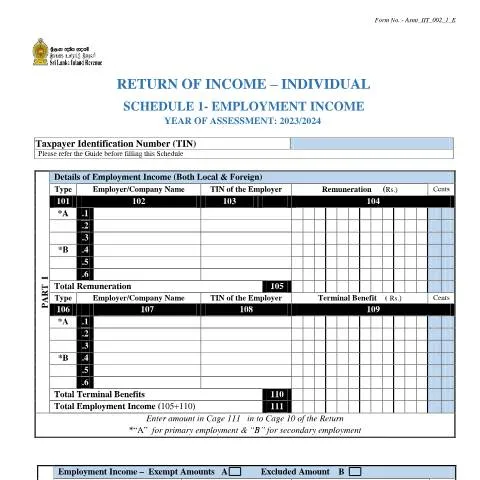
Navigating the Schedules to Return of Income - Asmt_IIT_002_2023
In the context of Sri Lanka’s taxation framework, the Schedules to Return of Income, specifically the Asmt_IIT_002_2023, are an essential part of the individual taxpayer’s responsibilities. These schedules facilitate the declaration of various income types, encompassing employment, business, investment, and other incomes for the year of assessment 2023/2024. Understanding the intricacies of these schedules is crucial for compliance and accurate reporting to the Inland Revenue Department (IRD).
The Structure of Schedules: A Comprehensive Overview
The return comprises multiple schedules, each serving a distinct purpose while collectively painting a complete financial picture of the taxpayer. Below is a breakdown of the key sections contained within these schedules:
- Schedule 1 - Employment Income
- Schedule 2 - Business Income
- Schedule 3 - Investment Income
- Schedule 4 - Other Income
- Schedule 5 - Qualifying Payments and Expenditure Relief
Each schedule is designed to capture specific income categories, ensuring that all taxable incomes are accounted for, thus enabling the IRD to assess the taxpayer's total tax liability accurately.
Critical Dates and Filing Timelines
Awareness of filing deadlines is essential for taxpayers. For the year of assessment 2023/2024, the following timeline applies:
- Start of the Assessment Year: The assessment year commences on April 1, 2023.
- Deadline for Submission: Taxpayers must submit their completed returns by the end of the assessment year, specifically by March 31, 2024.
Any extension requests or late submissions may incur penalties as stipulated under the relevant sections of the Inland Revenue Act. Therefore, timely preparation and submission are imperative.
Channels for Submission: Digital vs. Paper
The Sri Lankan government encourages the use of digital formats for tax returns, promoting efficiency and convenience. Taxpayers have the option to submit their returns through:
- Online Submission: Through the official portal, taxpayers can fill out and submit their return electronically. This method provides instant acknowledgment of submission.
- Paper Submission: Taxpayers may opt for traditional methods by printing the completed schedules and submitting them at their respective IRD branch. This method requires careful tracking and often leads to longer processing times.
Both channels require adherence to specific formats and guidelines provided in the accompanying guides, which can be crucial for avoiding mishaps during submission.
Essential Documentation: Gathering Your Evidence
Completing the Schedules to Return of Income necessitates comprehensive documentation to support the reported incomes. Depending on your income categories, the following may be required:
| Income Type | Required Documentation |
|---|---|
| Employment Income | Salary slips, employer TIN, contracts |
| Business Income | Profit and loss statements, business registration documents |
| Investment Income | Bank statements, investment certificates |
| Other Income | Proof of other income types (e.g., rental agreements) |
Proper organization and presentation of these documents can greatly facilitate the review process by the IRD.
Understanding the Review Process: What Happens Next?
Once the returns are submitted, the IRD undertakes a meticulous review process. The timeline for processing returns typically spans several weeks. During this period, taxpayers may receive notifications regarding:
- Clarifications: Queries may arise regarding specific entries or documentation. Prompt responses can expedite the process.
- Assessments: After review, the IRD will issue a notice of assessment stating the tax due or any refunds applicable.
Taxpayers are advised to keep track of their submission status and maintain communication with the IRD to clarify any potential issues.
Addressing Issues: What to Do if Problems Arise
In the event of an erroneous submission or if the IRD has flagged a return for any reason, understanding the next steps is paramount. Taxpayers should be prepared to:
- File Amendments: If errors are identified post-submission, amendments can be filed detailing the corrections needed.
- Provide Additional Documentation: Should the IRD require further information, swift compliance is essential to avoid delays.
- Appeal Processes: In cases of disagreement with assessments, taxpayers may appeal, following the laid-out procedures in the relevant tax laws.
Maximizing Reliefs: Understanding Qualifying Payments and Exemptions
Taxpayers must familiarize themselves with available reliefs to minimize their tax liabilities. The Schedules contain sections for qualifying payments and exemptions under different categories, including:
- Donations to Government Projects: Contributions may be eligible for deductions.
- Investment in Development Projects: Investments that meet specified criteria can reduce taxable income.
Understanding these provisions allows for strategic tax planning and effective financial management.
Final Thoughts on Completing the Schedules to Return of Income
Successfully navigating the intricacies of the Schedules to Return of Income requires diligence and attention to detail. Each component, from accurate income declaration to timely submission, significantly impacts your tax obligations. Taxpayers are encouraged to make use of available resources, including the ICTA's digital platforms and the guides provided, to ensure compliance and optimize their tax outcomes.
Understanding the Components of the Income Tax Return Schedule
Within the framework of the Income Tax Return Schedule, particularly Form Asmt_IIT_002_E, taxpayers in Sri Lanka are required to disclose various components that collectively contribute to their taxable income. These components are structured to ensure compliance with local tax regulations and facilitate accurate assessment by the Department of Inland Revenue (IRD).
Firstly, taxpayers must report their gross income, which includes earnings from salaries, business operations, and investment income. The definition of gross income is comprehensive, encompassing all forms of revenue received during the assessment period. Notably, the definition excludes certain exemptions outlined in the Income Tax Ordinance, which can significantly affect the overall tax liability.
In addition to gross income, taxpayers are permitted to identify and report allowable deductions. These deductions can include expenses directly related to generating income, such as business expenses, professional fees, and contributions to approved pension schemes. It is essential for taxpayers to maintain accurate records of these expenses to substantiate their claims during the assessment process. Failure to provide adequate documentation can result in disallowed deductions and increased tax liability.
Another critical aspect of the Income Tax Return Schedule is the section dedicated to tax credits. Taxpayers may be eligible for various tax credits, which can reduce their overall tax payable. These may include credits for investments in specified sectors, contributions to charitable organizations, and any foreign taxes paid. Understanding the eligibility criteria and the application process for these credits is vital for maximising tax savings.
Lastly, the Schedule also requires the assessment of any carry-forward losses from previous years. Taxpayers who have incurred losses in prior periods can offset these against the current year's taxable income, subject to specific regulations. Understanding how to apply carry-forward losses effectively can provide significant tax relief for businesses, particularly those operating in fluctuating economic conditions.
Filing Deadlines and Penalties for Late Submission
Filing the Income Tax Return Schedule in Sri Lanka is bound by specific deadlines that taxpayers must adhere to in order to avoid penalties. The standard deadline for individual taxpayers is generally set for the end of November each year, following the conclusion of the financial year on March 31. However, taxpayers who are liable to pay provisional tax may have additional deadlines for interim submissions, typically set at four-month intervals.
It is imperative that taxpayers are aware of these deadlines. Late submissions can incur penalties imposed by the Department of Inland Revenue, which can range from a fixed fee to a percentage of the tax due. Moreover, consistent late filings may lead to heightened scrutiny of a taxpayer's future submissions, potentially resulting in audits or further penalties.
To facilitate timely submission, taxpayers are encouraged to utilise digital platforms such as the IRD's online tax filing system. This platform not only offers a streamlined process for filing returns but also provides reminders for upcoming deadlines and allows for electronic payment of any taxes due. Leveraging these tools can significantly reduce the risk of late submissions and associated penalties.
In circumstances where a taxpayer anticipates difficulty in meeting the deadline, it is advisable to submit a formal request for an extension. Such requests must be submitted to the IRD in writing, detailing the reasons for the delay and any documentation that supports the case. However, extensions are not guaranteed and are generally considered on a case-by-case basis.
Common Mistakes and How to Avoid Them
Completing the Income Tax Return Schedule, including Form Asmt_IIT_002_E, can be a complex task that may lead to common errors if not approached carefully. Understanding these mistakes can facilitate more accurate filings and prevent unnecessary complications with the Department of Inland Revenue.
One prevalent error is the misreporting of income. Taxpayers sometimes forget to include all sources of income, such as rental income or capital gains, leading to underreporting. It is crucial to maintain comprehensive records of all income streams throughout the year, ensuring that each is accurately reported in the return. Utilizing bookkeeping software can assist in tracking income accurately and minimising the chances of omission.
Another mistake is related to the miscalculation of applicable deductions and tax credits. Taxpayers may inadvertently overlook eligible deductions or incorrectly calculate the amount, resulting in a higher tax liability. To mitigate this, it is beneficial to keep detailed records of all expenses and consult the IRD guidelines or a tax professional when in doubt. This proactive approach can help in accurately assessing entitlements and ensuring full compliance.
Additionally, the failure to sign the return or provide all required supporting documentation is a frequent pitfall. An unsigned return will not be accepted, and missing documentation can lead to delays in processing. Taxpayers should ensure that all forms are fully completed, signed, and accompanied by necessary documents before submission. A checklist can be invaluable in this regard, ensuring that all aspects are considered before the return is filed.
Finally, some taxpayers may also be unaware of the importance of filing on time or believe that filing later will not result in severe consequences. Educating oneself about the implications of late filing, including penalties and interest accrual, can provide motivation to comply with deadlines. Regularly checking the Department of Inland Revenue’s announcements can provide updates on any changes to deadlines or procedures, further aiding in compliance.