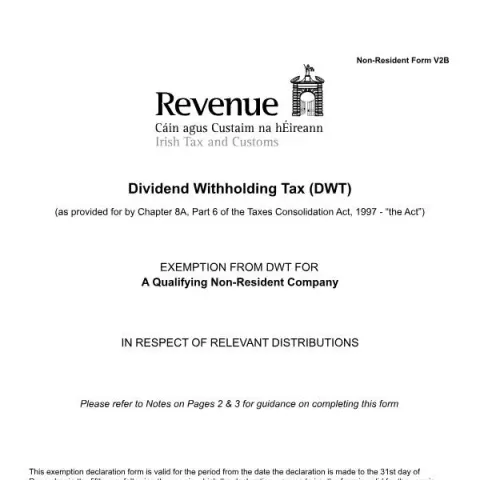
Understanding the Non-Resident Form V2B: A Guide for Irish Tax Compliance
The Non-Resident Form V2B is an official document issued by the Revenue Commissioners of Ireland, designed to facilitate the exemption from Dividend Withholding Tax (DWT) for qualifying non-resident companies receiving relevant distributions from Irish-resident companies. This form plays a crucial role in ensuring that eligible foreign entities can benefit from tax exemptions under Irish law, specifically under Chapter 8A, Part 6 of the Taxes Consolidation Act, 1997.
Purpose and Scope of Form V2B
The primary purpose of Form V2B is to declare a company's eligibility for exemption from DWT on relevant distributions. When a qualifying non-resident company submits this declaration to the Irish paying company, qualifying intermediaries, or authorized withholding agents, it enables the exemption to be applied. This process ensures that the non-resident entity benefits from a tax-efficient distribution without the usual withholding deductions.
The form is valid from the date it is signed until the 31st of December of the fifth year following that date. After this period, the exemption must be renewed through a new declaration to maintain its validity. It is important to note that the completed form should be sent directly to the relevant paying entity rather than to the DWT Unit of Revenue.
Who Can Use Form V2B?
A company qualifies to submit Form V2B if it meets specific criteria under Irish tax law:
- Requisite Residency and Control: The company must be resident in a "relevant territory," which includes EU member states, EEA countries, or nations with which Ireland has a Double Taxation Agreement (DTA).
- Ownership Structure: The company should be either controlled by entities resident in relevant territories or be traded regularly on a recognised stock exchange within such territories.
Furthermore, the entity must be beneficially entitled to the relevant distributions, meaning it has the legal and economic rights to the income received.
Key Definitions and Eligibility Conditions
Relevant Territories
These include countries that are members of the European Union, EEA states, or countries with which Ireland maintains a DTA. The list of such countries can be verified on the Revenue website.
Qualifying Non-Resident Person
This term refers to a company that is not Irish-resident but is eligible for exemption because it is resident in a relevant territory, is controlled by such entities, or is traded on a recognised stock exchange in a relevant territory.
Control and Ownership
Control is defined based on ownership and voting rights, typically considered as possessing more than 50% of share capital, voting power, or assets on winding-up. This assessment ensures that only genuinely qualifying companies benefit from the exemption.
Procedure for Completing and Submitting the Form
Completing Form V2B requires careful attention to detail, referencing the guidance notes provided on pages 2 and 3 of the form. The process involves:
- Providing accurate information about the company's residency, control, and ownership structure.
- Ensuring the declaration is signed and dated correctly.
- Forwarding the completed form to the relevant Irish company making the distribution, an intermediary, or an authorized withholding agent.
It is essential to note that the form should not be sent to the DWT Unit of Revenue for exemption purposes. Instead, it should be submitted directly to the entity responsible for making the relevant distributions to ensure the exemption is applied at source.
Fill in your form directly online
No printing: type your details into the boxes of the official form, tick, then download the PDF ready to send.
- 1Type into the form boxes
- 2Tick in one click
- 3Save and download the PDF
Post-Submission Considerations
Once submitted, the exemption remains valid for five years from the date of declaration. After this period, companies must submit a new declaration to continue benefitting from the exemption. Maintaining accurate records and timely renewals ensures ongoing compliance with Irish tax law and avoids unnecessary withholding taxes.
For further guidance, companies should consult the official notes accompanying the form or seek advice from a tax professional familiar with Irish tax regulations. The Revenue website also provides updates on relevant territories, double taxation agreements, and qualifying intermediaries, which can assist in maintaining compliance.
Conclusion
The Non-Resident Form V2B is a vital tool for qualifying non-resident companies to access Irish distributions without the deduction of dividend withholding tax. Proper understanding of its scope, eligibility criteria, and procedural requirements ensures compliance and optimizes tax efficiency for foreign investors operating within Ireland’s legal framework.