Understanding the Purpose and When to Use Form CA4 in Ireland
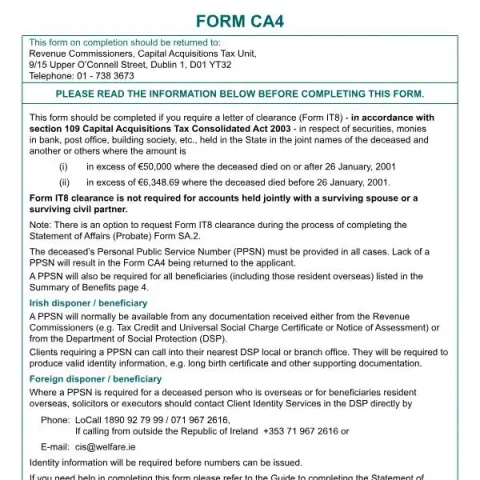
The Form CA4 is an official document issued by the Revenue Commissioners in Ireland. It serves as a crucial step for individuals involved in the administration of estates, particularly when seeking a letter of clearance known as Form IT8. This form is specifically designed for cases where there are securities, bank accounts, or other financial assets held jointly in the names of a deceased person and another individual, with the assets exceeding certain thresholds.
In practice, you should complete and submit Form CA4 if you require formal confirmation from Revenue that the estate’s tax obligations related to these joint assets have been settled or are in order. This process is essential for executors or administrators who are applying for probate or letters of administration, especially when the estate includes joint property or accounts that need to be declared to Revenue.
Key Information Required on Form CA4
The form requests detailed personal and estate-related data to facilitate the assessment of the joint assets and to determine whether a Form IT8 clearance can be issued. The main sections include:
- Deceased’s Personal Details: Name, PPSN (Personal Public Service Number), address, date of death, and domicile information.
- Details of Joint Assets: Description, value at the date of death, name of financial institutions, and specifics about the joint ownership, such as the relationship of the joint holder and the date when the account or property was held jointly.
- Asset Ownership and Proceeds: Information on assets solely in the deceased’s name, proceeds from life insurance policies, and details of beneficiaries receiving benefits over €20,000.
How to Complete and Submit Form CA4
When completing the form, it is essential to provide accurate and comprehensive information, particularly the deceased’s PPSN, which is mandatory. Missing or incorrect PPSN details will result in the return of the form for correction. The form must be signed and then sent to the Revenue Commissioners at the specified address:
Revenue Commissioners, Capital Acquisitions Tax Unit, 9/15 Upper O’Connell Street, Dublin 1, D01 YT32Before submitting, ensure that all relevant attachments are included, such as copies of the grant of probate or letters of administration, and any relevant documentation on joint assets or accounts. If the estate includes foreign assets or beneficiaries residing outside Ireland, additional steps may be necessary, including contacting the Department of Social Protection’s Client Identity Services for PPSN issuance.
Points of Attention and Practical Tips
- Providing Accurate PPSN: The PPSN is a critical identifier for both the deceased and beneficiaries. Obtain it from official documentation or through the Department of Social Protection if needed.
- Thresholds for Asset Values: Be aware of the thresholds for joint accounts: €50,000 for deaths on or after 26 January 2001, and €6,348.69 for deaths before that date. Assets below these limits generally do not require a Form IT8 clearance.
- Joint Accounts with Spouses or Civil Partners: No Form IT8 is required for joint accounts held solely with a surviving spouse or civil partner.
- Timing and Deadlines: Submit the completed form promptly to avoid delays in estate administration. While there is no specific deadline, early submission facilitates smoother processing of probate and tax clearance.
- Assistance and Guidance: If needed, refer to the Revenue’s guide on completing the Statement of Affairs (Probate) Form SA.2, which provides helpful explanations on joint property, group thresholds, and foreign property taxation.
Legal and Data Privacy Considerations
Completing Form CA4 involves sharing sensitive personal and financial information. The Revenue Commissioners handle this data in accordance with Irish data protection laws. Their privacy policy details how your data is used and your rights as a data subject. It is advisable to review this policy on the Revenue website for full understanding.
Fill in your form directly online
No printing: type your details into the boxes of the official form, tick, then download the PDF ready to send.
- 1Type into the form boxes
- 2Tick in one click
- 3Save and download the PDF
Finally, remember that this form is a procedural document and does not constitute legal or tax advice. For complex cases or uncertainties, consulting a legal or tax professional is recommended to ensure compliance with all legal requirements and proper estate management.