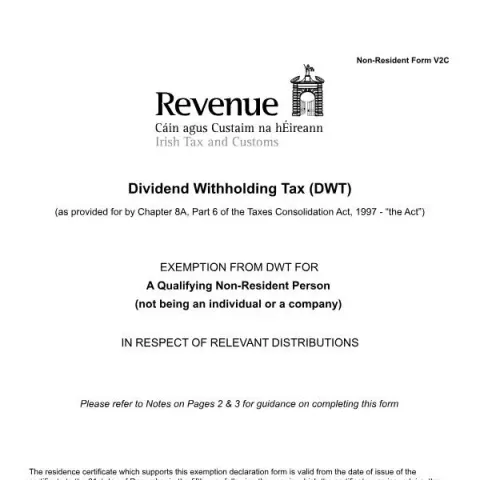
Understanding the Irish Non-Resident Form V2C: A Guide for Qualifying Non-Residents
The Irish Revenue Commissioners have established the Non-Resident Form V2C to facilitate exemption from Dividend Withholding Tax (DWT) for certain non-resident entities. This form is essential for unincorporated bodies such as charities, superannuation funds, and discretionary trusts that are not Irish residents but are entitled to receive relevant distributions from Irish-resident companies without DWT being deducted at source.
Purpose of the Form V2C
The primary objective of the Form V2C is to declare that a qualifying non-resident person is eligible for an exemption from DWT on relevant distributions. When properly completed and submitted, this declaration allows the relevant Irish company or intermediary to make payments without withholding tax, provided the recipient is beneficially entitled to the distribution and meets the criteria outlined by Irish law.
Who Should Complete the Form?
This form is specifically designed for unincorporated bodies of persons, such as charities, superannuation funds, or discretionary trusts, which are resident for tax purposes in a "relevant territory." A "relevant territory" includes countries that are members of the European Union, EEA states, or countries with which Ireland has a Double Taxation Agreement.
It is important to note that the form must be completed by a person with the authority to declare on behalf of the qualifying body, such as an officer or a person holding power of attorney. Additionally, the form should not be sent directly to the DWT Unit; instead, it must be forwarded to the relevant Irish paying company, qualifying intermediary, or authorized withholding agent to facilitate the exemption.
How to Complete the Form
Section 1: Declarant Details
Fill in the details of the person making the declaration or their authorized representative. This includes the name, position, and authority to act on behalf of the qualifying body. If acting under a power of attorney, a copy of the document should be retained with the form.
Section 2: Tax Residence of the Body
This section requires the tax authority of the body’s country of residence to confirm its tax status. The declaration from the foreign tax authority must be either a certificate of residence or a letter confirming the body's tax residency, translated into English if necessary.
Section 3: Additional Information (if applicable)
For discretionary trusts or bodies with complex structures, additional details may be required to clarify the beneficial entitlement to distributions.
Supporting Documentation and Submission
- The completed form must be signed and dated in ink by the declarant to verify its authenticity.
- A copy of the form should be retained by the declarant for record-keeping and potential future claims, such as refunds of DWT deducted in error.
- The form should be forwarded to the relevant Irish paying company, qualifying intermediary, or authorized withholding agent, not directly to the Revenue DWT Unit.
Important Considerations and Common Errors
It is crucial to ensure that all sections of the form are completed accurately, especially the details of the tax residence and the authority of the person signing the declaration. Incorrect or incomplete forms may delay processing or result in the loss of exemption status.
Fill in your form directly online
No printing: type your details into the boxes of the official form, tick, then download the PDF ready to send.
- 1Type into the form boxes
- 2Tick in one click
- 3Save and download the PDF
Additionally, the validity of the residence certificate is limited to the calendar year of issue plus the following five years, so renewal or re-declaration may be necessary for subsequent years.
Conclusion
The Irish Non-Resident Form V2C is a vital document for qualifying non-resident bodies seeking exemption from DWT on relevant distributions. Proper completion and timely submission to the appropriate Irish entity ensure compliance with Irish tax law and facilitate smooth receipt of distributions without unnecessary withholding tax deductions.