Understanding the IC8 Form: Tax Repayment Exemption Claim for Deed of Covenant in Ireland
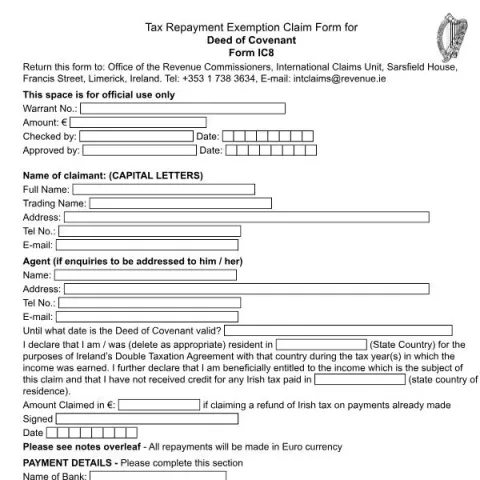
The Tax Repayment Exemption Claim Form for Deed of Covenant (Form IC8) is an official document issued by the Office of the Revenue Commissioners in Ireland. It serves as a formal application for individuals or entities seeking a refund of Irish tax deducted at source under a Deed of Covenant, which is a legal agreement that facilitates charitable donations or other specified payments eligible for tax relief. This article provides a comprehensive overview of the form’s purpose, eligibility criteria, the step-by-step process for completion, and key deadlines to ensure successful submission and processing.
Purpose and Scope of the IC8 Form
The primary function of the IC8 form is to claim a tax refund on income paid under a Deed of Covenant. When a person or organisation makes a donation or payment that qualifies as a Deed of Covenant, Irish tax may be deducted at source. The form enables the claimant to recover this deducted tax if they meet the relevant conditions, especially in cases where the income recipient resides outside Ireland or benefits from double taxation agreements.
This form is particularly relevant for individuals or organisations that:
- Have paid Irish tax via a Deed of Covenant and wish to reclaim it;
- Are non-residents of Ireland but have income subject to Irish withholding tax;
- Are claiming exemption based on double taxation agreements or specific relief provisions.
Eligibility Conditions for Submitting an IC8 Claim
To qualify for a tax refund using the IC8 form, claimants must satisfy several conditions:
- Residency: The claimant must declare that they were resident outside Ireland during the relevant tax year(s), in accordance with Ireland’s Double Taxation Agreement (DTA) with their country of residence.
- Beneficial Ownership: The claimant must be the beneficial owner of the income for which the claim is made, and not merely a nominee or agent.
- No Irish Tax Credit: The claimant should not have received credit for Irish tax paid in their country of residence for the same income.
- Supporting Documentation: Proper documentation, including the Deed of Covenant, original Form R185 (showing the tax deducted), and evidence of payment, must be provided.
Step-by-Step Procedure for Completing the IC8 Form
Completing the IC8 form requires careful attention to detail to ensure all relevant information is accurately provided. The steps are as follows:
- Claimant Details: Fill in the full name, address, contact details, and, if applicable, trading name and agent information.
- Deed Validity Period: Indicate the expiry date of the Deed of Covenant.
- Residency Declaration: Declare your country of residence during the relevant tax year(s) and confirm that you are beneficially entitled to the income.
- Claim Amount: Specify the amount of Irish tax paid and the total claim amount in euros.
- Bank Details: Provide your bank account information for the refund transfer, including IBAN and BIC codes.
- Certification by Resident Country: Your country’s tax authority must certify your residency status and the tax liability details, signing and stamping the form accordingly.
- Supporting Documentation: Attach all required documents, such as the Deed of Covenant, Form R185, evidence of payment, and any additional certificates relevant to your country of residence.
Important Deadlines and Processing Details
Claims must be submitted within a specific timeframe, as stipulated by Irish law. Under Section 17 of the Finance Act 2003, claims for tax refunds should be made within four years of the end of the calendar year in which the tax was deducted. For example, a claim relating to 2022 must be submitted by the end of 2026.
All refunds are processed electronically and paid directly into the bank account details provided by the claimant. It is advisable to ensure that the bank details are accurate to avoid delays.
Additional Considerations and Special Cases
If the covenantee (the recipient of the payment) is permanently incapacitated, medical evidence may be required to support the claim. For residents of the United States, a certificate of residence (Form 6166) from the IRS is necessary. Similarly, residents of Spain must provide a certificate of residence issued by Spanish authorities.
Fill in your form directly online
No printing: type your details into the boxes of the official form, tick, then download the PDF ready to send.
- 1Type into the form boxes
- 2Tick in one click
- 3Save and download the PDF
For cases where the Covenantee’s income exceeds exemption limits or where Ireland does not have a double taxation agreement, different procedures or forms (such as Form 59 CLAIMS FR) may apply.
Conclusion
The IC8 form is a vital tool for non-residents or entities seeking to recover Irish tax deducted at source under a Deed of Covenant. Accurate completion, timely submission, and proper supporting documentation are essential for a successful claim. Citizens and organizations should carefully review the official notes accompanying the form and adhere to deadlines to ensure their entitlement to tax refunds is preserved.