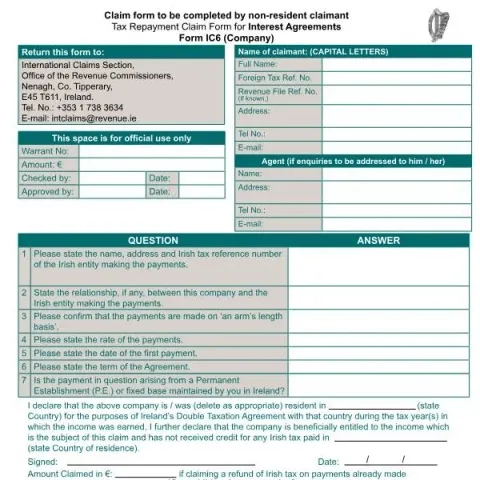
Understanding the Irish Tax Repayment Claim Form for Interest Agreements (Form IC6)
The Tax Repayment Claim Form for Interest Agreements (Form IC6) is an official document issued by the Office of the Revenue Commissioners in Ireland. It is specifically designed for companies that are non-resident claimants seeking a refund of Irish tax deducted on interest payments made to them. This form plays a crucial role in the process of reclaiming withholding tax under Ireland’s tax treaties and domestic legislation.
Purpose and Scope of the Form
The primary objective of Form IC6 is to enable companies outside Ireland to claim back Irish withholding tax deducted from interest payments they have received. It is applicable when a company has paid interest to a non-resident entity, and the payer has deducted Irish tax at source, often at the standard rate of 20%. The form facilitates the process for non-residents to recover this tax, provided they meet certain criteria, such as treaty benefits or exemption conditions.
This form is particularly relevant for companies involved in cross-border financial arrangements, interest agreements, or debt instruments where Irish interest payments are involved. It ensures compliance with Ireland’s tax laws, including the provisions of Double Taxation Agreements (DTAs), which may reduce the applicable withholding tax rate.
Preparing Your Submission
Gathering Essential Documentation
Before completing Form IC6, companies should gather several key documents:
- A signed copy of the Interest Agreement between the Irish payor and the non-resident company.
- The completed Form R185 if claiming a repayment of Irish tax deducted on interest payments.
- Proof of residence, such as a certificate of residence (e.g., Form 6166 for US residents or equivalent from Spanish tax authorities).
- Details of the interest payments, including dates, amounts, and the relevant interest rate.
Completing the Form
The form requires detailed information about both the Irish payor and the claimant:
- Identification details of the Irish entity making payments, including name, address, and Irish tax reference number.
- The relationship between the Irish payor and the claimant company.
- Confirmation that payments are made on an arm’s length basis.
- Details of the interest rate, payment dates, and the duration of the agreement.
- Declaration regarding the company’s residency status and beneficial ownership of the income.
Submitting the Claim
Where and How to Send the Form
Completed Form IC6 should be sent to the following address:
International Claims Section, Office of the Revenue Commissioners, Nenagh, Co. Tipperary, E45 T611, Ireland.Claims can be submitted via email to [email protected] or by mail. It is recommended to retain copies of all documentation for your records.
Additional Supporting Documents
Along with the completed form, the following documentation should be included where applicable:
Fill in your form directly online
No printing: type your details into the boxes of the official form, tick, then download the PDF ready to send.
- 1Type into the form boxes
- 2Tick in one click
- 3Save and download the PDF
- A copy of the signed Interest Agreement.
- Form R185, if applicable.
- Certificate of residence for the relevant tax year, especially for US or Spanish residents.
Processing and Timing
The Irish Revenue Commissioners process claims in accordance with statutory time limits, which generally restrict submissions to within four years from the end of the calendar year in which the tax was deducted. Once processed, refunds are typically paid electronically directly into the bank account specified in the claim.
Important Considerations
Claimants should review whether they qualify for any exemptions from Irish withholding tax under section 246(3) of the Taxes Consolidation Act 1997. Additionally, the provisions of Ireland’s Double Taxation Agreements may enable a reduced withholding rate, which can be claimed through self-certification processes outlined in Revenue’s guidance.
Finally, it is advisable to consult the relevant legal and tax professionals to ensure compliance and optimize the chances of a successful claim. The Irish Revenue’s official guidance and manuals provide detailed instructions and are accessible for further reference.