Understanding the IC9 Tax Repayment Claim Form for Trusts, Estates, Encashment Tax, and Ulster Bank Bonds in Ireland
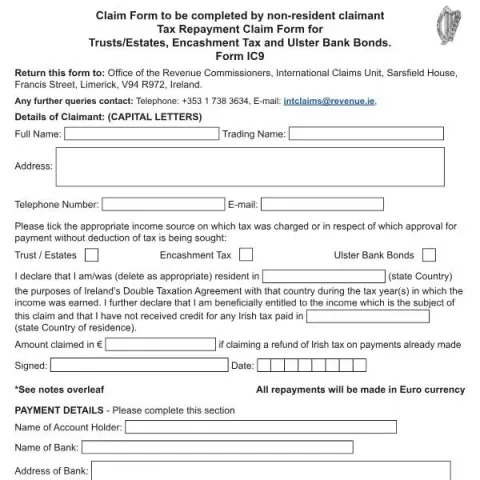
The Form IC9 is an official document issued by the Office of the Revenue Commissioners, International Claims Unit. It is designed for non-resident claimants seeking refunds of Irish tax deducted on specific income sources such as trusts, estates, encashment tax, and bonds issued by Ulster Bank. This form is essential for individuals and entities who believe they have overpaid or are eligible for a tax exemption under Ireland’s double taxation agreements (DTAs).
Purpose and Scope of the Form
The primary purpose of the IC9 form is to facilitate the recovery of Irish tax paid by non-residents on certain types of income. Specifically, it covers:
- Trusts and Estates: Claims related to income earned through trusts or estates, including those established via wills or probate grants.
- Encashment Tax: Refunds for tax deducted on foreign securities, notably dividends or interest payments, where Irish tax was withheld.
- Ulster Bank Bonds: Refunds for tax paid on bonds formerly issued by First Active PLC, now managed by Ulster Bank, where non-residents are eligible for exemption under DTAs.
This form is applicable only to non-residents who, during the relevant tax year, were beneficially entitled to the income and did not receive credit for Irish tax paid in their country of residence.
Eligibility and Conditions for Claiming
To be eligible to complete and submit the IC9 form, claimants must meet several conditions:
- Residency Status: The claimant must be a non-resident of Ireland during the year(s) in which the income was earned. The form requires a declaration of residency and supporting documentation from the claimant’s country of residence.
- Beneficial Ownership: The claimant must be the beneficial owner of the income, not just an intermediary or nominee.
- Tax Paid: Irish tax must have been deducted at source, and the claimant must not have received a credit for this tax in their country of residence.
- Time Limit: Claims must be submitted within four years of the end of the calendar year in which the tax was deducted, according to Irish law.
Step-by-Step Procedure for Filling Out the Form
The process for completing the IC9 form involves several key steps:
- Identify Income Source: Tick the relevant box indicating whether the claim pertains to trusts/estates, encashment tax, or Ulster Bank bonds.
- Provide Claimant Details: Fill in the full name, address, telephone number, email, and, if applicable, trading name in capital letters.
- Declare Residency and Income Source: Specify the country of residence during the relevant tax year and confirm the income source for which the claim is made.
- State the Claim Amount: Enter the amount of Irish tax paid or overpaid, in euros (€).
- Bank Details for Refund: Complete the payment section with bank account details, including IBAN and BIC, ensuring the refund is transferred electronically.
- Resident Certification: A resident authority or official from the claimant’s country must certify the claimant’s residency status by signing and stamping the form.
Supporting Documentation and Submission
Alongside the completed IC9 form, claimants must submit relevant supporting documents:
Fill in your form directly online
No printing: type your details into the boxes of the official form, tick, then download the PDF ready to send.
- 1Type into the form boxes
- 2Tick in one click
- 3Save and download the PDF
- For trusts and estates: Documentation establishing the trust or estate, such as a will, probate grant, or trust deed, and a completed Form R185 from trustees.
- For encashment tax: A Foreign Income Advice and Irish Tax Certificate (Form 1 F.D.) issued by the encashment agent or intermediary.
- For Ulster Bank Bonds: Original interest bond vouchers and proof of Irish tax paid, with entitlement to exemption documented if applicable.
- Additional certificates, such as Form 6166 for U.S. residents or Spanish residency certificates, are required for residents of those countries.
Important Considerations and Deadlines
Claimants should be aware of the following:
- Time Limits: Claims must be submitted within four years from the end of the calendar year in which the tax was deducted.
- Method of Payment: Refunds are processed electronically and will be paid directly into the bank account specified in the form.
- Further Inquiries: For questions or assistance, claimants can contact the International Claims Unit at +353 1 738 3634 or via email at [email protected].
Conclusion
The IC9 form is a crucial tool for non-resident individuals and entities seeking to recover Irish taxes deducted on income from trusts, estates, bonds, or encashment transactions. Proper completion, timely submission, and supporting documentation are vital to ensure a smooth process. Claimants should carefully review the instructions and consult relevant legal or tax advice if necessary, to maximize their chances of a successful refund.