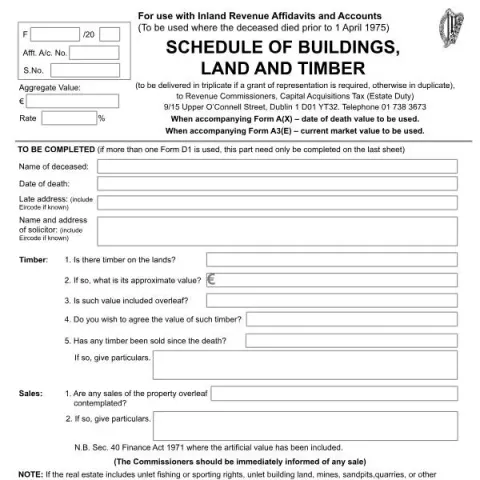
Understanding Form D1: A Guide to Irish Estate Tax Documentation
Form D1 is a crucial official document issued by the Revenue Commissioners of Ireland, specifically designed for the administration of estate taxes, such as Capital Acquisitions Tax (Estate Duty), in cases where the deceased individual passed away before 1 April 1975. This form serves as a detailed schedule of the deceased's lands, buildings, timber, and related property assets, providing the necessary valuation information for tax assessment purposes.
The Purpose and Scope of Form D1
The primary objective of Form D1 is to facilitate the accurate assessment of estate value for taxation purposes. It gathers comprehensive details about the property assets inherited, including land, buildings, timber, and any sales since the date of death. This information enables the Revenue Commissioners to determine the taxable value of the estate, ensuring compliance with Irish tax laws such as the Taxes Consolidation Act 1997.
Specifically, the form is used when:
- The deceased died prior to 1 April 1975, requiring a detailed estate valuation.
- Property assets include land, buildings, timber, or other hereditaments that may influence the estate's principal value.
- There are transactions, such as sales, that occurred after the death, which could impact the estate valuation.
Preparing and Completing Form D1
Proper preparation of Form D1 involves gathering accurate information about the deceased’s estate, including:
- Personal Details: Name of the deceased, date of death, and last known address, including the Eircode if available.
- Solicitor’s Details: Name and address of the solicitor handling the estate, if applicable.
- Property Details: Precise location, acreage, and description of lands and buildings, along with their rateable values and tenure.
- Valuation of Timber: If timber exists on the lands, estimate its value and specify whether this is included in the overall estate valuation.
- Sales Since Death: Record any property sales that have occurred post-mortem, including sale dates and prices realized.
It is essential to complete the form accurately and in triplicate if a grant of representation is required, or in duplicate otherwise. The form must be signed and submitted to the Revenue Commissioners at their Dublin address, 9/15 Upper O’Connell Street, Dublin 1.
Filling Out the Schedule of Property
A significant part of Form D1 involves a detailed schedule of property assets, including:
| S.No. | Situation of Property | Rateable Valuation | Acreage | Tenure | Annual Outgoings | Rent or Letting Price | Sale Details |
|---|---|---|---|---|---|---|---|
| 1 | Townland or Street | Value | Acreage | Leasehold or Freehold | Outgoings | Rent | Date and Price |
The schedule captures the principal values, tenure details, and any annual charges associated with each property. When property includes unlet rights or assets with no annual value, full details must be provided to establish the principal value accurately.
Special Considerations and Additional Disclosures
It is important to note that if the estate includes assets such as unlet fishing or sporting rights, mines, quarries, or other property with no straightforward annual value, these should be fully disclosed. Additionally, any licensed property must be explicitly stated in the form.
Any sale of property since the date of death must be documented, including the sale date and the amount realized, as this can influence the estate's valuation and tax obligations. The form also prompts the taxpayer to declare if they wish to agree on the timber's value or if they intend to contest it.
Fill in your form directly online
No printing: type your details into the boxes of the official form, tick, then download the PDF ready to send.
- 1Type into the form boxes
- 2Tick in one click
- 3Save and download the PDF
Submitting and Following Up on Form D1
Once completed, Form D1 must be submitted in accordance with Irish Revenue procedures, either in person or by mail. The Revenue Commissioners will review the submitted information, and may request additional documentation or clarification if necessary. They will also provide an official opinion on the principal value of the estate, which forms the basis for tax calculations.
It is advisable for executors or estate administrators to retain copies of all submitted documents and correspondence, as this facilitates ongoing communication and compliance with Irish tax law.
Conclusion
Form D1 plays a vital role in the Irish estate taxation process, ensuring that the valuation of property assets is accurate and transparent. Proper completion of this form, with detailed and precise information, helps facilitate the smooth administration of estate duties and compliance with legal requirements. For assistance, individuals should consider consulting a qualified solicitor or tax advisor familiar with Irish inheritance tax procedures.