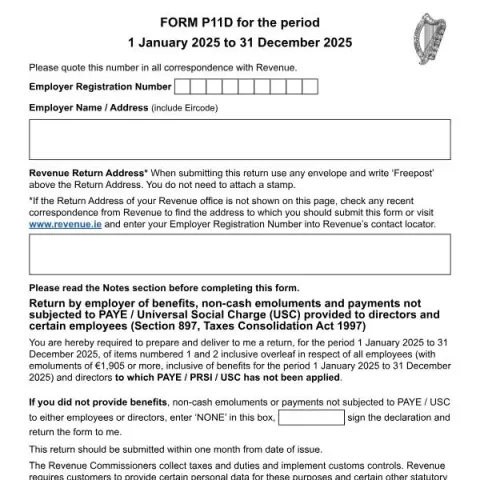
Understanding the P11D Form for the 2025 Tax Year in Ireland
The Form P11D is an official document issued by the Revenue Commissioners of Ireland, designed for employers to report benefits-in-kind, non-cash emoluments, and certain payments provided to directors and employees that have not been subjected to the Pay As You Earn (PAYE), Pay Related Social Insurance (PRSI), or Universal Social Charge (USC) deductions during the tax year. The form covers the period from 1 January 2025 to 31 December 2025.
Purpose and Scope of the P11D
The primary purpose of the P11D is to ensure that the Revenue Commissioners receive comprehensive information about taxable benefits provided to employees and directors which are not taxed at source through PAYE. This includes benefits such as company cars, subsidised childcare, or other non-cash benefits that might otherwise escape taxation. Employers are legally required to submit this return annually, and it plays a crucial role in the correct calculation of an individual's tax liability.
The form is relevant only for employees and directors who received benefits valued at €1,905 or more during the specified period, and for whom PAYE, PRSI, or USC were not deducted at the time of benefit provision.
Who Needs to Complete the Form?
- Employers who provided benefits, non-cash emoluments, or payments not subjected to PAYE/USC/PRSI to their employees or directors during 2025.
- Employers must include all relevant employees and directors, even if they are no longer resident in Ireland.
- If no such benefits were provided during the period, the employer must declare “NONE” on the form.
How to Complete the P11D: Step-by-Step Guide
1. Gather Employee and Director Data
Collect details such as the PPSN (Personal Public Service Number), full name, and address (including Eircode) for each individual. This information is vital for accurate reporting and identification.
2. Identify Reportable Benefits
Review all benefits provided during 2025 that have not been taxed at source. These include, but are not limited to, company cars, accommodation, childcare facilities, or memberships paid by the employer.
3. Complete the Relevant Sections
| Field | Description |
|---|---|
| PPSN | Enter the PPSN of the employee or director. |
| First Name and Surname | Provide the full name of the individual. |
| Unrecouped PAYE / USC | Declare any PAYE or USC amounts not recovered from the individual before the relevant date. |
| Benefits Description | Briefly describe the benefit provided, such as "company car" or "subsidised childcare." |
| Net Realisable Value | Enter the estimated market value of the benefit at the time it was provided. |
4. Finalize and Sign the Return
After completing the form, the employer must sign and date the declaration, confirming the accuracy of the information provided. The signed form must then be returned to the Revenue Commissioners within one month of issue, which typically falls before the end of February following the tax year.
Important Deadlines and Submission Details
The P11D must be submitted within one month of the form’s issue date, which is usually early in the new year. Employers should ensure timely submission to avoid penalties and to facilitate accurate tax assessments for their employees and directors.
When mailing the form, employers can use any envelope and write ‘Freepost’ above the address, meaning no postage is necessary. If the employer prefers, they may also submit the form electronically via the Revenue’s online services, such as MyGovID or Revenue Online Service (ROS).
Fill in your form directly online
No printing: type your details into the boxes of the official form, tick, then download the PDF ready to send.
- 1Type into the form boxes
- 2Tick in one click
- 3Save and download the PDF
Post-Submission Responsibilities
Once the Revenue Commissioners receive the P11D, they will process the information to adjust the individual’s tax records accordingly. Employees and directors will be notified if additional tax is due based on the benefits declared. Employers should retain copies of submitted forms for their records and for any future audits or inquiries.
Additional Considerations
- Employers should be aware of exemptions and small benefit rules, such as benefits with a total value not exceeding €1,500, which may be exempt from taxation.
- Benefits like subsidised childcare or living accommodation might have specific tax implications, detailed on the Revenue website.
- Consult the Revenue’s guidance or a tax professional if unsure about the classification or valuation of benefits.
In summary, the P11D is a vital compliance document that ensures transparency and fairness in the taxation of benefits provided by employers in Ireland. Proper completion and timely submission help maintain good standing with the Revenue Commissioners and ensure employees’ tax affairs are accurately managed.