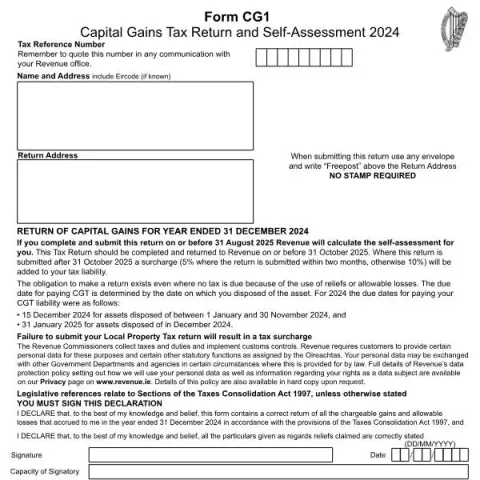
Understanding the Form CG1: Capital Gains Tax Return and Self-Assessment for 2024 in Ireland
The Irish Revenue Commissioners require individuals and entities to complete and submit the Form CG1 to report capital gains realized during the tax year ending on 31 December 2024. This official form serves as both a capital gains tax return and a self-assessment tool, ensuring taxpayers declare gains, claim reliefs, and calculate their tax liability accurately.
Who Must Complete Form CG1?
Any person or company who disposed of chargeable assets in the 2024 tax year must consider submitting this form, regardless of whether any tax is due. This includes individuals, partnerships, and corporations involved in the sale or transfer of assets such as property, shares, securities, or other assets listed in the form. Even if losses or reliefs offset gains to the extent that no tax is payable, the return must still be filed to comply with Irish tax law.
Key Sections and How to Fill Them
Description of Assets and Disposals
The core of Form CG1 involves detailing each asset disposed of during 2024. This includes:
- Shares or securities (quoted and unquoted)
- Property assets such as residential and commercial premises
- Land, development land, and agricultural land
- Foreign life policies and offshore funds
- Other assets, including venture funds and exchanged securities
For each category, you must specify the number of disposals, the total area (for land), and the aggregate consideration (sale price or market value at disposal). Accurate data entry is crucial, as errors can lead to penalties or incorrect tax assessments.
Reliefs and Exemptions
The form allows you to claim various reliefs, such as:
- Disposal of principal private residence
- Retirement relief under sections 598 and 599
- Disposal of a site to a child
- Farm restructuring relief under section 604B
When claiming reliefs, you must provide the consideration amount and specify the relief type. If claiming reliefs for your spouse or civil partner, separate columns are provided for their considerations. Be sure to complete the relevant sections to ensure your relief claims are properly processed.
Calculating Gains and Losses
The form guides you through calculating:
- Chargeable gains for the year before reliefs
- Losses incurred during the year
- Net chargeable gains after offsetting losses and reliefs
If you have connected-party transactions or market value substitutions, these details must be disclosed to ensure proper assessment of gains.
Declaration and Submission
Once completed, the form must be signed and dated, confirming that all information provided is correct to the best of your knowledge. The declaration affirms your understanding of the legal obligations under the Taxes Consolidation Act 1997.
Submission deadlines are as follows:
Fill in your form directly online
No printing: type your details into the boxes of the official form, tick, then download the PDF ready to send.
- 1Type into the form boxes
- 2Tick in one click
- 3Save and download the PDF
- On or before 31 October 2025 for the 2024 tax year
- If submitted late, penalties or surcharges may apply, with a 5% surcharge if late within two months and 10% thereafter.
Taxpayers can submit their return by post using any envelope marked “Freepost,” with no stamp required, or electronically via the Revenue’s online systems, such as MyGovID or ROS, for faster processing.
Important Tips and Common Errors to Avoid
- Ensure accuracy of asset details: Double-check the description, consideration, and area details for each asset.
- Claim reliefs correctly: Provide supporting details and complete the relevant sections to avoid rejection or penalties.
- Meet deadlines: Late submissions attract surcharges, so plan ahead to avoid penalties.
- Keep records: Maintain documentation supporting your disposals, valuations, and relief claims for at least six years in case of audit.
Additional Information and Support
For further guidance, detailed instructions, or to clarify any entries, taxpayers should consult the official Revenue guidance or contact their local Revenue office. The Revenue Commissioners emphasize the importance of accurate and timely submissions to comply with Irish tax legislation and avoid penalties.
Remember, completing Form CG1 correctly ensures your capital gains are properly assessed, and any reliefs or losses are correctly applied, facilitating a smooth tax compliance process for the 2024 tax year.