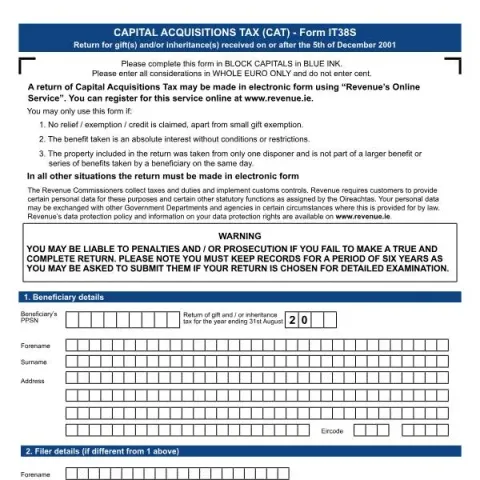
Understanding the IT38S Form for Capital Acquisitions Tax in Ireland
The Form IT38S is an official document issued by the Revenue Commissioners in Ireland, specifically designed for reporting gifts and inheritances received on or after December 5, 2001. It is a vital component of the country’s Capital Acquisitions Tax (CAT) system, which aims to tax the transfer of assets between individuals. This article provides a comprehensive overview of the form’s purpose, eligibility criteria, how to complete it, and key deadlines to ensure compliance with Irish tax law.
Purpose and Scope of the IT38S Form
The primary purpose of the IT38S form is to declare and calculate the amount of Capital Acquisitions Tax due on gifts or inheritances received by an individual (the beneficiary). It is used to report benefits that fall within the scope of Irish tax law, which includes both gifts and inheritances, depending on the valuation date and circumstances of the transfer.
This form covers transfers with valuation dates from December 5, 2001, onwards and is applicable when the recipient does not claim any reliefs, exemptions, or credits other than the small gift exemption. Its use is mandatory for most cases where the benefit involves an absolute interest without conditions or restrictions, and where the property is transferred from a single disponer (donor) without subsequent benefits linked to the same event.
Eligibility and When to Use the Form
- No relief, exemption, or credit (apart from small gift exemption) is claimed.
- The benefit involves an absolute interest with no conditions or restrictions.
- The property is transferred from only one disponer and is not part of a larger series of benefits taken on the same day.
If your situation does not meet these criteria—for example, if you are claiming reliefs or if the transfer involves multiple benefits or conditions—you are required to submit your return electronically via the Revenue’s Online Service (ROS). This ensures proper processing and compliance with Irish tax procedures.
Step-by-Step Guide to Completing the Form
1. Beneficiary and Disponer Details
Start by filling in the personal details of the beneficiary, including their PPSN (Personal Public Service Number), full name, address, and Eircode. If the filer is different from the beneficiary, provide their details as well, including contact information and any client reference number for your records.
2. Details of the Gift or Inheritance
Specify whether the transfer is a gift or inheritance by marking the appropriate box. Indicate whether the property is real property, other property, or both. Enter the date of the benefit, which should be the date of the gift or inheritance, or, in the case of an inheritance, the date of the disponer’s death.
3. Valuation and Thresholds
Enter the valuation date and the relevant group threshold applicable to your case. The thresholds are set annually and are available on the Revenue website. The form requires you to input the taxable value of the benefit, subtract any small gift exemption, and calculate the net taxable value.
4. Calculating the Tax
Using the provided figures, determine the taxable excess over the threshold and apply the appropriate tax rate. The form allows for the calculation of the tax payable, which must be declared and signed by the beneficiary or their agent.
Key Deadlines and Payment Procedures
Returns for gifts or inheritances received with valuation dates ending on 31 August must be filed by 31 October of the same year. Payments of the Capital Acquisitions Tax can be made via the Revenue Online Service (ROS) or by cheque, payable to the Collector-General.
Fill in your form directly online
No printing: type your details into the boxes of the official form, tick, then download the PDF ready to send.
- 1Type into the form boxes
- 2Tick in one click
- 3Save and download the PDF
It is essential to allow sufficient time—at least three working days—for payments to reach Revenue before the deadline. Late payments can incur interest charges and may lead to enforcement actions, including court proceedings or enforced collection measures.
After Filing the Form
Once the form is completed and submitted, the Revenue Commissioners will process the return and calculate the amount of tax due. If there is any tax payable, the beneficiary must settle it promptly to avoid penalties. Detailed records of the transaction should be kept for at least six years, as Revenue may request supporting documentation during audits or reviews.
In conclusion, the IT38S form is a crucial tool for complying with Ireland’s Capital Acquisitions Tax regulations. Proper completion and timely submission help ensure that beneficiaries meet their legal obligations and avoid unnecessary penalties or legal complications.