Understanding the Capital Gains Tax (CGT) Form B in Ireland
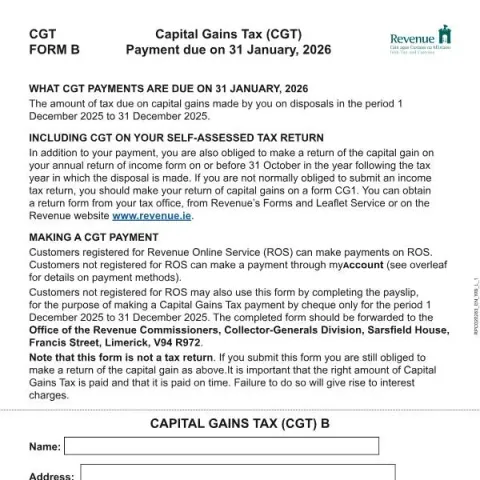
The Capital Gains Tax (CGT) Form B is an official document issued by the Office of the Revenue Commissioners in Ireland. It serves as a crucial instrument for taxpayers to settle their CGT liabilities arising from disposals of assets during a specific period. This article provides a comprehensive overview of the purpose, who must complete it, how to do so, and the procedures involved in submitting this form.
Purpose of the Form and Its Role in CGT Compliance
The primary function of the CGT Form B is to notify the Revenue Commissioners of the amount of capital gains tax due for the period from 1 December 2025 to 31 December 2025. It is not a tax return but an accompanying payment form that ensures the correct amount of CGT is paid by the deadline of 31 January 2026. The form facilitates timely and accurate payments, helping taxpayers avoid interest charges and penalties associated with late or insufficient payments.
Who Should Complete the Form?
Taxpayers who have made capital gains during the period specified—namely, from 1 December 2025 to 31 December 2025—are required to complete and submit the CGT Form B. This includes individuals, trustees, or companies that have disposed of assets resulting in gains subject to CGT. It is important to note that submitting this form does not replace the obligation to file a full self-assessment return of income; rather, it acts as a supplementary payment method.
How to Fill Out the Form
Required Information
- Name and Address: Enter your full name and current address.
- PPSN: Provide your Personal Public Service Number, which can be found on your Certificate of Tax Credits.
- Payment Amount: Specify the total Capital Gains Tax payable for the period in whole euros only (no cents).
- Date: Indicate the date of completing the form.
- Signature: Sign the form to authenticate the declaration.
Completing the Payment
If you are registered for Revenue Online Service (ROS), you can make your payment directly online through the platform. Alternatively, if you are not registered for ROS, you may use the 'myaccount' portal or complete the form manually and send a cheque for the amount due. When using the manual method, the completed form and cheque should be sent to:
Office of the Revenue Commissioners, Collector-Generals Division, Sarsfield House, Francis Street, Limerick, V94 R972.
Additional Obligations and Considerations
Completing and submitting Form B is only part of your CGT obligations. You are also required to file an annual self-assessment return of capital gains on or before 31 October of the year following the disposal. If you are not normally obliged to submit an income tax return, you should complete a specific form designated for capital gains, such as the CG1 form. These returns can be obtained from your local tax office or the Revenue website.
Methods of Payment and Timelines
Taxpayers can settle their CGT liability through various methods:
- Revenue Online Service (ROS): An online platform allowing direct payments.
- myaccount: A secure online portal where payments can be made via debit or credit card, or through a bank deduction instruction.
It is essential to allow at least three working days for your payment to reach the Revenue authorities before the due date. Failure to pay on time may result in interest charges, enforcement actions, or additional costs.
Fill in your form directly online
No printing: type your details into the boxes of the official form, tick, then download the PDF ready to send.
- 1Type into the form boxes
- 2Tick in one click
- 3Save and download the PDF
Important Reminders
Ensuring the correct amount of CGT is paid timely is vital to avoid penalties. Remember that the submission of Form B does not replace your obligation to file a full income tax return if required. For any inquiries regarding your liability or payment, you should contact your local Revenue office or the Collector-Generals Division in Limerick at the provided address or phone number.
Finally, always keep copies of your completed forms and payment receipts for your records. The Revenue Commissioners emphasize that this guidance is informational and not a substitute for professional advice tailored to your specific circumstances.