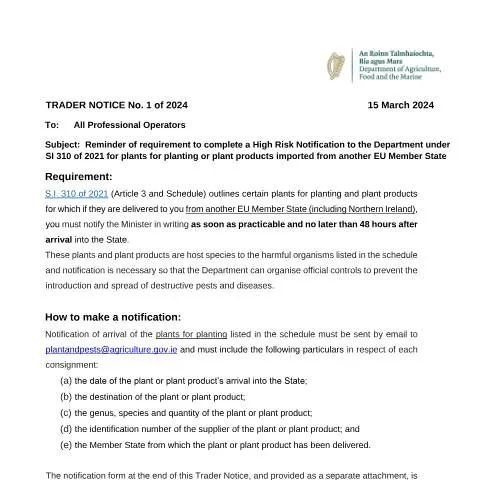
Understanding the Forest Health Notification Requirements: A Critical Component in Plant Importation
In the realm of agricultural importation, understanding the High Risk Notification requirements set forth by the Department of Agriculture, Food and the Marine is crucial for all professional operators engaged in the trade of plants for planting and plant products within the European Union. As outlined in the S.I. 310 of 2021, this document serves to safeguard Ireland's ecosystem from the introduction of harmful pests and diseases, thereby ensuring both agricultural productivity and environmental integrity.
The Legislative Framework Behind the Notification Requirement
The notification requirements are embedded within a broader legislative context, primarily governed by the European Union’s plant health regulations. This framework is designed to manage the risks associated with the importation of certain species known to harbor pests and diseases. Specifically, S.I. 310 of 2021 mandates that if high-risk plants or plant products are imported from another EU Member State, notification must be submitted within a strict timeline of 48 hours post-arrival.
This regulatory measure aims to facilitate timely inspections and controls to mitigate the potential spread of harmful organisms. The provision underscores Ireland's commitment to maintaining rigorous biosecurity standards that align with EU directives.
Key Legislative Provisions
- Article 3: Outlines the notification requirements for specific plants and plant products.
- Schedule: Lists the species categorized as high risk, necessitating notification upon import.
Operators need to familiarize themselves with these provisions to avoid penalties and ensure compliance with national and EU regulations.
The Role of Professional Operators in Compliance
Professional operators, including growers, exporters, and importers, bear the responsibility of adhering to these notification requirements. The importance of this obligation cannot be overstated; failure to comply can result in significant legal repercussions and operational disruptions.
Who Needs to Submit the Notification?
The High Risk Notification is particularly relevant for:
- Importers of specific high-risk plants listed under the notification requirements.
- Traders receiving consignments from other EU Member States.
- Horticulturalists involved in the cultivation or distribution of plants that could potentially harbor harmful organisms.
Understanding the profiles of those required to submit notifications is essential for maintaining compliance and protecting the integrity of Ireland's agricultural landscape.
Steps for Completing the High Risk Notification
Completing the High Risk Notification is a straightforward process, yet attention to detail is paramount. The notification must be submitted via email to the designated Department addresses, with specific information outlined clearly.
Required Information for Submission
- Date of arrival of the plant or plant product into the State.
- Destination of the plant or plant product.
- Genus, species, and quantity of the plant or plant product.
- Identification number of the supplier.
- Member State of origin for the consignment.
Accuracy in this submission is critical because it informs the Department about potential biosecurity risks and enables them to implement necessary control measures effectively. Operators should refer to the notification form provided in the official trader notice for any amendments and ensure they are using the most up-to-date version.
Understanding the Notification Process: From Submission to Control Measures
Upon submission of the notification, there are several pathways and processes that unfold. The Department uses the information provided to plan inspections and safeguard Ireland’s biodiversity.
Post-Submission: Monitoring and Compliance Checks
After the notification email is sent, the Department may conduct inspections based on the risk assessment associated with the plants being imported. Should any concerns arise from the notification, further inquiries may be initiated, potentially leading to:
- On-site inspections of the plants or products.
- Additional documentation requests to clarify the origin and condition of the goods.
- Implementation of pest control measures if harmful organisms are detected.
Operators should be prepared for these possibilities and maintain clear records of all transactions and communications related to their imported goods.
Distinguishing the High Risk Notification from Other Forms
In the landscape of agricultural documentation, understanding differences between various forms is vital for compliance. The High Risk Notification serves a specific function that is distinct from other forms that may be in use for general importation.
Comparative Analysis with Other Notifications
| Notification Type | Purpose | Regulatory Body | Submission Timeline |
|---|---|---|---|
| High Risk Notification | Notify of high risk plants/products post-import | Department of Agriculture, Food and the Marine | Within 48 hours |
| Import Notification | General notification for imports from third countries | Department of Agriculture, Food and the Marine | As per TRACES requirements |
| Pest Control Notification | Report detected harmful organisms | Department of Agriculture, Food and the Marine | As soon as detected |
This table highlights the distinct purposes and requirements of the High Risk Notification in comparison to other forms, ensuring operators are aware of each form’s unique role in maintaining biosecurity.
Challenges Faced by Operators in Meeting Notification Requirements
While the legislative framework aims to enhance biosecurity, operators encounter various challenges in fulfilling these requirements. Understanding these difficulties is essential for devising effective strategies to ensure compliance.
Common Challenges and Strategies for Overcoming Them
- Time Constraints: Meeting the 48-hour notification deadline can be challenging for busy operators. Strategies such as streamlined internal processes and staff training can help mitigate this risk.
- Information Availability: Operators may struggle with obtaining accurate data about the consignments. Establishing strong communication channels with suppliers and keeping comprehensive records can alleviate this issue.
- Regulatory Changes: Keeping abreast of evolving regulations can be daunting. Regularly reviewing updates from the Department and participating in training sessions can enhance awareness and preparedness.
Conclusion: A Commitment to Biosecurity and Best Practices
The High Risk Notification represents a critical aspect of Ireland's commitment to safeguarding its agricultural landscape. By adhering to these requirements, operators not only protect their enterprises but also contribute to the overall health of the environment. Engaging proactively with the notification process and understanding its nuances can play a significant role in enhancing biosecurity measures, ultimately benefiting all stakeholders in the agricultural sector.
Understanding the High-Risk Notification Process
The High-Risk Notification process, particularly concerning the tn fh 012024 regulations, is pivotal for the preservation of Ireland’s forest health. This process requires forestry owners and operators to notify the Department of Agriculture, Food and the Marine (DAFM) when they suspect or confirm the presence of a high-risk pest or disease. The objective is to ensure rapid communication and appropriate measures to prevent the spread of these threats.
To initiate this process, you must complete the specific notification form and submit it to the DAFM. The notification form requires critical information such as the type of pest or disease suspected, the geographical location of the affected area, and the estimated extent of the infestation. Identifying the affected trees or areas using the Eircode can streamline the communication process, ensuring that the department can respond effectively.
Upon receipt of the notification, the DAFM will assess the information provided. This assessment may involve on-site inspections, where forestry inspectors will evaluate the situation firsthand. Based on their findings, they may issue guidance on treatment options or management practices to mitigate the impact of the infestation. It is advisable to keep thorough records of all communications and actions taken regarding the notification, as this can serve as crucial documentation in case of future inquiries or assessments.
Implications of Non-Compliance
Non-compliance with the tn fh 012024 high-risk notification requirements can have significant repercussions for individuals and businesses involved in forestry. If a high-risk pest or disease is not reported in a timely manner, it can lead to broader infestations that threaten local ecosystems and the forestry industry as a whole.
In terms of legal implications, failing to notify the DAFM may result in penalties under the Plant Health Act and other related regulations. This can manifest in fines or even restrictions on your ability to operate within the forestry sector. Additionally, the long-term consequences include potential loss of market access, as international trade partners may impose stricter import conditions or bans on products sourced from areas with known pest or disease issues.
Moreover, the environmental implications of non-compliance are profound. By neglecting to report a high-risk threat, you not only endanger your own forestry investments but also jeopardize the health of surrounding forests and biodiversity. This can lead to cascading effects, including loss of habitat for wildlife and alteration of local water cycles, impacting the broader community and ecological equilibrium.
Therefore, understanding and adhering to the notification requirements is not just a matter of legal compliance; it is an essential responsibility for all stakeholders involved in forestry management.
Best Practices for Managing Forest Health
Effective management of forest health encompasses proactive measures that extend beyond merely reacting to high-risk notifications. Implementing best practices can significantly reduce the likelihood of pest or disease outbreaks and enhance the overall resilience of forest ecosystems.
First and foremost, regular health monitoring of forested areas is crucial. This can be achieved through seasonal inspections where forestry managers look for signs of pest activity, such as unusual tree decline or the presence of specific insect species. Engaging in continuous education and training regarding the identification of pests and diseases ensures that all stakeholders can recognize threats early.
Additionally, integrating integrated pest management (IPM) strategies can be highly effective. IPM combines biological control methods, cultural practices, and the judicious use of chemical interventions to manage pest populations while minimizing environmental impact. This holistic approach not only enhances the health of existing trees but also improves the resilience of the ecosystem against future infestations.
Collaboration with local and national forestry organizations can also bolster efforts to maintain forest health. Sharing information regarding pest outbreaks, research findings, and management strategies can create a collective defense against high-risk threats. Participating in workshops or forums hosted by the DAFM or environmental groups can provide valuable insights and networking opportunities.
Lastly, adhering to best practices while reforesting or planting new trees is vital. Opting for native species that are more resilient to local pest pressures can be a strategic choice. Additionally, ensuring genetic diversity in new planting efforts can enhance resilience to disease outbreaks, helping to maintain a robust forestry sector in Ireland.