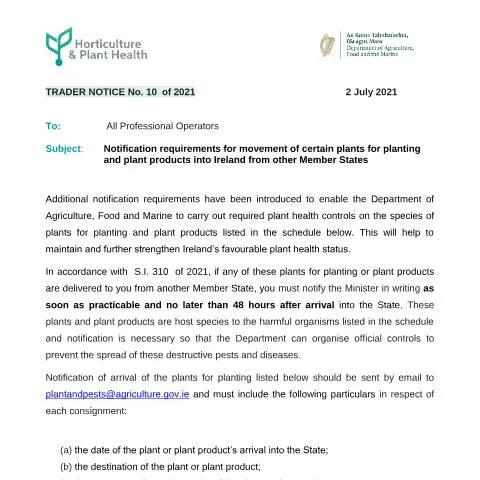
Navigating the Forest Health Notification Landscape: Understanding Trader Notice No. 10 of 2021
For professional operators engaged in the movement of certain plants and plant products within Ireland, the introduction of Trader Notice No. 10 of 2021 marks a significant shift in regulatory compliance. This notice, enacted by the Department of Agriculture, Food and the Marine, establishes strict notification requirements to bolster Ireland's plant health status. Understanding the nuances of this document is vital for maintaining compliance and effectively preventing the spread of harmful organisms.
The Core of Trader Notice No. 10: Key Objectives
This notice serves a critical role in safeguarding Ireland's agriculture from the introduction and spread of harmful pests and diseases. The notification requirements stipulate that:
- Professional operators must notify the Minister in writing of the arrival of certain plants and plant products.
- Notification must occur as soon as practicable, but no later than 48 hours after the consignment's arrival into the State.
- The focus is on specific host species that pose risks to plant health.
By mandating such notifications, the Department aims to implement necessary official controls to avert potential infestations, thereby preserving the integrity of Ireland's agricultural ecosystem.
Who Needs to Be Aware of the Notification Requirements?
The obligations outlined in Trader Notice No. 10 are primarily aimed at professional operators managing the importation of specified plant species and products. While the notification requirements are extensive, there are clear distinctions in responsibilities:
- Importers: Those bringing in plants and plant products from other EU Member States.
- Transporters: Individuals or companies responsible for the delivery of these consignments.
It's crucial to note that movements from Northern Ireland are unaffected by these changes, streamlining the process for operators connected to that region.
Essential Details for Notification
When notifying the Department of Agriculture, Food and the Marine, operators are required to include specific particulars for each consignment. This includes:
- The date of arrival into the State.
- The destination address for the plants or products.
- The genus, species, and quantity of the plants or products.
- The identification number of the supplier.
- The Member State from which the consignment originated.
Failure to accurately provide this information may result in delays or complications regarding compliance and future importation activities.
What Happens Next? Understanding the Follow-Up Process
Upon submission of the notification, the Department will organize the necessary official controls. This could involve:
- Site inspections to verify the health status of the plants.
- Sampling and testing for harmful organisms as listed in the notice.
| Step | Action Required | Outcome |
|---|---|---|
| 1 | Submit Notification | Await confirmation and possible inspection |
| 2 | Undergo Inspection | Determination of plant health status |
| 3 | Receive Results | Cleared for further movement or actions required |
Understanding these steps is crucial for professional operators, as timely compliance can significantly influence operational efficiency and biosecurity measures.
Clarifying the Distinction: TN10 vs Other Forms
Trader Notice No. 10 of 2021 may often be confused with other documentation related to plant importation, particularly those concerning imports from non-EU countries. Unlike forms required for third-country imports, TN10 focuses exclusively on intra-EU movements.
Entities involved in cross-border trade should familiarize themselves with additional documentation such as TRACES for third-country imports, ensuring they can navigate multiple regulatory landscapes without confusion.
The Common Ground: Similarities and Differences
To elucidate the differences further, here’s a comparative overview:
| Aspect | Trader Notice No. 10 | TRACES Notification (Third Countries) |
|---|---|---|
| Geographic Scope | EU Member States | Non-EU Countries |
| Submission Timeline | No later than 48 hours | Prior to arrival |
| Health Checks | Focused on listed harmful organisms | Comprehensive inspections depending on species |
Operators should remain well-informed about these distinctions to ensure seamless compliance with Irish plant health regulations.
Examining the Historical Context: Why TN10 Exists
The establishment of Trader Notice No. 10 is not an arbitrary decision but rather a result of evolving agricultural practices and increased trade within the EU. Such regulations are designed to combat the threat posed by invasive species, which can devastate local ecosystems and agriculture.
Historically, Ireland has maintained stringent plant health standards to protect its agricultural landscape and biodiversity. Recent trends in global trade have necessitated an even more proactive approach to plant health surveillance. The integration of EU directives on plant health has further solidified the necessity of documentation such as TN10.
Legislative Framework Supporting TN10
Trader Notice No. 10 is supported by various legislative acts, notably S.I. 310 of 2021, which outlines the obligations of professional operators regarding the movement of plants and plant products. This legal framework underscores the seriousness with which Ireland approaches the protection of its plant health.
Professional operators are advised to consult the Constitution of Ireland and relevant sector-specific acts to gain a comprehensive understanding of their obligations.
Addressing Issues: What to Do If Problems Arise
In the event of non-compliance issues—such as failure to notify, incorrect information, or failure to meet health standards—operators must take immediate action:
- Contact the Department: Reach out directly via the provided contact emails for urgent clarification.
- Rectify Submissions: If errors are found in submitted notifications, amend and resubmit the information promptly.
- Prepare for Inspections: Cooperation with inspectors during follow-up checks is critical for resolution.
Additionally, operators should maintain records of all notifications to facilitate a smooth resolution process in case of disputes or follow-up inquiries.
Utilising Resources: Staying Informed and Compliant
To navigate the complexities of Trader Notice No. 10 effectively, professional operators should leverage available resources:
- Department of Agriculture, Food and the Marine: Official resources and guidelines can be found on their website.
- Industry Associations: Joining relevant associations may provide additional insights and support networks.
- Workshops and Seminars: Participating in training sessions can enhance knowledge of compliance requirements.
By remaining vigilant and proactive in understanding these regulations, operators will not only enhance their compliance but also contribute to the protection of Ireland's rich agricultural heritage.
Understanding Notification Requirements for Plant Movement
Under the Forest Health Regulations, specifically the TN 10 of 2021, there are strict notification requirements for the movement of certain plants for planting. This regulation is aimed at preventing the spread of harmful plant pests and diseases. It is crucial for individuals and businesses involved in the trade of plants to understand these requirements in detail.
The first step in compliance is to ascertain whether the plants you intend to move fall under the specified categories outlined in the TN 10 of 2021. The list typically includes various species of trees and shrubs that are known to be susceptible to pests or diseases, which may include species such as Quercus robur (English oak) or Picea abies (Norway spruce).
Before moving any plants, you are required to submit a notification to the Department of Agriculture, Food and the Marine (DAFM). This notification must include details such as the type of plants being moved, the quantity, the origin, and the destination of the plants. Importantly, notifications should be submitted at least 24 hours prior to the planned movement to ensure regulatory compliance. Failure to adhere to these notification requirements can result in delays and potential penalties.
Additionally, be aware that there are exemptions to these requirements, especially for small quantities or specific plant species. It’s vital to check the latest guidance from DAFM, as these exemptions can change based on emerging threats to plant health.
Inspection and Compliance Checks
In conjunction with the notification requirements, the movement of plants under TN 10 of 2021 may also trigger inspections by regulatory officials. The DAFM is responsible for ensuring compliance with these regulations, and they may carry out random checks to verify the health status of plants being moved.
Inspections focus on identifying any signs of pests or diseases that could compromise plant health. During these inspections, officials may request documentation such as health certificates or additional information regarding the origin of the plants. It’s advisable for businesses and individuals to maintain transparent records that can readily demonstrate compliance with health standards.
Furthermore, if a batch of plants is found to be infested or diseased, the DAFM has the authority to enforce remedial actions, which may include quarantine measures or destruction of affected plants. Therefore, maintaining high standards of plant health in your nursery or holding area is not only a legal obligation but also a sound business practice.
Best Practices for Plant Health Management
To ensure compliance with the TN 10 of 2021 notification requirements and promote overall plant health, certain best practices should be observed. These practices not only facilitate smooth plant movement but also help in maintaining a healthy ecosystem, which is essential for sustainable forestry in Ireland.
First and foremost, it’s essential to source plants from reputable suppliers who comply with plant health regulations. Always ask for phytosanitary certificates that guarantee the plants have been inspected and are free from harmful pests and diseases.
Regular health monitoring of your plants can prevent the spread of diseases and pests. Implementing an integrated pest management (IPM) plan will allow you to manage plant health effectively. This can include cultural practices such as crop rotation, the introduction of beneficial insects, and the use of organic alternatives to chemical pesticides.
Additionally, maintaining proper record-keeping practices for all incoming and outgoing plants is vital. This should encompass details such as the date of movement, species involved, and any health certificates associated with the plants. Such records will be invaluable during inspections and can demonstrate your commitment to compliance with the Forest Health Regulations.
Finally, staying informed about updates to plant health regulations is crucial. The DAFM regularly communicates changes to legislation, so subscribing to their alerts or checking their website frequently will ensure that you remain abreast of new developments and requirements.