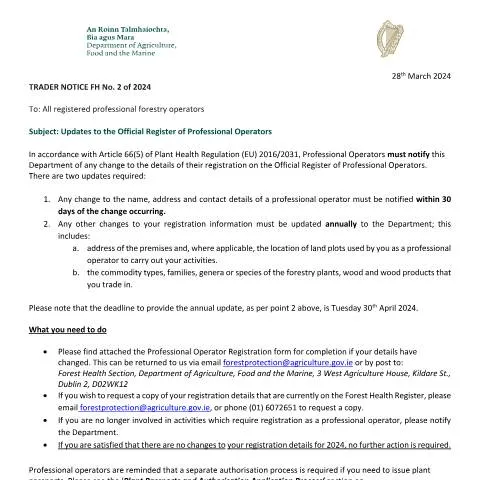
Understanding the Forest Health Registration Update: A Key Requirement for Professional Operators
For any professional operator engaged in forestry activities in Ireland, adherence to the regulations outlined by the Department of Agriculture, Food and the Marine is not just crucial but mandatory. The Forest Health — tn fh 022024 fh registration update is a fundamental document that ensures that operators keep their registration details current, maintaining compliance with EU regulations. Understanding this document's role and the process surrounding it can significantly impact your business operations.
Who Needs to Take Action? Identifying Professional Operators
Defining the Audience
The registration update applies specifically to registered professional forestry operators in Ireland. This includes individuals or businesses involved in the management, harvesting, and trading of forestry products. The importance of this requirement becomes clear when considering the variety of stakeholders affected by changes in the forestry sector.
Situational Considerations
- Foreign Operators: If you are a non-Irish operator seeking to conduct business in Ireland, ensure you are registered with the Forest Health Section.
- Minor Changes: Even seemingly small updates, such as a change in email or phone number, must be communicated within a strict timeframe.
- Complex Cases: If your business structure changes significantly, such as an incorporation or merger, a thorough review of your registration details is necessary.
Timeline and Frequency of Updates: Keeping Your Registration Current
Compliance doesn't stop with initial registration. Operators must be aware of specific timelines for updates:
- Immediate Notifications: Any changes to personal details such as name, address, or contact information must be reported within 30 days.
- Annual Updates: A comprehensive review of registration details is needed every year, covering aspects such as the types of forestry products traded.
Significance of Deadlines
Failure to comply with these stipulations can lead to penalties or issues in obtaining necessary permits for forestry activities. The upcoming deadline for annual updates has been set for Tuesday, 30th April 2024, making it imperative for operators to act swiftly.
The Registration Form: Navigating the Application Process
Completing the registration form correctly is critical. The Professional Operator Registration form is the document you will use to report any changes. Here’s a detailed breakdown of the sections within the form:
Essential Sections of the Form
- Operator Details: This section includes basic information such as name, address, and contact numbers. Ensure that these are updated as soon as any changes occur.
- Business Activities: Detail the specific forestry activities you engage in. This helps the Department understand the scope of your operations.
- Commodity Types: List the types, families, genera, or species of forestry plants, wood, and wood products traded. Accurate descriptions are essential to prevent compliance issues.
Pitfalls to Avoid While Filling Out the Form
Common errors can lead to delays or miscommunication. Here are some tips:
- Double-check all entries for accuracy, particularly in contact details.
- Review the list of commodities carefully, as errors can result in your registration being deemed incomplete.
Communicating with the Department: A Two-Way Process
Once the form is completed, communication with the Department of Agriculture, Food and the Marine takes several forms:
Submission Options
- Email: You can submit your updated form via email to [email protected].
- Post: Alternatively, send your form to:
Forest Health Section, Department of Agriculture, Food and the Marine, 3 West Agriculture House, Kildare St., Dublin 2, D02WK12
Follow-Up Procedures
After submission, if you need to check the status of your registration or require further assistance, the Department offers several avenues:
- Email inquiries to the same address for clarity on any issues.
- Phone contact at (01) 6072651 for immediate assistance.
Dealing with Changes: Special Circumstances and Exceptions
In the dynamic field of forestry, operators may face unique challenges. Here are some considerations that could arise:
When You Will No Longer Operate
If an operator ceases activities that require registration, it is vital to inform the Department promptly. This helps maintain accurate records and alleviate unnecessary regulatory burdens.
Specific Authorisations: Beyond Registration
Operators planning to issue plant passports must undergo a separate authorisation process. This step is crucial for those involved in the trade of plants and is regulated under the Plant Health Regulation (EU) 2016/2031.
Insights on the Role of the Registration Update in Forestry Management
The Forest Health Registration Update is not merely a bureaucratic obligation but a cornerstone for sustainability in forestry practices. By keeping records accurate, the Department can better manage plant health risks, trade in forestry products, and enforce regulations effectively.
Linking Compliance to Broader Goals
By ensuring that individual operators maintain current records, the Department can better prevent the spread of pests and diseases and support the overall health of the Irish forestry sector.
Resources and Support for Professional Operators
For further guidance, operators are encouraged to explore the resources available on the Department's official website. Here are some valuable links:
- Plant Passports and Authorisation Application Process: https://www.gov.ie/pdf/Authorisationprocedure
In concluding this overview, it is paramount for professional forestry operators in Ireland to recognize the significance of the Forest Health — tn fh 022024 fh registration update. By fulfilling these requirements diligently, operators not only comply with regulations but also contribute positively to the sustainable management of Ireland's valuable forestry resources.
Understanding Forest Health Regulations in Ireland
In Ireland, forest health is governed by a combination of EU directives and national legislation aimed at preserving the ecological balance and sustainability of forested areas. The primary authority responsible for monitoring and enforcing these regulations is the Department of Agriculture, Food and the Marine (DAFM). Regulations surrounding forest health involve a myriad of factors, including pest control, disease prevention, and the management of invasive species.
To ensure compliance with forest health regulations, owners and managers of forest properties must adhere to strict guidelines. These guidelines often require forest health assessments, which can include inspections for signs of disease or infestation. The Forest Service, a division of the DAFM, provides resources and support for landowners to manage their forests effectively. This includes information on best practices for maintaining forest health and resources for reporting any suspected cases of infestation or disease.
One vital component of maintaining forest health is the use of integrated pest management (IPM) practices. IPM involves monitoring pest populations and using a combination of biological, cultural, and chemical methods to control them effectively while minimizing harm to the surrounding ecosystems. This holistic approach is crucial for preserving the biodiversity that exists within Ireland’s forests.
The Role of Technology in Forest Health Management
With the advancement of technology, forest health management in Ireland has seen significant improvements. Geographic Information Systems (GIS) and remote sensing technologies play an essential role in monitoring forest conditions and assessing risks related to pest infestations and diseases. These technologies allow for real-time data collection and analysis, enabling forest managers to react quickly to emerging threats.
Additionally, mobile applications and online platforms have been developed to assist landowners in reporting forest health issues. These applications often include tools for identifying pests and diseases, making it easier for users to understand the potential risks to their forests. This use of technology not only empowers forest owners but also enhances the overall efficiency of forest health monitoring.
Moreover, the DAFM actively promotes the use of digital resources for education and training purposes. Stakeholders can access webinars, online courses, and interactive workshops that focus on the latest developments in forest health management. This commitment to education ensures that landowners and forestry professionals stay informed about best practices and emerging challenges.
Collaborative Efforts and Community Involvement
Community involvement is a fundamental aspect of maintaining forest health in Ireland. Local communities, conservation groups, and forestry professionals often collaborate to address forest health issues. This collaboration can take the form of community workshops, tree planting events, and informational sessions aimed at raising awareness about forest health.
The DAFM supports these initiatives by providing funding and resources for community-driven projects that focus on forest health preservation. Grant schemes are available for programs that aim to enhance biodiversity, improve forest resilience, and involve local communities in active forest management practices.
Furthermore, citizen science projects have become increasingly popular, allowing individuals to contribute to forest health monitoring efforts. These projects encourage the public to report sightings of invasive species or signs of disease, thereby fostering a sense of stewardship and responsibility towards Ireland's forests. Engaging the community in this way not only helps gather valuable data but also builds a collective understanding of the importance of forest health.