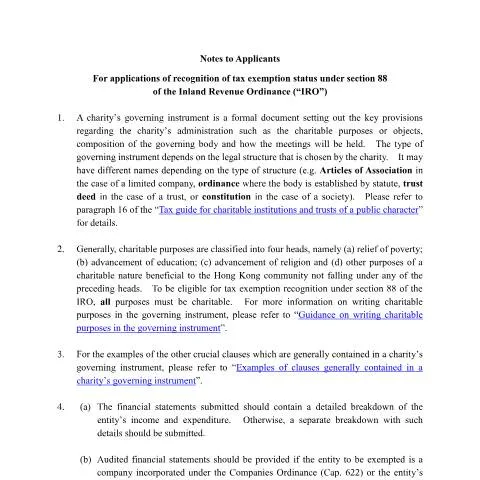
Understanding the Notes to Applicants: A Vital Tool for Tax-Exempt Charities in Hong Kong
In the vibrant landscape of Hong Kong's charitable scene, navigating the regulatory requirements for tax exemption can be intricate. The Notes to Applicants (C.D.22B) serves as an essential guide for entities seeking recognition of tax exemption status under Section 88 of the Inland Revenue Ordinance (IRO). This document is not merely bureaucratic; it represents a lifeline for organizations dedicated to serving the community, providing crucial financial benefits that enhance their operational capacities.
The Significance of the C.D.22B Document
The primary role of the C.D.22B document is to outline the steps and requirements essential for charities to gain tax-exempt status. This recognition allows for exemptions from profits tax and provides tax-deductible benefits for donors. The stakes are high; a successful application allows the organization to allocate more resources towards its charitable purposes rather than administrative expenses.
Key Components of the C.D.22B
- Governing Instrument: This section mandates that applicants submit a formal document establishing the charity’s administration, detailing its purpose and structure.
- Charitable Purposes: The document classifies charitable activities into four main categories: relief of poverty, advancement of education, advancement of religion, and other purposes beneficial to the Hong Kong community.
- Financial Statements: Detailed income and expenditure breakdowns are necessary for demonstrating fiscal responsibility and transparency.
- Activities Description: Applicants must clearly outline the charity’s activities to illustrate alignment with its declared charitable objectives.
- Governing Body Members: The roles and responsibilities of individuals overseeing the organization are crucial for establishing accountability.
Filling Out the C.D.22B: A Step-by-Step Guide
Completing the C.D.22B accurately is pivotal for a successful application. Each section must be filled out with precision, as errors can lead to delays or rejections.
Decoding the Governing Instrument
The governing instrument serves as the backbone of the application. It must clearly articulate:
- The type of organization (e.g., trust, limited company, society).
- The administrative structure and the composition of the governing body.
Each detail should reflect the legal structure chosen by the charity, as any misalignment could jeopardize the application. Be mindful of varying terminologies used across different types of entities; for example, an "ordinance" refers to a statutory framework for a charity established by law.
Identifying Charitable Purposes
For an organization to qualify for tax exemption, it must demonstrate that all its purposes are charitable. The document outlines four main categories:
- Relief of Poverty: Activities aimed at alleviating poverty in the community.
- Advancement of Education: Programs designed to enhance educational opportunities.
- Advancement of Religion: Initiatives that promote religious causes.
- Other Charitable Purposes: Any other activities deemed beneficial to the community.
Non-compliance in defining these categories may result in the denial of the application. Clearly articulate how your charity fits within these definitions.
Financial Statements: Transparency is Key
Financial transparency is a cornerstone of any charity's credibility. The C.D.22B requires:
- Detailed Financial Breakdown: All income and expenditures must be itemized.
- Audited Statements: If applicable, charities must provide audited financial statements, especially if established under the Companies Ordinance.
It's crucial to submit these documents as they mirror the organization’s financial health and operational integrity, directly influencing the assessment of your tax-exempt status.
Common Pitfalls in Financial Reporting
Many applicants underestimate the importance of thorough financial documentation. Failsafe practices include:
- Ensuring all financial statements are up-to-date.
- Providing a comprehensive breakdown of both income and expenditure, avoiding vague categories.
- Submitting a certified true copy of financial statements verified by an authorized person.
Describing Charitable Activities: Aligning Actions with Objectives
The section dedicated to charitable activities requires a detailed account of how the organization’s operations support its declared purposes. This involves:
- Listing specific activities conducted, including dates, venues, and beneficiaries.
- Demonstrating alignment between activities and the charity's stated objectives.
Inadequate descriptions can lead to misunderstandings regarding the charity's mission and operations. Ensure that all activities reflect genuine charitable intent, as this directly impacts the perception of the organization by the authorities.
Governance Structure: Responsibility and Oversight
The governing body is instrumental in the management of the charity. Members are responsible for ensuring that the organization adheres to its stated purposes and operates within legal frameworks. Key points to address include:
- Composition of the Governing Body: List the names and roles of board members, directors, committee members, or trustees.
- Responsibilities: Outline the key responsibilities and authority of the governing body in governance and oversight.
The clarity of governance structures can significantly enhance the credibility of the application. Authorities are keen on understanding who makes decisions and how those decisions align with the organization’s charity work.
Finalizing the Application: Submission and Follow-Up
Completing the C.D.22B is just the beginning. Once the application is finalized:
- Bundle all required documents, including the completed C.D.22B and financial statements.
- Submit the application to the Commissioner of Inland Revenue at the designated postal address.
After submission, applicants should maintain awareness of their application status. Regular follow-ups can ensure that any queries or additional documentation requests are promptly addressed.
Post-Submission Steps
It's advisable to:
- Keep copies of all submitted documents for reference.
- Monitor timelines and deadlines; be proactive in responding to any requests from the Inland Revenue Department.
- Understand the possible outcomes: approval, requests for further information, or denial. Each step requires strategic planning and responsiveness.
Understanding Consequences: Rights and Obligations
Being granted tax-exempt status carries both privileges and responsibilities. Recognize that:
- Tax Benefits: Charities can receive generous tax deductions, enhancing financial viability.
- Ongoing Compliance: Organizations must ensure continual compliance with the stipulated regulations to maintain their tax-exempt status.
- Accountability: Public trust and credibility hinge on transparent operations and accurate reporting.
Failure to comply can result in the loss of tax-exempt status, emphasizing the necessity for meticulous adherence to regulations and processes.
Conclusion: Empowering Charities Through Effective Documentation
The C.D.22B is more than just a form; it is a pivotal document that shapes the future of charitable organizations in Hong Kong. Understanding its nuances can empower applicants to present their cases effectively, ensuring alignment with regulatory expectations. As organizations strive to make impactful contributions to society, mastering the intricacies of tax-exempt status applications becomes not just beneficial but essential.
Understanding the Purpose of Notes to Applicants (C.D.22B)
The Notes to Applicants (C.D.22B) serve as an essential guide for individuals and organizations intending to submit a formal application for charitable status under Hong Kong's legal framework. The document outlines the significance of providing accurate and comprehensive information during the application process, thereby facilitating a smoother review by the relevant authorities, primarily the Companies Registry (CR) and the Inland Revenue Department (IRD).
Applicants should recognize that the C.D.22B not only lists the required documents—such as the Memorandum and Articles of Association, details of the governing body, and a comprehensive statement of the charitable purposes—but also emphasizes the importance of transparency regarding financial statements and operational practices. In essence, this document is a roadmap for demonstrating compliance with the Basic Law and other relevant legislation governing charitable organizations in Hong Kong.
Moreover, notes included in the C.D.22B highlight common pitfalls that applicants encounter, such as failing to adequately address the public benefit requirement or providing insufficient information on how funds will be utilized. A clear understanding of these nuances is imperative for ensuring that the application process is efficient and effective, minimizing the risk of delays or rejections.
Common Mistakes to Avoid When Completing C.D.22B
Completing the Notes to Applicants (C.D.22B) can be a daunting task, especially for first-time applicants unfamiliar with the specifics of Hong Kong’s administrative requirements. To enhance your application’s chances of approval, it is crucial to be aware of the common mistakes that applicants often make.
One prevalent error is the incomplete documentation. While the C.D.22B specifies the necessary documents, applicants sometimes overlook including all required materials. For example, failing to attach updated financial statements or neglecting to provide a detailed breakdown of proposed charitable activities can lead to unnecessary delays. It is advisable to create a checklist based on the C.D.22B instructions to ensure that all required documents accompany the application.
Another common mistake is insufficient clarity in outlining the charitable purposes. The Basic Law mandates that all charitable organizations operate for public benefit; hence, applicants must articulate their objectives clearly and convincingly. Vague descriptions or overly broad statements about the organization's aims can result in rejection. It is recommended to provide specific examples of intended activities and their anticipated impact on the community.
Furthermore, applicants should pay close attention to the governance structure of their proposed organization. Failing to adequately outline the roles and responsibilities of the governing body or not including relevant qualifications can raise red flags during the review process. Clear documentation of governance can significantly enhance the credibility of the application.
Post-Application Procedures and Follow-Up with Authorities
Once the application for charitable status using the Notes to Applicants (C.D.22B) has been submitted, it is essential for applicants to engage actively in the follow-up process. The interval between submission and decision can vary, and maintaining communication with the Companies Registry (CR) or the Inland Revenue Department (IRD) is advisable. A proactive approach can help clarify any queries or additional information requests that may arise during the review process.
Applicants should be prepared for potential requests for clarification or further documentation. In such cases, timely responses are crucial to avoid delays. Moreover, understanding the typical timeline for processing applications can aid applicants in managing their expectations. While some applications may be resolved fairly quickly, others could take several months, particularly if additional information is required.
It is also beneficial to familiarize oneself with the appeals process in case the application is rejected. The C.D.22B provides guidance on what steps to take if a decision does not align with the applicant’s expectations. Knowing how to navigate these procedures can be invaluable for organizations looking to uphold their mission and continue serving the community.