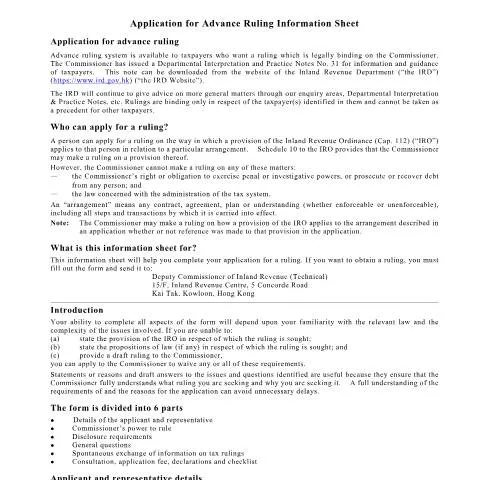
Navigating the Application for Advance Ruling Information Sheet (IR1297)
The Application for Advance Ruling Information Sheet (IR1297) is a crucial document within Hong Kong's taxation framework, particularly for those seeking clarity on the application of the Inland Revenue Ordinance (Cap. 112). This article delves into the intricacies of the IR1297, offering a comprehensive guide on its components and how to strategically leverage it for your tax planning needs.
Understanding the Context: Why Request an Advance Ruling?
In the complex landscape of taxation, uncertainty can lead to significant financial repercussions for businesses, particularly those engaged in international operations. The advance ruling process serves as a protective measure, allowing taxpayers to obtain binding opinions from the Commissioner of Inland Revenue about specific tax matters before they engage in transactions. This is particularly relevant for companies that generate foreign-sourced income and are considering exemptions under the Economic Substance Requirement.
Key Benefits of Advance Rulings
- Clarity: Provides definitive guidance on how a given provision of tax law applies to your situation.
- Risk Mitigation: Reduces the risk of unexpected tax liabilities and aids in making informed business decisions.
- Strategic Planning: Helps in aligning your tax strategies with compliance requirements, specifically under complex rules like the Economic Substance Requirement.
The Structure of the IR1297: Components and Their Significance
The IR1297 document comprises several sections, each designed to address different aspects of the ruling process. Understanding these components is critical for preparing an effective application.
Section Breakdown
- Applicant and Representative Details: This part gathers essential information about the applicant and any representatives acting on their behalf. It's vital for ensuring that communications and decisions from the Commissioner are accurately directed.
- Commissioner’s Power to Rule: This section clarifies the parameters within which the Commissioner can make rulings. It is essential to understand that there are limitations—such as ongoing objections or appeals that may affect the validity of the ruling.
- Disclosure Requirements: Here, applicants must outline the specific questions they wish to have addressed. This section emphasizes the importance of transparency and provides guidelines for what details need to be disclosed.
- General Questions: This section includes queries that help the Commissioner assess the application’s compliance with legal requirements. Understanding these questions in advance can streamline the application process.
- Spontaneous Exchange of Information on Tax Rulings: Under international obligations like the OECD’s guidelines, this section discusses the conditions under which information related to your ruling may be shared with other jurisdictions.
- Consultation: Before finalizing a ruling, the Commissioner may consult with applicants to clarify aspects of the application, ensuring all parties are aligned.
Who Should Consider Utilizing IR1297?
The audience for the IR1297 is primarily businesses operating in Hong Kong that generate foreign-sourced income and wish to take advantage of exemptions available under the economic substance requirements. However, the ruling is not exclusively for large corporations; small to medium enterprises (SMEs) can also benefit when they face complex tax situations.
Practical Scenarios for Application
- International Transactions: Companies involved in cross-border transactions may need clarity on how local laws apply to their foreign income.
- Tax Planning: Businesses aiming to structure their operations optimally to minimize tax liabilities may find advance rulings particularly beneficial.
- Uncertainty in Tax Obligations: If there's ambiguity regarding the application of tax laws, seeking an advance ruling can provide preemptive clarity.
Maximizing the Use of the IR1297 Document
To effectively utilize the IR1297, applicants should adopt a systematic approach to prepare their request. Here’s a step-by-step guide:
Step-by-Step Approach
- Research and Preparation: Familiarize yourself with the Inland Revenue Ordinance and related guidelines. Understanding relevant laws is pivotal for articulating your questions effectively.
- Drafting the Application: Pay special attention to the details required in each section. Ensure that the facts presented are comprehensive and unambiguous.
- Consult with Professionals: Engaging tax professionals or legal advisors can enhance the quality of your application, especially in drafting the 'propositions of law' section.
- Submission: Send the completed application to the Deputy Commissioner of Inland Revenue at the specified address. Double-check that all required documents are included and the application fee is paid.
- Follow-up: After submission, stay proactive by following up on the application status and being available to provide any additional information the Commissioner may request.
Essential Considerations and Limitations
While the IR1297 offers significant advantages, it is also important to be aware of its limitations. Not every application will result in a favorable ruling, and there are scenarios where the Commissioner cannot provide a ruling.
Common Limitations
- The Commissioner cannot rule on matters currently subject to an objection or appeal.
- Rulings cannot be made on already existing arrangements that have been previously ruled upon.
- Certain conditions may preclude ruling if the necessary disclosures aren't made adequately.
Considering the Broader Tax Environment
The IR1297 and the associated ruling process do not exist in isolation. They are part of a larger tax environment governed by various regulations and international agreements. It is essential to consider how these external factors might influence your application.
International Context: OECD Guidelines
The requirement for spontaneous exchange of information, as outlined in the IR1297, highlights the importance of compliance with global standards. Organizations must be aware of their obligations under international tax agreements to avoid potential pitfalls.
Final Thoughts on the Application Process
Submitting an application using the IR1297 is a strategic move for businesses seeking certainty in their tax obligations. Understanding the document fully enables better preparation and execution of applications. Businesses should view the advance ruling not merely as a bureaucratic step but as an opportunity to fortify their tax positioning in an increasingly complex global market.
Understanding Economic Substance Requirements for Foreign-Sourced Income
The Economic Substance Requirement (ESR) in Hong Kong is a crucial regulatory framework that aims to ensure that entities claiming foreign-sourced income exemptions genuinely engage in substantive activities within the region. The Hong Kong government has instituted this requirement to comply with international standards set by the OECD in its efforts to combat base erosion and profit shifting (BEPS). Businesses must demonstrate that they possess a real connection to the economic activities being conducted to qualify for tax exemptions.
For the purposes of the Foreign-sourced Income Exemption Regime, entities must fulfill specific criteria related to their business activities. These criteria include having an adequate number of qualified employees, incurring sufficient operational expenditures, and maintaining a physical presence in Hong Kong. Companies should maintain comprehensive documentation to support their claims regarding economic substance—including contracts, invoices, employee records, and proof of operational activities. Additionally, the types of income that may qualify for the exemption must be carefully analyzed, as not all foreign-sourced income is eligible under the ESR.
The Submission Process for Form IR1298B: Key Considerations
When preparing to submit the Data Form IR1298B, applicants must consider several important aspects to ensure compliance with the requirements stipulated by the Inland Revenue Department (IRD). First, it is vital to accurately complete all sections of the form, as any discrepancies or incomplete information can lead to delays in processing or unfavorable rulings.
Moreover, applicants should be aware of the supporting documents required to accompany the form. A detailed explanation of the economic activities conducted, along with evidence supporting the claim of foreign-sourced income, is imperative. This may involve submitting financial statements, detailed business plans, and other relevant information that showcases the entity's operations and economic contributions in Hong Kong.
Furthermore, it is essential to keep in mind the deadlines for submission. As the tax year in Hong Kong runs from 1 April to 31 March, applicants must align their submissions with this timeline to avoid penalties. The IRD encourages electronic submissions through its online platforms, which offer a user-friendly interface for applicants. By utilizing these e-services, businesses can track the status of their application and receive timely alerts regarding any additional documentation that may be required.
Dealing with Potential Challenges and Appeals
In the course of applying for an Advance Ruling using Form IR1298, businesses may encounter various challenges. One common hurdle is the need for clarity regarding the specific criteria for economic substance. Different types of businesses may face unique requirements based on the nature of their operations; thus, a one-size-fits-all approach may not suffice. Companies are urged to conduct thorough research or seek professional advice to navigate these complexities effectively.
In cases where an application is not accepted or where the ruling is not favorable, companies have the right to appeal the decision made by the IRD. The appeal process is governed by clearly defined protocols, and it is advisable to act promptly. Typically, businesses must submit a formal appeal within a specified timeframe from the date of the ruling notification. During this process, it is crucial to present any new evidence or arguments that support the case for reconsideration, including expert opinions or additional documentation that may strengthen the application.
This appeals process can be intricate, and having a clear understanding of procedural requirements and timelines is vital for a successful outcome. Engaging legal counsel or tax professionals who specialize in Hong Kong's tax regulations can significantly enhance the chances of a favorable appeal decision.