Navigating the Notice of Objection: A Comprehensive Guide
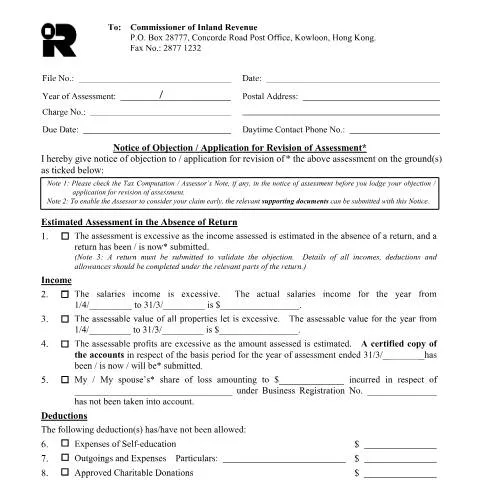
When an entity engages with the Profits Tax regime in Hong Kong, the stakes are high. An erroneous assessment can lead to unwarranted financial burdens, making the Notice of Objection/Application for Revision of Assessment (IR 831) a vital document for taxpayers. This guide elucidates the contents and practical application of this document, ensuring users comprehend its significance and nuances.
Understanding the Core Components of the Notice
The Notice of Objection is not merely a procedural formality; it represents an avenue for taxpayers to contest evaluations deemed inaccurate. Below are the primary sections of the IR 831 that warrant attention:
- Estimated Assessment in Absence of Return: This section discusses the implications of having no tax return submitted and how the assessment might be based on estimations.
- Income Details: Taxpayers detail their actual earnings, highlighting discrepancies with the assessed figures.
- Deductions and Allowances: This crucial section captures various deductions not granted by the revenue authorities, allowing taxpayers to argue for their rightful claims.
- Other Grounds for Objection: This allows for additional claims, addressing unique circumstances that merit a revision.
The Importance of the Estimated Assessment Section
Arguably, the most critical aspect of the IR 831 is the section concerning the Estimated Assessment in Absence of Return. Taxpayers must thoroughly understand the ramifications of this clause. If a tax return has not been submitted, the revenue authorities often base their assessments on available data, which may not reflect the actual financial situation of the entity.
Key Takeaway: Without a submitted return, one might find themselves subject to inflated tax assessments that do not align with reality, making it imperative to contest such evaluations.
Common Misinterpretations: Avoiding Pitfalls
Understanding the intricacies of the IR 831 is essential, yet many taxpayers stumble due to common misconceptions:
- Assuming Automatic Approval: Many believe that submitting the IR 831 guarantees a favorable outcome. However, additional documentation and clear justification are usually required to support any claims made.
- Underestimating Timelines: The document must be lodged promptly, ideally within one month of receiving the assessment notice. Delays can lead to forfeiting the right to appeal.
- Neglecting Supporting Documents: Merely filling out the form is not enough. Supporting documents strengthen the case and should be included to eliminate doubts about the claims made.
Highlighting Financial Discrepancies
Upon completing the income details section, it’s crucial to illustrate the differences between your reported earnings and the assessed values. Clear and accurate documentation of all income streams, including salaries, property assessments, and any other relevant financial data, should be compiled. This helps build a robust case for revision.
Specific Situations Requiring the IR 831
The IR 831 is not a one-size-fits-all document. Several scenarios necessitate its use:
- Disputed Income Levels: If your business experienced lower sales or revenue than assessed, submitting this notice will prompt a review.
- Unaccounted Deductions: If you believe certain deductions were unjustly denied, the IR 831 serves as a mechanism to challenge this.
- Change in Business Structure: Businesses undergoing structural changes may find their tax assessments outdated, leading them to contest the current evaluation.
Who Can Benefit from This Notice?
Beyond sole proprietors, any business entity that has a legitimate grievance with the assessed profits can utilize the IR 831. This includes partnerships, limited companies, and even non-profit organizations. Understanding who qualifies is key to effectively leveraging this document.
Interconnections with Other Tax Documentation
The IR 831 does not operate in isolation. Several related documents serve as vital companions throughout the objection process:
| Document | Purpose |
|---|---|
| Tax Computation/Assessor’s Note | Provides clarity on how the assessed amount was computed. |
| Supporting Documents (e.g., Form IR6072) | Required to validate claims made regarding income and deductions. |
| Business Registration Documents | Establishes the legitimacy and operational scope of the business in question. |
Each of these documents plays a role in strengthening the objection filed via the IR 831. Therefore, it is crucial to gather all pertinent documents in advance.
Effective Strategies for Submission
Submitting the IR 831 is not merely a procedural step; it requires careful planning and execution. Here are some strategies to consider:
- Compile Comprehensive Evidence: Ensure all financial statements, receipts, and documentation are organized and ready for submission.
- Review Prior Assessments: Familiarize yourself with previous assessments to better argue any discrepancies and evolution in the business's financial situation.
- Seek Professional Advice: Consulting with a tax adviser can provide insights into the most effective strategy for filing your objection.
Establishing a Clear Narrative
In addition to presenting factual data, establishing a coherent narrative can be beneficial. Clearly articulate the reasons for the objection, supported by evidence, to persuade the assessing officer of the merits of your case.
Final Considerations Before Submission
Before finalizing the submission of the IR 831, review each section meticulously. Ensure:
- All required sections are filled accurately.
- Supporting documents are attached as necessary.
- Submission is made within the stipulated timeframe to avoid late objections.
Being diligent and thorough at this stage can make a significant difference in the outcome of the objection.
Your Rights and Responsibilities
While the IR 831 is a powerful tool for contesting tax assessments, it is crucial to recognize the responsibilities that accompany its submission:
- Right to Fair Assessment: Taxpayers are entitled to challenge assessments that appear unjust or incorrect.
- Obligation for Accurate Reporting: All information provided must be truthful and accurately reflect financial realities.
- Responsibility to Cooperate: Be prepared to furnish additional information or documentation as requested by the tax authorities during their review process.
Fostering a Proactive Approach
Understanding the implications of the IR 831 transcends mere compliance; it is about fostering a proactive approach to tax management. Regular reviews of financial standings and assessments bolster preparedness for any discrepancies that may arise.
Understanding the Notice of Objection Process
The Notice of Objection is a crucial administrative tool in Hong Kong, primarily utilized by taxpayers who wish to contest an assessment made by the Inland Revenue Department (IRD). This process is governed by Section 66 of the Inland Revenue Ordinance (Cap 112), which allows taxpayers to formally express their disagreement with an assessment and request a revision.
To initiate this process, you must submit a completed Notice of Objection (Form IR1463), which can be obtained from the IRD’s website or in person at their offices. It is essential to provide substantial grounds for your objection, as mere dissatisfaction with the assessment is insufficient. Common grounds for objection may include miscalculation of income, incorrect treatment of deductible expenses, or errors in the valuation of property.
The deadline for submitting your Notice of Objection is generally one month from the date of the assessment notification. Failing to adhere to this timeline could result in the loss of your right to appeal. Once submitted, the IRD will review your case and may request further information or clarification to support your objection.
It is recommended to prepare a comprehensive response that includes supporting documentation, such as tax returns, financial statements, or correspondence with the IRD, to bolster your position. The IRD aims to resolve objections promptly, but processing times can vary based on the complexity of your case and the workload of the department.
If the IRD decides in your favor, your assessment will be revised accordingly. However, if your objection is rejected, you have the right to appeal to the Board of Review. Engaging with a professional tax advisor can be instrumental in navigating this process and ensuring your objection is articulated effectively.
Application for Revision: Factors to Consider
The Application for Revision of Assessment is another avenue for taxpayers in Hong Kong who believe their tax liability has been incorrectly assessed. This application is typically made when a taxpayer has new information or evidence that was not available at the time of the original assessment.
To file an Application for Revision, you must use Form IR1465, which details the rationale behind your application and the new information you are presenting. The submission should be made within the timeframe specified in your assessment notice. It is critical to understand that this application is distinct from a Notice of Objection; the latter disputes the assessment itself, while the former seeks to amend it based on new developments.
In many cases, applicants may find it beneficial to consult with tax professionals who can assist in effectively articulating the reasons for revision and ensuring that all necessary documentation is included. Supporting documents might include updated financial statements, revised profit calculations, or additional evidence of deductible expenses that were overlooked initially.
Once your Application for Revision is submitted, the IRD will assess the new information and determine if it warrants a reassessment of your tax liability. This process can take several weeks, depending on the complexity of the data provided. During this time, it is wise to remain engaged with the IRD and be responsive to any inquiries or requests for additional information.
It is essential to note that if your application is denied, you still hold the right to appeal the decision. This further underscores the importance of having a well-organized set of documents and clear reasoning for your application. The IRD's decision-making process involves careful scrutiny of the new evidence presented, and taxpayers are advised to ensure that their submissions are as compelling and comprehensive as possible.
Common Mistakes to Avoid in the Objection and Revision Processes
Navigating the Notice of Objection and Application for Revision processes can be daunting, especially given the stringent rules and deadlines involved. Understanding common pitfalls can significantly enhance your chances of a successful outcome. Here are several mistakes to avoid:
Missing Deadlines: One of the most critical aspects of both processes is adhering to the stipulated deadlines. For Notice of Objection, ensure that your submission is made within one month of receiving your assessment. Similarly, for Applications for Revision, be aware of the deadlines set forth in your assessment notice. Late submissions are typically rejected outright.
Insufficient Documentation: A frequent error is providing incomplete or insufficient documentation to support your claims. Always include comprehensive evidence, such as financial records, previous correspondence with the IRD, and any relevant tax legislation that supports your argument. Failing to substantiate your case adequately can lead to rejection.
Poorly Articulated Grounds for Objection or Revision: When drafting your Notice of Objection or Application for Revision, clarity and precision are paramount. Clearly articulate the grounds for your objection or the reasons for revision. Avoid jargon and ensure your arguments are logically structured. A well-written document is more likely to be favorably considered by the IRD.
Neglecting to Communicate with the IRD: Keeping an open line of communication with the IRD is vital. Should you need to provide additional information or clarify your submission, respond promptly to any inquiries. Lack of communication can lead to misunderstandings and potential negative outcomes.
Assuming Automatic Approval: A common misconception is that submitting a Notice of Objection or Application for Revision guarantees a favorable outcome. The IRD conducts a thorough review process, and approval is not guaranteed. It’s essential to be prepared for both outcomes and consider your options should your request be denied.
Lack of Professional Guidance: Tax laws can be complex and nuanced. Engaging a professional tax advisor familiar with Hong Kong's tax landscape can provide invaluable insights and increase the likelihood of a successful objection or revision. They can help identify the strongest grounds for your case and ensure compliance with all procedural requirements.
By avoiding these pitfalls, taxpayers can navigate the Notice of Objection and Application for Revision processes more effectively, potentially leading to favorable resolutions of their tax disputes.