The Strategic Importance of the IRBR 200A Form in Hong Kong's Business Landscape
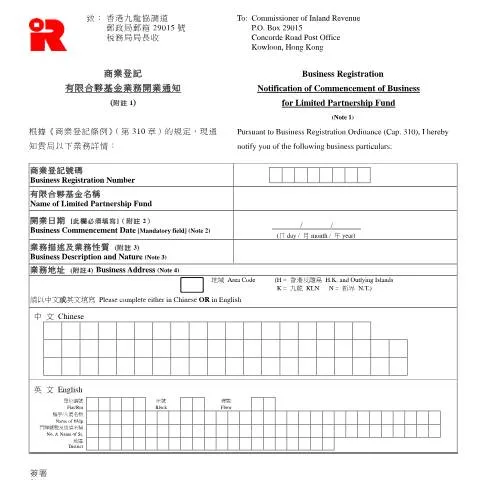
In the intricate world of business in Hong Kong, the Notification of Commencement of Business for Limited Partnership Fund, known by its reference code IRBR 200A, serves as a pivotal document for entrepreneurs and investors alike. Understanding its role is essential for those looking to establish a limited partnership fund in this bustling financial hub.
Navigating the Application Process: Who Is Responsible for Submission?
The onus of submitting the IRBR 200A form lies primarily with the general partner of the limited partnership fund. In the case where the fund is a corporate entity, the authorized representative or investment manager can also complete this task. This emphasizes the hierarchical structure within limited partnerships, where the duty of compliance rests with specific individuals.
For non-residents or foreign entities wishing to commence business in Hong Kong, it is crucial to understand that they must appoint a local representative. This representative will act as a liaison with the local authorities and ensure that the IRBR 200A is appropriately filled out and submitted. The process is designed not only for compliance but also to safeguard the integrity of Hong Kong's business environment.
Completing the IRBR 200A Form: A Step-by-Step Guide
Filling out the IRBR 200A form requires careful attention to detail. Each section of the form is critical and must be completed accurately to avoid delays in processing. Here’s a breakdown of the form's key components:
- Business Registration Number: This unique identifier is assigned upon completion of the business registration process and should be included here.
- Name of Limited Partnership Fund: Clearly define the name as registered with the relevant authority.
- Business Commencement Date: Indicate the date when the business operations are scheduled to begin. This is a mandatory field that requires attention.
- Business Description and Nature: Provide a concise description that captures the essence of the business. This should not exceed 30 Chinese characters or 60 English characters.
- Business Address: The address must be precise, including the correct area code. If the business address differs from the registered office, clarification is essential.
- Signature and Name of Signer: The form must be signed by the general partner or an authorized representative, with identification details provided for verification.
Preparation of Supporting Documents
In addition to the completed IRBR 200A form, specific supporting documents are required. For instance:
- A copy of the identity card or passport of the signer.
- If the signer is a corporate entity, include the business registration number of the entity.
- Any additional documents that may be requested depending on the specific nature of the partnership.
Submitting the IRBR 200A: Options and Best Practices
Once the form is completed, it must be submitted to the Inland Revenue Department through one of the following methods:
- By Mail: Send the completed form to P.O. Box 29015, Concorde Road Post Office, Kowloon, Hong Kong.
- In Person: Visit the Inland Revenue Centre located at 2/F, 5 Concorde Road, Kai Tak, Kowloon, Hong Kong.
It is crucial to note that the submission should be made within one month from the date of business commencement to avoid penalties.
What Happens Next? Understanding the Review Process
After submission, the Inland Revenue Department undertakes a review of the IRBR 200A form. This review process is designed to ensure that all information is accurate and complete. If there are discrepancies or additional information is needed, the department may reach out to the applicant through the contact details provided in the form.
Typically, applicants can expect processing times to vary, so it is advisable to follow up if no confirmation is received within a reasonable timeframe. Keeping a record of all correspondence and submission receipts can be beneficial in case any issues arise.
Addressing Common Issues: What If Your Application Is Rejected?
Should there be any rejection or request for additional information regarding the IRBR 200A application, it is essential to act swiftly. The first step is to carefully review the reasons for the rejection, which will be communicated by the Inland Revenue Department. Common issues may include:
- Incomplete forms or missing signatures.
- Inaccurate business commencement dates.
- Insufficient supporting documentation.
To rectify these issues, applicants should provide the requested information without delay and resubmit the form appropriately. Engaging with a local consultant or legal advisor can also help navigate any complications effectively.
Special Considerations for Foreign Investors
Foreign investors looking to establish a limited partnership fund in Hong Kong should be aware of additional considerations. Apart from the IRBR 200A form, foreign entities may need to provide:
- Proof of incorporation from their home country.
- Details of the appointed local representative.
- Verification of compliance with local laws and regulations.
Understanding local business practices and legal requirements can significantly ease the establishment process. Consulting with local legal experts can provide clarity and guidance on navigating these complexities.
Understanding the Broader Context: How the IRBR 200A Fits Into Business Registration in Hong Kong
The IRBR 200A form is part of a larger framework of business registration in Hong Kong, which is governed by the Business Registration Ordinance (Cap. 310). This ordinance outlines the requirements for various types of business entities, including limited partnerships.
By successfully submitting the IRBR 200A, businesses not only comply with local regulations but also contribute to the overall transparency and integrity of Hong Kong's financial landscape. Understanding this context underscores the importance of accurate and timely submission of the form.
Conclusion: Key Takeaways for a Successful Application
Completing the IRBR 200A form is a critical step for limited partnership funds in Hong Kong. By understanding the nuances of the application process, including the necessary documentation and submission methods, applicants can ensure a smoother experience.
Remember, the key to a successful application lies in attention to detail, timely submissions, and proactive communication with the Inland Revenue Department. By adhering to these principles, you can navigate the complexities of business registration in Hong Kong effectively.
Understanding the Notification Process for Limited Partnership Funds
In Hong Kong, the Notification of Commencement of Business for a Limited Partnership Fund (LPF) is critical for compliance with the regulatory framework established under the Limited Partnership Fund Ordinance. This section aims to provide insight into the necessary steps involved in the notification process, highlighting key considerations that fund managers and partners must be aware of.
The notification must be submitted to the Companies Registry (CR) within 14 days of the fund commencing its operations. It is essential to adhere to this timeline to avoid potential penalties or complications with fund registration. The notification form (LPF-1) requires specific details such as the name of the fund, business address, and particulars of the general partner. Importantly, the submission can be completed electronically through the CR's e-Services portal, facilitating a seamless experience for fund managers.
Moreover, each Limited Partnership Fund must ensure that its information remains up to date. Any alterations, such as changes in the general partner or investment strategy, must be promptly reported to the CR through the appropriate forms. Failing to notify the Companies Registry of these changes can lead to regulatory scrutiny and possible sanctions. Therefore, maintaining accurate records and timely updates is paramount for the smooth operation of an LPF in Hong Kong.
Tax Implications and Regulatory Compliance for Limited Partnership Funds
Understanding the tax landscape is crucial for Limited Partnership Funds operating in Hong Kong. LPFs benefit from a favorable tax regime, which is an appealing aspect for investors. Under the Inland Revenue Ordinance, a fund may be eligible for profits tax exemption if it qualifies as a qualifying fund. However, certain conditions must be satisfied, including conducting business in Hong Kong and not investing in specified assets, among others.
It is advisable for fund managers to consult with tax advisors or legal experts who specialize in the Hong Kong financial sector to navigate these complexities effectively. They can provide guidance on structuring the fund to optimize tax efficiency and ensure compliance with local regulations. Additionally, fund managers must be aware of the annual filing requirements, which include submitting audited financial statements and tax returns to the Inland Revenue Department (IRD) within the designated deadlines. The tax year runs from 1 April to 31 March, and thus, timely submissions are essential for maintaining the fund's good standing.
The regulatory environment in Hong Kong is stringent, and adherence to the guidelines set forth by the Securities and Futures Commission (SFC) is vital for LPFs, especially if they engage in regulated activities. This could involve licensing requirements or additional filing obligations under the Securities and Futures Ordinance. Fund managers must remain vigilant and stay informed of any regulatory changes that may impact their operations.
Best Practices for Limited Partnership Fund Documentation and Record-Keeping
Effective record-keeping and documentation practices are indispensable for Limited Partnership Funds in Hong Kong. Establishing a robust system for maintaining records can not only facilitate compliance with regulatory requirements but also enhance operational efficiency. LPFs should maintain detailed records of all transactions, agreements, and communications related to the fund's activities. This includes investor agreements, subscription documents, and correspondence with regulatory bodies.
Additionally, implementing a digital document management system can streamline the process, making it easier to store, retrieve, and manage important documents. Such systems can also assist in tracking deadlines for filings and renewals, which is crucial in a fast-paced regulatory environment. Keeping an organized electronic database ensures that all necessary documentation is readily available for audits or inspections by regulatory authorities.
Moreover, periodic internal reviews of documentation practices can help identify areas for improvement and ensure compliance with evolving regulatory requirements. Engaging legal counsel to conduct these reviews can provide an additional layer of assurance that the fund is operating within the legal framework and is prepared for any potential inquiries from authorities.