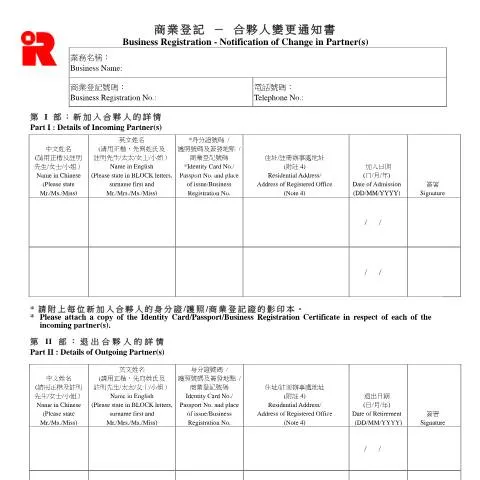
Understanding the Business Registration - Notification of Change of Partners (IRBR 64)
In the dynamic landscape of Hong Kong's business environment, any alterations within a partnership can have significant implications. The Business Registration - Notification of Change of Partners, commonly referred to as IRBR 64, is a pivotal document that facilitates formal updates regarding the partners involved in a business. This article delves deep into the nuances of this document, its critical role, and the procedures surrounding its use.
When to Initiate Changes: The Timing of Notifications
Timeliness is crucial when notifying the Business Registration Office of changes in partnership. Here’s a detailed timeline:
- Immediate Notification: You are required to submit the IRBR 64 within one month from the date of admission or retirement of a partner. Failing to do so could lead to penalties.
- Understanding the One-Month Deadline: Recognizing when the one-month period begins is essential. It starts on the date the change occurs, such as the signing of an admission agreement for a new partner or the official retirement of an existing one.
- Subsequent Steps: After submission, the Business Registration Office will process the notification and update their records accordingly. This ensures that all legal documents reflect the current partnership structure.
Consequences of Inaction: The Risks of Delay
Neglecting to submit the IRBR 64 on time can lead to several unfavorable outcomes:
- Legal Penalties: Businesses may face fines for late notifications, impacting their financial standing.
- Operational Implications: A lack of updated records can create challenges in legal matters, potentially hindering business operations.
- Tax Consequences: Tax liabilities may arise if the partnership structure is not accurately reported, leading to complications during assessments.
Who Must File? Detailed Profiles and Exceptions
The parties responsible for filing the IRBR 64 include:
- Incoming Partners: Any new partner joining the business must be officially documented. Their identification and business registration details need to be accurately filled out in the form.
- Outgoing Partners: Partners retiring or leaving the business must also be recorded, ensuring all past partners are accounted for in the official registry.
- All Remaining Partners: Unique to this form, all remaining partners are required to sign the notification, affirming that the changes are acknowledged and accepted by all involved.
Exceptions include instances where a partner is a corporate entity, which necessitates different documentation and a registered office address for compliance.
The Step-by-Step Process: From Trigger to Submission
Understanding the procedural journey for completing the IRBR 64 can greatly assist in ensuring compliance:
- Identify the Change: Establish whether the change involves an incoming or outgoing partner.
- Gather Required Information: This includes personal details like names, identification numbers (HKID or passport), and the dates of admission or retirement.
- Complete the Form: Fill out the IRBR 64 with all necessary details, ensuring accuracy to avoid delays.
- Signatures: Ensure all remaining partners sign the form, which is a mandated step for validation.
- Submit the Document: Choose from available submission methods—postal service, in-person delivery at the Business Registration Office, or other authorized channels.
The Regulatory Framework Surrounding the IRBR 64
The necessity of the IRBR 64 is grounded in the legislative structure of Hong Kong, specifically the Business Registration Ordinance (Cap. 310). This ordinance mandates the maintenance of accurate and current records of business entities, including partnerships. The legal framework aims to:
- Ensure Transparency: By keeping an up-to-date record of partners, the government promotes accountability within businesses.
- Facilitate Compliance: Regular updates assist the authorities in enforcing tax and business regulations effectively.
- Protect Stakeholders: Accurate registrations safeguard the interests of all stakeholders, including creditors and clients.
Channels for Submission: Online vs. Offline
Potential filers have multiple avenues for submitting the IRBR 64, and it's essential to choose the method that best suits your needs:
| Submission Method | Advantages | Considerations |
|---|---|---|
| Online Submission | Convenient and efficient; immediate confirmation of receipt. | Requires access to a stable internet connection and electronic documentation. |
| Postal Submission | Traditional method; suitable for those less comfortable with technology. | Longer processing time and potential delays in mail delivery. |
| In-Person Submission | Direct interaction with officials; opportunity to clarify any queries on the spot. | Requires time and may involve waiting in queues. |
Each submission method has its unique advantages; consider your specific situation to ensure the most efficient processing of your notification.
Placement within Overall Business Registration Procedures
The IRBR 64 is just one piece in a larger puzzle of business registration procedures. Understanding its role is critical:
- Connection with Initial Business Registration: Before any partnership changes can be processed, the initial business registration must be complete.
- Integration with Tax Obligations: Changes in partnership directly impact tax filings, necessitating an immediate update to ensure compliance with tax obligations.
- Role in Licensing and Permits: Certain licenses may rely on the integrity of partnership information; inaccuracies could risk suspension of operations.
Key Considerations and Best Practices for Submission
To ensure a seamless process when filing the IRBR 64, adhere to these best practices:
- Double-Check Information: Verify that all partner details are correct and up-to-date, which minimizes the risk of rejection.
- Keep Copies: Maintain copies of everything submitted for your records, which can be useful for future reference.
- Stay Informed: Regularly check updates from the Business Registration Office regarding any changes in procedures or requirements.
By understanding the intricacies of the IRBR 64, stakeholders can navigate the complexities of partner changes effectively, ensuring compliance and fostering a transparent business environment in Hong Kong.
Understanding the Importance of Timely Notification
The Hong Kong business environment is characterized by its dynamic nature, making it essential for businesses to stay compliant with the legal requirements governing their operations. One critical aspect of this compliance is the timely notification of any changes to your partnerships. Under the Business Registration Ordinance, failure to promptly inform the Companies Registry (CR) of changes in partners can result in penalties and further complications. Notifying the CR within one month of the change is not just a best practice; it is a legal obligation. Such notifications ensure that your business remains in good standing, and that all public records reflect the current operational structure of your business.
In practice, this means keeping all stakeholders, including regulatory authorities, informed about who is responsible for various aspects of the business. This is particularly important in sectors that require stringent oversight and compliance, such as financial services or healthcare. The implications of failing to notify can extend beyond penalties; they can affect the company’s reputation, investor trust, and even the ability to secure future funding or partnerships.
Common Scenarios Requiring Notification
In the realm of business partnerships, several scenarios may necessitate notifying the Companies Registry of changes in partners. Understanding these scenarios can help prevent compliance issues and potential legal ramifications.
1. Partner Departure: If a partner leaves the business, whether voluntarily or involuntarily, it is imperative to notify the CR. This is particularly critical if the departing partner held significant stakes or responsibilities within the company.
2. New Partner Entry: When a new partner joins the business, whether as a co-owner or through investment, it is essential to file the appropriate notification to reflect this change in partnership structure. This not only keeps your records accurate but also reassures existing partners and stakeholders about the management of the company.
3. Change in Partner’s Details: Changes in addresses, contact numbers, or identification documents of existing partners also require notification. Such details must be up-to-date to ensure that all communications and legal documents reach the correct individuals promptly.
4. Changes in Partner Responsibilities: If a partner's role evolves or if responsibilities are redistributed among partners, this should also be reported. While it may not always be a legal requirement, maintaining clear records can prevent misunderstandings and disputes in the future.
By being proactive in notifying the CR of these changes, businesses can create a transparent and well-documented operational structure, ensuring that the partnership operates smoothly and in compliance with Hong Kong laws.
Utilizing E-Services for Efficient Notification
The Hong Kong government has made significant strides in digital transformation to provide more efficient services to businesses. The e-services offered by the Companies Registry are particularly beneficial for notifying changes in partners. By utilizing these online platforms, businesses can streamline their administrative processes and reduce the time spent on paperwork.
The process begins with accessing the relevant forms online. The Companies Registry website provides all necessary forms, including the specific forms for notifying changes in partnerships. Once the appropriate form, such as the NNC2, is completed, businesses can submit it electronically. This not only expedites the submission process but also allows for immediate confirmation of receipt, providing peace of mind to business owners.
Moreover, utilizing e-services helps in maintaining accurate records. Once a notification is submitted, stakeholders can instantly access updated documents, ensuring everyone is on the same page. It also minimizes the risk of errors that often occur during manual submissions. For instance, entering incorrect details can lead to significant delays in processing times and potential penalties.
In addition to these benefits, the online submission process is designed with user-friendliness in mind. The interface is bilingual, providing options in both English and Traditional Chinese, which caters to a diverse business community in Hong Kong. This accessibility facilitates better compliance and encourages businesses to stay on top of their administrative responsibilities.