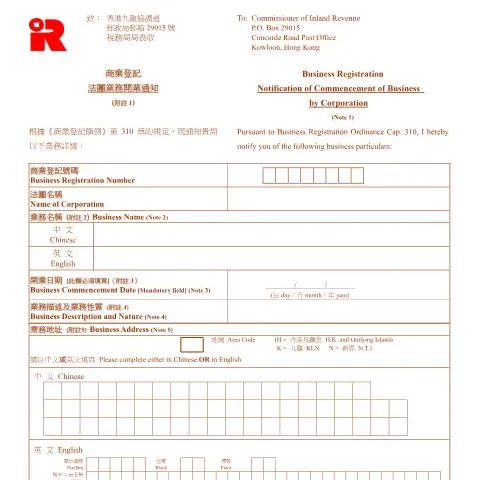
A Deep Dive into the Notification of Commencement of Business by Corporation
Establishing a business in Hong Kong entails a series of regulated procedures, one of which is the timely submission of the Notification of Commencement of Business by Corporation (IRBR 200). This document serves a pivotal role in officially informing the Commissioner of Inland Revenue about the commencement of business activities by a corporation. Understanding the intricacies involved in this process is crucial for compliance and operational success.
Defining the Unique Context: Who Needs This Form?
The IRBR 200 form is primarily applicable to corporations that have been incorporated in Hong Kong and are ready to initiate their business activities. It's essential to recognize the profile of those who must submit this form:
Corporate Entities
- Limited Companies: This includes private and public limited companies registered under the Companies Ordinance.
- Non-Hong Kong Companies: Foreign companies that have registered to carry on business in Hong Kong also fall under this category.
Exceptions to Consider
- If a corporation is set up solely for holding investments without any operational activities, it may not require the submission of this form.
- Additionally, companies that are registered under different ordinances may have varying requirements.
The Importance of Timing: When to Submit the IRBR 200
Timing is vital in the submission of the IRBR 200. The form must be submitted within one month from the commencement date of business operations. Failure to comply can result in penalties as severe as a fine of HKD 5,000 and potential imprisonment for up to one year. The importance of the timing cannot be overstated; it not only affects compliance but also impacts the corporation’s operational legitimacy.
Navigating the Completion Process: Step-by-Step Instructions
Filling out the IRBR 200 requires precision and attention to detail. Below is a breakdown of the key sections involved in completing the form:
Business Registration Number
This is a unique identifier assigned upon the registration of the corporation. Ensure this number is readily available when filling out the form.
Name of Corporation
The official name under which the business operates should be accurately reflected. If the business name differs from the corporation name, both must be provided along with the language specifications.
Business Commencement Date
Providing an accurate date is mandatory. This date marks the official beginning of business activities and is critical for record-keeping and compliance.
Description and Nature of Business
A clear description of the business is necessary. This includes the main activities to be carried out. Adhere to character limits specified in the guidelines where a Chinese description cannot exceed 30 characters and an English description 60 characters.
Business Address
The registered address must be clearly stated. This section also requires the completion of housing details, including block and floor numbers.
Signatory Details
The form must be signed by an authorized representative. If this individual is a corporate director, additional documentation, such as the Certificate of Incorporation, may be required to validate their authority.
Submission Channels: Understanding Your Options
Once the IRBR 200 has been duly filled, the next step is its submission. There are various channels through which this can be accomplished:
Online Submission
Utilizing the e-services offered by the Business Registration Office allows for a streamlined submission process. Corporations can submit their completed forms electronically via the official website.
Postal Submission
If opting for physical submission, the form must be sent to:
To: Commissioner of Inland Revenue P.O. Box 29015, Concord Road Post Office, Kowloon, Hong Kong.
In-Person Submission
Corporations can also submit the form in person at the Business Registration Centre located at:
2/F, Inland Revenue Centre, 5 Concord Road, Kai Tak, Kowloon, Hong Kong.
Post-Submission: What Happens Next?
After submission, corporations may wonder about the next steps regarding their notification:
Processing Timeline
Although the processing times may vary, it generally takes a few weeks for confirmation of successful registration. Corporations are encouraged to monitor the status of their submission if necessary.
Follow-Up Mechanism
In the case of delays or issues, corporations can contact the Business Registration Office directly to inquire about their application status. Having the business registration number handy will facilitate smoother communications.
Distinguishing the IRBR 200: A Comparative Insight
The IRBR 200 is often confused with other forms related to business registration; however, it serves a distinct purpose. Here’s a comparative insight:
| Form Name | Purpose | Who Should File? |
|---|---|---|
| IRBR 200 | Notification of Commencement of Business | All corporations commencing business in Hong Kong |
| BR1 | Application for Business Registration | New businesses registering for the first time |
| IRBR 201 | Notification of Change of Business Particulars | Corporations updating their business registration details |
This differentiation is crucial for ensuring compliance with the Hong Kong business regulations. Submitting the correct form at the right time can significantly influence corporate governance and operational integrity.
Regulatory Framework: The Legal Backbone
The necessity for the IRBR 200 stems from the Business Registration Ordinance (Cap. 310), which governs the requirements for business registration in Hong Kong. Understanding this legal framework is vital for corporations:
Core Regulations
The ordinance outlines the obligations of businesses, including the requirement to notify the Commissioner of Inland Revenue promptly. Non-compliance can result in administrative penalties, reinforcing the need for adherence.
Implications of Non-Compliance
Failure to submit the IRBR 200 can lead to fines and legal repercussions. It is imperative for business owners to recognize that timely submission is not merely a formality, but a critical component of maintaining compliance.
Preparing Your Documentation: Key Considerations
Before embarking on the submission of the IRBR 200, ensure that all necessary documentation is adequately prepared:
Identity Verification
Ensure that the signatory’s identity can be verified through recognized identification methods. This may include the HKID for local signatories or a passport for overseas representatives.
Complete and Accurate Information
Double-check all entries on the form to ensure that they are accurate and complete. Missing or incorrect information can lead to delays or rejection of the submission.
Record Keeping
Maintain copies of all submitted documents and correspondence with the Business Registration Office. This can serve as a reference in case of future inquiries or disputes.
Final Thoughts on the IRBR 200
Navigating the process of business registration in Hong Kong can be intricate, but understanding the role of the IRBR 200 significantly simplifies the journey toward operational legitimacy. By complying with the requirements and submitting the necessary notifications, corporations can focus on what truly matters—growing their business.
For corporations poised to commence operations in Hong Kong, utilizing the IRBR 200 form effectively is not just about compliance; it's a step towards establishing a foundation for success in one of Asia's most dynamic business environments.
Understanding the Notification Process
In Hong Kong, the Notification of Commencement of Business (NNC1) is a crucial step for corporations that have recently completed their incorporation process. The NNC1 form serves as a formal declaration to the Companies Registry (CR) indicating that the company has commenced its business activities. It is imperative to understand the intricacies involved in this notification process to ensure compliance with local regulations.
The Notification of Commencement of Business must be submitted to the CR within one month from the date of commencement of business activities. This timeframe is non-negotiable, and failure to meet this deadline could result in penalties or complications in the business registration process. Corporations should be diligent in determining the precise date they begin operations, as this will dictate the timeline for submitting the NNC1 form.
When filling out the NNC1 form, corporations are required to provide specific details including the company's name, registration number, and the nature of its business activities. Moreover, all information must be clearly articulated to avoid any discrepancies that could delay the processing of the notification. The form is available in both English and Traditional Chinese to accommodate the bilingual nature of Hong Kong’s administrative systems.
Implications of Non-Compliance
Failure to submit the Notification of Commencement of Business within the stipulated timeframe can lead to serious implications for a corporation in Hong Kong. This includes not only potential fines imposed by the Companies Registry but also challenges in establishing business credibility with banks, suppliers, and clients.
Moreover, if the notification is not filed, the corporation may face complications in obtaining necessary permits or licenses for its specific trade or profession. In certain industries, such as food and beverage or construction, local authorities require proof of business commencement to approve further applications for operational permits or health licenses.
In extreme cases, prolonged non-compliance may lead to the striking off of the company from the Register of Companies, rendering it inactive and thus affecting its legal standing. Therefore, it is critical for corporations to not only submit the NNC1 form on time but also maintain thorough records of all business activities and any communications with the Companies Registry.
Key Considerations for Foreign Corporations
Foreign corporations looking to establish a presence in Hong Kong must navigate additional considerations when it comes to the Notification of Commencement of Business. The complexities of operating as a foreign entity include understanding local market regulations, compliance requirements, and the operational framework within which they must operate.
One key aspect is the necessity of having a local company secretary, as stipulated by the Companies Ordinance. The company secretary plays a crucial role in ensuring that the NNC1 form is accurately completed and submitted on behalf of the foreign corporation. This local representative can provide valuable insights into local practices and help avoid pitfalls in the notification process.
Furthermore, foreign corporations must also consider the cultural nuances of doing business in Hong Kong. Understanding the local business etiquette, negotiation styles, and consumer behavior can greatly enhance their chances of success. They should seek to engage with local consultants or advisors who can provide guidance on both regulatory compliance and market entry strategies.
Lastly, foreign corporations should not overlook the importance of integrating local labor laws and employment practices into their operational plans. This includes understanding the taxation policies applicable to foreign enterprises and complying with the relevant regulations to avoid any legal repercussions that could impact their business operations.