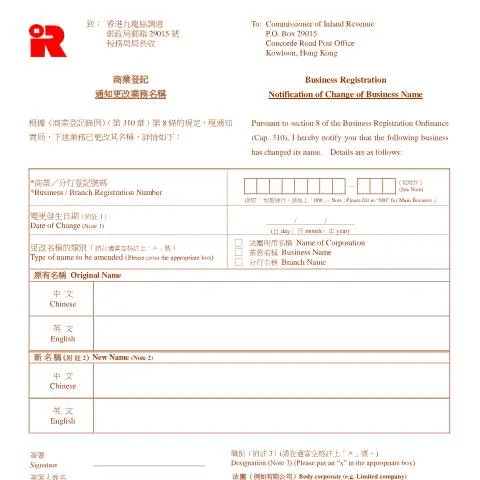
Understanding the Notification of Change of Business Name: An Essential Tool for Hong Kong Enterprises
When the name of a business requires alteration, the Notification of Change of Business Name (IRC 3110A) serves as a pivotal document in Hong Kong's business registration landscape. This form is not merely a bureaucratic requirement but a critical mechanism that ensures businesses maintain their compliance with the regulations set forth in the Business Registration Ordinance (Cap. 310). The implications of failing to submit this form accurately and on time can lead to severe repercussions, including financial penalties and legal complications.
Navigating the Business Landscape: The Crucial Moments for Submitting the Form
Timing is of the essence when it comes to submitting the IRC 3110A. The Business Registration Ordinance necessitates that any change in business particulars, including a name change, must be reported to the Commissioner of Inland Revenue within one month of the change's occurrence. Delaying this notification could result in:
- Financial Penalty: Non-compliance may lead to a fine up to $5,000.
- Legal Repercussions: Failure to notify could result in criminal prosecution.
Thus, it's vital that business operators stay vigilant about any alterations to their registered names and adhere to this timeline, ensuring compliance with the law.
Deciphering the Form: Essential Sections and Common Pitfalls
Completing the Notification of Change of Business Name form involves meticulous attention to detail. Each section of the document requires accurate information to prevent unnecessary delays or rejections. Here’s a breakdown of the critical sections and some traps to avoid:
1. Business Registration Number
This section demands the registered number of the business. A common oversight is providing incorrect digits. Always double-check this information against your original registration documents.
2. Date of Change
It is imperative to record the correct date of the name change. Note that the date format should adhere to the Hong Kong standard (DD/MM/YYYY). Errors in date entry can lead to confusion and potential rejection of your submission.
3. Types of Names to be Amended
Here, a business must indicate whether the change refers to a Business Name, Name of Corporation, or Branch Name. Misclassification is a recurrent issue; thus, ensure to cross the correct box meticulously.
4. Original and New Name
Both the original name and the new name must be provided in Chinese and English. The Chinese name should not exceed 30 characters, while the English name must remain within 120 characters. Be cautious of character limits here, as exceeding them can result in invalid submissions.
5. Signature and Designation
The final segment requires the signature of the business operator and their designation. It’s crucial that the person signing the form is duly authorized and their identity is verified with the correct identification number.
Consequences of Non-compliance: What to Expect
Failure to abide by the regulations and submit the Notification of Change of Business Name on time can lead to serious ramifications. Beyond fines, it could jeopardize the business's legal standing and operational continuity. If the form submission is not performed correctly, here are the next steps:
- Clarification Request: The Business Registration Office may reach out for clarification, which could delay your name change.
- Submission Rejection: A rejection may lead to the need for resubmission, further compounding delays and potential penalties.
- Legal Action: In extreme cases, continued non-compliance could result in criminal charges.
Exploring the Regulatory Framework: The History Behind the Form
The requirement to submit the Notification of Change of Business Name stems from a long-standing commitment to corporate transparency and accountability within Hong Kong’s business environment. The Business Registration Ordinance was established to facilitate the effective regulation of business operations and enhance public trust. This legal framework was enacted not merely for administrative purposes but as a means to protect consumers and promote fair business practices.
Over the years, this ordinance has been refined to adapt to the evolving business landscape, ensuring that businesses remain compliant with local regulations. The specificity of the IRC 3110A form reflects the government’s intention to maintain that regulatory integrity.
Comparing the Notification of Change of Business Name with Other Related Forms
Understanding how the IRC 3110A differs from other forms in the business registration spectrum is essential for any business operator. Many confuse this form with others, leading to misfiled submissions. Here’s a comparison:
| Form | Purpose | Deadline for Submission |
|---|---|---|
| IRC 3110A | Notify about a change in business name | Within one month of the change |
| IRC 3110B | Notification of Change of Business Address | Within one month of the change |
| IRC 3110C | Notification of Change of Business Structure | Within one month of the change |
It’s essential for business owners to recognize the unique requirements and deadlines associated with each of these forms to ensure seamless navigation through Hong Kong’s regulatory environment.
Post-Submission: What Happens After You File the Form?
Upon filing the Notification of Change of Business Name, there are several steps that follow:
- Form Processing: The Business Registration Office will process the form within a stipulated timeframe.
- Confirmation: Once approved, a confirmation notice will be sent to the business operator detailing the successful name change.
- Database Update: The new name will be updated in the official business register, solidifying its legal standing.
The Larger Context: Integrating Name Change into Business Operations
Changing a business name is not merely a clerical task; it extends to various operational dimensions. After successfully filing the IRC 3110A, businesses must:
- Update branding materials, including signage and marketing collateral.
- Notify clients, suppliers, and other stakeholders to ensure continuity in communications.
- Adjust legal documents, contracts, and financial accounts to reflect the new business name.
Falling short in any of these areas can lead to confusion among customers and partners, potentially impacting business operations and reputation.
Final Thoughts: The Importance of Diligence in Business Name Maintenance
The Notification of Change of Business Name (IRC 3110A) is not just a formality; it embodies the principles of accountability in business operations. Understanding the nuances of this document, from its specific requirements to the broader implications of non-compliance, empowers business operators in Hong Kong to navigate the complex waters of corporate law effectively. By remaining proactive and diligent about their business name, operators can ensure that their enterprises continue to thrive in a competitive environment.
Understanding the Process of Notification of Change of Business Name
Changing a business name in Hong Kong is a process that requires careful attention to both legal and administrative requirements. The Companies Registry (CR) oversees the incorporation and registration of companies, including name changes. To notify the CR of a business name change, you must submit a NNC2 form which is specifically designed for this purpose. It's crucial to ensure that the new name complies with the regulations set forth in the Companies Ordinance. Names that are misleading, offensive, or too similar to existing registered names may be rejected.
Once the NNC2 form is properly filled out, it can be submitted online through the CR e-Registry or in person at one of their offices. Notably, online submissions can expedite the approval process, although you should still allow for processing time as stipulated by the CR. It is advisable to verify the availability of your desired new name through the name search service provided by the CR before submitting your application, which can save you time and potential rejection down the line.
Legal Implications and Considerations
When changing a business name, it is essential to consider the legal implications of the new name. Under the Basic Law of the Hong Kong Special Administrative Region, your chosen name must not infringe on existing trademarks or intellectual property rights. Conducting a thorough trademark search is a prudent step to ensure that the new name does not conflict with those rights. Failure to do so may result in legal disputes, which can be both costly and damaging to your business reputation.
In addition, the new business name must be registered with relevant organizations and licenses, as appropriate. This includes updating your business registration with the Business Registration Office, typically using the BR1 form. Furthermore, if your business is operating in specific sectors, you may need to update your licenses or permits to reflect the new name, ensuring compliance with the respective regulatory bodies. It’s advisable to consult with legal professionals to understand any ramifications of the name change on contracts, agreements, and ongoing projects.
Updating Your Business Documents and Online Presence
After successfully notifying the CR of your business name change, the practical aspects of your business operations will require updates to various documents and platforms. This includes a broad array of critical materials such as business cards, invoices, contracts, and marketing materials. Each document should be meticulously reviewed to reflect the new business name accurately.
Online presence is equally crucial; you will need to update your website domain, social media profiles, and any third-party platforms where your business is registered. This not only helps prevent confusion among customers but also assists with search engine optimization (SEO), ensuring that your business can be found easily with its new name. Implementing a comprehensive digital marketing strategy that includes redirecting old URLs to the new site can help maintain and even enhance your online visibility.
It's also essential to communicate the name change clearly with your customers, suppliers, and partners. A formal announcement via email, newsletters, or social media can ensure that everyone is aware of the change and understands that your services and quality will remain the same. This proactive communication strategy can significantly mitigate any potential disruptions in business relationships or customer loyalty.