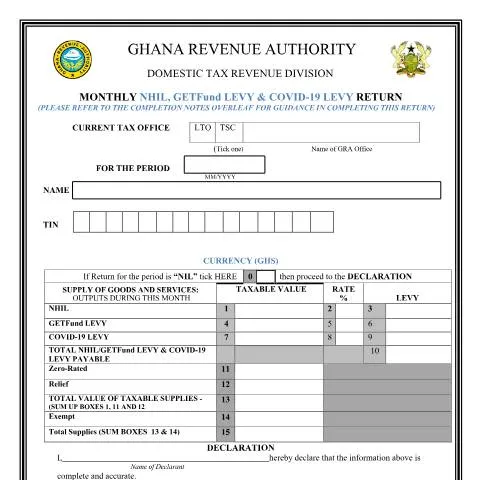
Navigating the Monthly NHIL, GETFund Levy & COVID-19 Return: A Practical Guide
In the realm of taxation within Ghana, the Monthly NHIL, GETFund Levy & COVID-19 Return (Form DT-0138) is an essential document for entities conducting taxable activities. As businesses rebound from the challenges posed by the pandemic, understanding how to correctly complete and submit this return is paramount.
Understanding the Context and Importance of Form DT-0138
The Monthly NHIL, GETFund Levy & COVID-19 Return is designed for the reporting of National Health Insurance Levy (NHIL), GETFund Levy, and COVID-19 Levy by registered taxpayers. This return must be submitted to the Ghana Revenue Authority (GRA) by entities that have engaged in taxable supplies during the reporting month. The significance of this return lies in its role in funding vital national initiatives, including healthcare and education.
Notably, businesses must submit this form even if their operations yield no taxable activities during the month. This is particularly relevant in the context of the COVID-19 pandemic, where many businesses have experienced fluctuations in their operations.
Who is Responsible for Submission?
All registered businesses, whether companies or sole proprietors, are obligated to file this return. The responsibility extends to any entity that has a Taxpayer Identification Number (TIN) and has conducted taxable transactions. Understanding your obligations is crucial to avoiding penalties and ensuring compliance with Ghana's tax laws.
- Companies: Registered corporations, including limited liability companies.
- Sole Proprietors: Individuals conducting business under their legal name.
- Partnerships: Any business structure comprising multiple individuals or entities.
Step-by-Step Guide to Completing the Return
Completing the Monthly NHIL, GETFund Levy & COVID-19 Return requires careful attention to detail. The following sections outline the specific steps necessary for accurate submission.
Initial Details
Begin by entering the following:
- Current Tax Office: Indicate the GRA office where you are registered.
- Name: Provide the legally registered name of the business.
- TIN: Enter your eleven (11) character Taxpayer Identification Number.
- Period: Specify the reporting month and year (format: MM/YYYY).
Reporting Taxable Supplies
In the body of the form, taxpayers must report the taxable values related to the NHIL, GETFund Levy, and COVID-19 Levy. The following items must be completed:
| Box Number | Description | Details Required |
|---|---|---|
| 1 | Taxable Value | Enter the exclusive value of taxable goods and services. |
| 2 | NHIL Rate | Provide the applicable rate of NHIL. |
| 3 | NHIL Amount | Enter the amount charged for NHIL. |
| 4 | GETFund Levy Value | Document the exclusive value of taxable goods/services for GETFund Levy. |
| 5 | GETFund Levy Rate | Specify the applicable GETFund Levy rate. |
| 6 | GETFund Levy Amount | Indicate the amount charged for GETFund Levy. |
| 7 | COVID-19 Levy Value | Report the exclusive value for COVID-19 Levy. |
| 8 | COVID-19 Levy Rate | State the applicable COVID-19 Levy rate. |
| 9 | COVID-19 Levy Amount | Document the amount charged for the COVID-19 Levy. |
| 10 | Total Levy Payable | Sum of NHIL, GETFund Levy, and COVID-19 Levy. |
Declaration Section
Complete the declaration section accurately. This must be signed by a responsible officer within the organization, affirming the truthfulness and completeness of the information provided. Ensure to include:
- Name of Declarant: The individual completing the form.
- Designation: The official position of the declarant.
- Contact Information: A reliable phone number for any follow-up.
- Date: The date of submission.
Submission Channels: Where and How to File
Once the form is completed, it is imperative to understand the various channels available for submission.
Online Submission
Taxpayers can conveniently submit their returns online through the GRA’s digital platform. This method is often preferred for its efficiency:
- Log in to the Ghana Revenue Authority e-Services platform.
- Navigate to the tax return section.
- Upload the completed Form DT-0138.
- Ensure a confirmation is received, which serves as proof of submission.
In-Person Submission
For those who prefer traditional methods, submitting the form in person at the nearest GRA office is also an option. This can be beneficial for individuals seeking direct assistance:
- Visit the designated GRA office.
- Submit the form to the relevant officer.
- Request a stamped copy for your records.
Postal Submission
Alternatively, you may choose to mail your completed form to the appropriate GRA office. However, this method is the least recommended due to potential delays:
- Ensure the form is securely packaged.
- Use a reliable postal service to deliver your return.
- Consider sending via registered mail for tracking purposes.
Handling Errors and Omissions: A Guide to Corrections
In the event that you discover errors or omissions after submitting the form, it’s crucial to take swift action. Taxpayers are responsible for ensuring the accuracy of their returns, and corrections may affect liability.
Identifying Errors
Common errors include:
- Incorrect TIN or name entries.
- Mathematical errors in calculating tax owed.
- Failure to include all taxable supplies.
Corrective Action Steps
If you find an error, follow these steps:
- Contact the nearest GRA office immediately to report the issue.
- Prepare any necessary documentation to support your correction.
- Depending on guidance received, complete a correction form if required.
Dealing with Rejections
In certain cases, your return might be rejected due to incompleteness or errors. When this happens:
- Carefully review the feedback provided by the GRA.
- Address the indicated issues promptly.
- Resubmit the corrected form within the stipulated timeframe to avoid penalties.
What Happens After Submission? Understanding the Process
Once your return is submitted, it undergoes a review process by the GRA. This section outlines what you can expect post-submission.
Verification Process
The GRA will verify the information provided in your return. They may:
- Conduct random audits to ensure compliance.
- Request additional documentation if necessary.
- Reach out directly for clarifications regarding your submission.
Tax Assessments
After verification, taxpayers may receive a tax assessment. This will indicate:
- The total amount of tax due based on your reported figures.
- Any adjustments for prior periods if applicable.
Payment Instructions
Upon receiving an assessment, you will be provided with instructions to make your payment. This may include:
- Online payment options through the GRA portal.
- Bank payment details for physical transactions.
- Deadlines for payment to avoid penalties.
Consequences of Non-Compliance: Understanding Your Obligations
Failing to submit the Monthly NHIL, GETFund Levy & COVID-19 Return can have serious repercussions. Non-compliance can result in:
Penalties and Interest
Taxpayers who neglect to file on time may incur:
- Late filing penalties based on the duration of delay.
- Interest charges on outstanding tax amounts.
Impact on Business Operations
Continued non-compliance can lead to further complications, including:
- Difficulty in obtaining necessary permits or licenses.
- Legal actions or audits from the GRA.
Rounding Off: Keeping Records and Staying Informed
To ensure smooth compliance with tax obligations, maintaining accurate records is vital. Taxpayers should:
- Keep copies of all submitted forms and confirmations.
- Document all taxable supplies and calculations for future reference.
Staying informed about changes in tax regulations and deadlines through the GRA's official communications is equally important. Regular engagement with the GRA can help clarify obligations and ensure that your business remains compliant.
Understanding the Monthly NHIL Get Fund Levy in the Context of COVID-19
The National Health Insurance Levy (NHIL) is a critical mechanism designed to support the National Health Insurance Scheme (NHIS) in Ghana. Established to provide health coverage to citizens, this levy plays a significant role in the healthcare funding ecosystem. The COVID-19 pandemic has placed additional strain on health resources, prompting a need for an enhanced understanding of how the NHIL and the Covid-19 Returns interact.
The COVID-19 pandemic led to a reevaluation of many existing financial structures, including the NHIL. The Monthly NHIL Get Fund Levy, as specified in the COVID-19 Return (VR 2) dated August 18, 2018, incorporates specific provisions aimed at addressing funding challenges induced by the pandemic. This levy is primarily collected from businesses and individuals with Tax Identification Numbers (TIN) as part of Ghana Revenue Authority (GRA) regulations. The funds help bolster the health sector, particularly in tackling the ramifications of COVID-19.
To ensure compliance with the NHIL requirements during the pandemic, the GRA outlined a new reporting structure in Form VR 2. Businesses are obliged to submit their NHIL contributions alongside their VAT returns. It’s imperative to note that failure to comply with these mandates could result in significant penalties, emphasizing the necessity for businesses to stay informed and updated on tax obligations.
How to Complete the Monthly NHIL Get Fund Levy Return
Completing the Monthly NHIL Get Fund Levy Return requires meticulous attention to detail and adherence to the guidelines set forth by the GRA. Below is a step-by-step guide on navigating this process effectively.
Step 1: Gather Required Documentation
Step 2: Access Form VR 2
Form VR 2 can be accessed via the Ghana Revenue Authority's official website, enabling businesses to fill out the form digitally. This digital approach facilitates ease of completion and submission.
Step 3: Fill in Company Details
In the designated sections, input your business name, TIN, and registered address. Ensure that these details are consistent with what is registered with the GRA to avoid discrepancies.
Step 4: Report NHIL Contributions
Calculating your NHIL contribution involves taking a percentage of your taxable supply. Be sure to refer to the latest guidelines as the percentage may vary, especially in light of COVID-19 adjustments. Input the calculated figures accurately into the appropriate sections of the form.
Step 5: Review and Submit
Once the form is filled out, take the time to review all entries for accuracy. Submit the completed Form VR 2 electronically through the GRA’s online portal. Retain a copy of the submission confirmation for your records.
Consequences of Non-Compliance with NHIL Obligations
Failure to comply with the NHIL obligations, particularly during the COVID-19 pandemic, can lead to severe repercussions for both individuals and businesses. Understanding these consequences is essential for any taxpayer in Ghana.
Penalty Fees
One of the immediate consequences of non-compliance is the imposition of penalty fees. The GRA has indicated that businesses that fail to submit their Monthly NHIL Get Fund Levy returns or remit their payments on time may face fines. These fines can escalate swiftly, particularly for repeat offenders.
Legal Action
Continued non-compliance could lead to legal action by the GRA. In extreme cases, the authority may pursue litigation against businesses, leading to costly legal fees and potential loss of business licenses.
Furthermore, businesses that fail to comply with NHIL obligations may find it challenging to secure loans from financial institutions, as banks often require proof of tax compliance before granting credit.
Impact on National Health Initiatives
The consequences of failing to adhere to NHIL obligations extend beyond individual businesses. Non-compliance collectively impacts national health initiatives designed to address public health challenges, particularly during crises such as the ongoing pandemic. By contributing to the NHIL, businesses play a vital role in ensuring that the National Health Insurance Scheme remains functional and capable of supporting Ghana’s health sector.