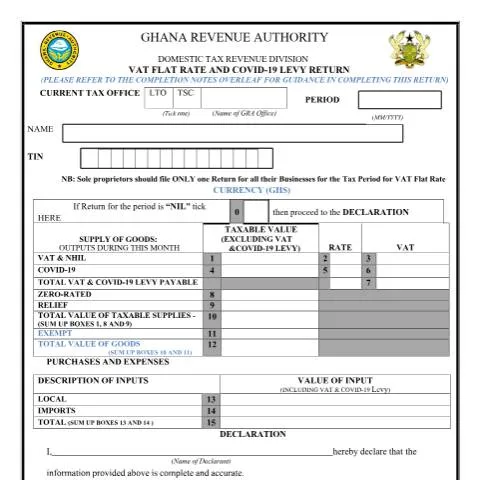
Understanding the Monthly VAT NHIL COVID-19 Flat Rate Return Form (DT-0137)
The Monthly VAT NHIL COVID-19 Flat Rate Return (DT-0137) is a crucial component for businesses operating in Ghana, particularly those that are registered under the Value Added Tax (VAT) scheme. This form is pivotal in ensuring that Ghana Revenue Authority (GRA) can accurately assess and collect taxes related to the Economic and Social impacts of the COVID-19 pandemic. By submitting this form, businesses declare their tax obligations for a specific reporting period, which is essential for maintaining compliance with tax regulations.
The Target Audience and Their Specific Contexts
Businesses are the primary audience for this tax return, particularly those engaged in the sale of goods and services that are VAT-registered. Understanding the profiles of these businesses is essential, as it influences how they complete and submit the form.
Sole Proprietors vs. Corporations
- Sole Proprietors: These individuals are required to submit only one return for all their businesses for the tax period. This simplifies compliance for individual entrepreneurs.
- Corporations: Larger entities may have multiple transactions across various sectors, necessitating a more detailed approach to complete the form accurately.
Exceptions and Special Cases
Some businesses may qualify for exemptions from certain tax obligations. Notably, businesses involved in the sale of exempt goods or services must also report information regarding these transactions. It is paramount for such businesses to understand the implications of these exemptions when completing the form.
Key Dates and Submission Timeline
Understanding the timeline for filing the Monthly VAT NHIL COVID-19 Flat Rate Return is crucial for compliance. The return must be submitted monthly, with specific due dates that businesses must adhere to.
Filing Frequency and Deadlines
- The return is due on the last working day of the month following the reporting period. For instance, the return for the month of June must be submitted by the end of July.
- Given the necessity to maintain compliance, businesses should ensure that they set reminders for these deadlines to avoid penalties.
Post-Submission Process
Once the form is submitted, businesses should maintain copies of their returns for future reference. The GRA may conduct audits, and having documentation readily available can ease the verification process.
Historical Context and Regulatory Framework
The Monthly VAT NHIL COVID-19 Flat Rate Return is situated within a larger historical and regulatory framework. The introduction of this form is tied to both the 1992 Constitution of Ghana and subsequent parliamentary enactments aimed at enhancing revenue collection during economic challenges like the COVID-19 pandemic.
Legislative Backdrop
Legislation surrounding VAT and the COVID-19 Levy reflects the government’s intention to both stimulate the economy and ensure equitable tax distribution. Understanding this backdrop can help businesses appreciate the importance of their compliance.
Integration into Broader Tax Compliance Processes
This return is not an isolated document; it plays a significant role in a series of tax compliance processes. Businesses need to be aware of how the Monthly VAT NHIL COVID-19 Flat Rate Return integrates with other tax obligations.
Linking with Other Tax Returns
- The VAT return must be aligned with income tax submissions, which means a business’s financial reporting across various tax forms must match consistently.
- While completing the Monthly VAT NHIL COVID-19 Flat Rate Return, businesses may also need to consider additional returns for other taxes, including corporate income tax.
A Step-by-Step Guide to Completing the Form
The completion of the Monthly VAT NHIL COVID-19 Flat Rate Return (DT-0137) requires careful attention to detail. Here’s a thorough breakdown of each section within the form to facilitate accurate and complete submissions.
Form Breakdown and Sections
| Box Number | Description | Common Pitfalls |
|---|---|---|
| 0 | If there were no transactions, tick the box for a 'NIL' return. | Ensure to complete the declaration even if returns are NIL. |
| 1 | Input the VAT and COVID-19 Levy exclusive value of taxable goods. | Exclude zero-rated supplies, and ensure accuracy in reported values. |
| 2 | Enter the applicable VAT rate. | Confirm the correct rate is used based on current tax legislation. |
| 3 | Calculate and enter VAT charged. | Double-check calculations to avoid underreporting. |
| 4 | Input COVID-19 Levy exclusive value of taxable goods. | Ensure it aligns with box 1, excluding zero-rated goods. |
| 5 | State the applicable COVID-19 Levy rate. | Verify current rates as they may change over time. |
| 6 | Enter the amount for COVID-19 Levy charged. | Calculate accurately based on the rate applied. |
| 7 | Total VAT and COVID-19 Levy payable. | Make sure the figures add up correctly. |
| 8 | Document the value of zero-rated supplies made during the month. | List all relevant transactions to avoid discrepancies. |
| 9 | Supplies granted authority to remit or relieve VAT & NHIL. | Ensure documentation of exemptions is available. |
| 10 | Summation of taxable supplies made during the month. | Check all sums are correctly calculated. |
| 11 | Value of exempt supplies made during the month. | Keep comprehensive records of exempt transactions. |
| 12 | Total value of all goods supplied in the month. | Total should reflect all relevant entries from boxes 10 and 11. |
| 13 | Record local purchases and expenses. | Ensure all relevant costs are captured. |
| 14 | Value of imports including VAT & COVID-19 Levy. | Include only actual imports during the month. |
| 15 | Total purchases and expenses incurred locally and imports. | Cross-check totals from boxes 13 and 14 to ensure accuracy. |
What to Do in Case of Errors or Missing Information
Despite best efforts, discrepancies may arise. Whether due to errors in data entry or omissions, knowing how to address these issues is vital for maintaining compliance.
Steps to Rectify Mistakes
- If an error is discovered after submission, businesses should immediately contact their local GRA office.
- Prepare to resubmit the form with accurate information, clearly detailing the original submission date and the corrections being made.
Missing Information Protocol
In case of missing documentation or data, businesses must ensure that they follow up promptly to gather all required information. Submitting an incomplete form may lead to penalties or additional scrutiny from GRA.
Final Thoughts on Effective Tax Compliance
Completing the Monthly VAT NHIL COVID-19 Flat Rate Return is a critical obligation for businesses in Ghana. Beyond just ticking boxes, it serves as a foundation for maintaining good standing with the tax authorities and ensuring that businesses contribute fairly to national revenue. By understanding the details of each section, adhering to timelines, and maintaining accurate records, taxpayers can navigate the complexities of tax compliance more effectively.
Ultimately, staying informed on the evolving landscape of the VAT and COVID-19 Levy regulations is paramount. Businesses must regularly consult the GRA and utilize available resources to ensure they meet their tax obligations efficiently and accurately.
Understanding the Monthly VAT NHIL COVID-19 Flat Rate Return
The Monthly VAT NHIL COVID-19 Flat Rate Return is a crucial compliance requirement for businesses operating in Ghana, especially in the wake of the economic disruptions caused by the COVID-19 pandemic. This return is designed to simplify the tax compliance process for small and medium-sized enterprises (SMEs) who are availing the flat rate scheme introduced by the Ghana Revenue Authority (GRA). Under this scheme, qualifying businesses are allowed to pay a flat percentage of their turnover as Value Added Tax (VAT) instead of the standard percentage based on actual input and output tax calculations.
To qualify for the COVID-19 flat rate, a business must have a turnover not exceeding GHS 200,000 annually. This measure aims to ease the burden on businesses during a challenging economic period. The applicable flat rate for this category of businesses is set at 3%, which is designed to help them maintain their operations while fulfilling their tax obligations. It is imperative for businesses to keep accurate records of their turnover since the VAT NHIL COVID-19 Flat Rate Return is based on the total gross revenue generated in a month.
Filing Procedure for Monthly VAT NHIL COVID-19 Flat Rate Return
Filing the Monthly VAT NHIL COVID-19 Flat Rate Return requires businesses to adhere to a structured process to ensure compliance with GRA regulations. The steps involved in filing the return are as follows:
- Register for a Tax Identification Number (TIN): Before filing, businesses must ensure they possess a valid Tax Identification Number, which can be obtained from the GRA. This TIN is critical as it links the business to its tax obligations and is required for all tax filings.
- Determine the Monthly Turnover: Businesses must document their total sales for the month accurately. This figure will serve as the basis for calculating the VAT NHIL due. It is beneficial to maintain a well-organized bookkeeping system to track sales.
- Calculate the VAT NHIL Amount: The tax liability is calculated by applying the 3% flat rate to the monthly turnover. Small businesses need to be meticulous in ensuring they apply the correct rate to avoid penalties or overpayment.
- Complete the VAT NHIL Return Form: Businesses are required to fill out the relevant VAT NHIL return forms, which may include Form One or specific GRA forms designated for flat rate taxpayers. These forms must include the TIN, turnover, and calculated VAT.
- Submit the Completed Return: The completed return must be submitted to the GRA by the 15th day of the following month. Electronic submission is encouraged, and businesses can utilize the GRA's online portal for this purpose.
- Make Payment: Alongside the submission of the return, any VAT NHIL due must be paid. This can be done through various payment channels as provided by GRA. Late payments may incur penalties.
Adhering to this filing procedure not only ensures compliance but also helps businesses avoid potential legal repercussions, including fines and interest on unpaid taxes.
Common Challenges and Solutions in Filing VAT NHIL Returns
Filing the Monthly VAT NHIL COVID-19 Flat Rate Return can present several challenges for businesses. Understanding these common pitfalls can assist taxpayers in navigating the process more effectively. Below are some frequent issues encountered by businesses along with suggested solutions:
- Lack of Proper Record-Keeping: Many SMEs struggle with maintaining adequate records of their sales. This can lead to inaccuracies in reporting turnover. Solution: Implement a simple bookkeeping system, perhaps even a spreadsheet, to track daily sales and expenses. Regular reconciliation of accounts can help ensure accuracy.
- Understanding Tax Obligations: Some business owners may not fully understand their tax obligations or the implications of the flat rate scheme. Solution: Seek advice from tax professionals or GRA representatives. The GRA offers assistance and resources to educate taxpayers on their obligations.
- Technical Difficulties with Online Filing: Businesses may face challenges submitting returns electronically due to platform issues or lack of familiarity with the online system. Solution: Allow time for troubleshooting technical issues. Familiarization with the GRA online portal can also reduce filing anxiety. GRA provides support for users facing issues.
- Changes in Tax Regulations: Frequent changes to tax laws can confuse business owners about compliance requirements. Solution: Stay informed through the official GRA website and reputable news sources. Consider subscribing to GRA newsletters or updates.
By recognizing these challenges and proactively seeking solutions, businesses can enhance their ability to file timely and accurate VAT NHIL returns.