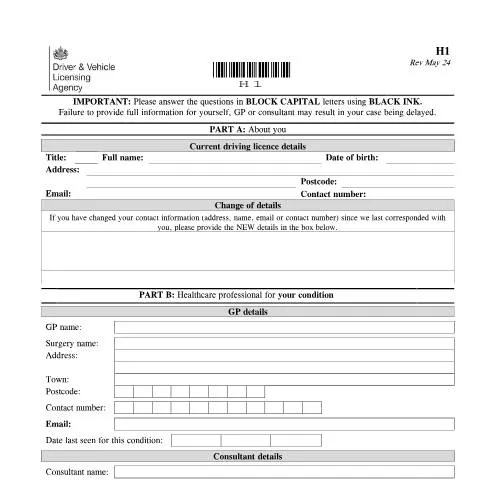
The Critical Link Between Medical Fitness and Road Safety
When a heart condition emerges or evolves in your life, the implications extend far beyond medical treatment. In the United Kingdom, form H1 serves as the essential bridge between your cardiovascular health and your legal right to drive. This medical questionnaire represents the Driver and Vehicle Licensing Agency's systematic approach to ensuring that drivers with heart conditions can maintain their independence whilst protecting public safety on British roads.
The form addresses a fundamental challenge: balancing individual mobility rights with collective road safety. Unlike routine licence renewals, the H1 process acknowledges that heart conditions exist on a spectrum – from manageable arrhythmias to complex device implantations – each requiring nuanced assessment rather than blanket restrictions.
For the estimated 7.6 million people living with heart and circulatory diseases in the UK, this form often marks a pivotal moment. It determines whether driving privileges continue uninterrupted, require temporary suspension, or need permanent modification. The stakes are particularly high for those whose livelihoods depend on driving, from delivery drivers to healthcare workers covering rural territories.
Medical Conditions That Trigger the H1 Reporting Requirement
The H1 form encompasses a comprehensive range of cardiovascular conditions, each carrying distinct implications for driving safety. Aortic aneurysms feature prominently due to their potential for sudden rupture, with the form specifically categorising aneurysms by size thresholds: under 6cm, 6cm to 6.4cm, and 6.5cm or larger. This granular approach reflects medical evidence showing that rupture risk correlates directly with aneurysm diameter.
Abnormal heart rhythms represent another critical category, encompassing conditions from common atrial fibrillation to rare but serious Brugada Syndrome. The form distinguishes between controlled arrhythmias that pose minimal driving risk and unstable rhythms that could cause sudden incapacitation behind the wheel.
| Condition Category | Key Assessment Factors | Typical Outcome Timeline |
|---|---|---|
| Aortic Stenosis | Severity grade, symptom presence | Annual review if stable |
| Heart Failure | Functional class, ejection fraction | 6-12 month assessments |
| Congenital Heart Disease | Surgical history, current function | Case-by-case evaluation |
| Heart Transplant | Recovery progress, rejection risk | Quarterly monitoring initially |
Long QT Syndrome receives particular attention due to its association with sudden cardiac death, especially in younger drivers. The form's approach recognises that genetic testing and family history often inform risk stratification beyond traditional symptom assessment.
Device-Related Considerations
The form dedicates substantial space to cardiac devices, reflecting their growing prevalence in modern cardiology. Pacemakers are distinguished from Implantable Cardioverter Defibrillators (ICDs), acknowledging their different risk profiles for drivers. While pacemaker recipients may continue driving almost immediately after implantation, ICD patients face more complex restrictions due to the device's shock capability.
Cardiac Resynchronisation Therapy devices (CRT-P and CRT-D) receive specific mention, recognising their dual function in treating heart failure whilst potentially affecting driving eligibility. Ventricular Assist Devices (VADs) represent the most complex category, with their mechanical nature and surgical requirements typically necessitating extended driving restrictions.
Navigating the Healthcare Professional Network
The H1 form's structure reveals the DVLA's recognition that heart conditions require input from multiple healthcare professionals. Part B systematically captures details from both GPs and specialist consultants, acknowledging their complementary roles in comprehensive cardiac care.
Your GP often provides the longitudinal perspective – how your condition has evolved over months or years, medication adjustments, and day-to-day functional impact. Consultant cardiologists contribute specialised insights into complex procedures, device function, and prognosis that general practitioners may not possess.
The form requests specific contact dates, recognising that cardiac conditions can change rapidly. A patient seen six months ago for stable angina might have experienced a heart attack since that consultation, fundamentally altering their driving risk profile. This temporal precision enables DVLA medical advisors to request the most current information when making licensing decisions.
Coordination Challenges and Solutions
Many applicants struggle with coordinating information between healthcare providers. Shared care arrangements – where GPs manage routine monitoring whilst consultants oversee complex interventions – can create information gaps. The form's dual healthcare professional structure helps identify these gaps before they delay processing.
Private healthcare adds another layer of complexity. Patients receiving treatment through private consultants must ensure their NHS GP remains informed, as DVLA medical staff typically contact NHS providers for additional information. The form's email fields reflect modern communication preferences, though telephone contact remains the DVLA's preferred method for urgent clarifications.
Symptom Assessment and Driving Safety Implications
Question 2 addresses the critical intersection between symptoms and driving safety. Shortness of breath, chest pains, and palpitations aren't merely medical curiosities – they represent potential driving hazards that could manifest suddenly while operating a vehicle.
The form's approach recognises that symptom severity varies dramatically between individuals. One person's "mild chest discomfort" might be another's incapacitating angina. By asking whether healthcare professionals have specifically advised stopping driving, the form captures clinical judgement that transcends standardised symptom descriptions.
Sudden incapacitation events receive particular scrutiny through Question 3. The 12-month timeframe reflects medical evidence about recurrence patterns and the effectiveness of interventions. A single syncopal episode might represent a one-off event or herald an unstable cardiac condition requiring immediate driving cessation.
The Critical Nature of Honest Reporting
The form's emphasis on recent symptoms acknowledges a common challenge: patients may minimise or forget episodes they consider minor. However, what seems insignificant to a patient – a brief dizzy spell, momentary chest tightness – could indicate serious underlying instability requiring immediate evaluation.
Date precision for blackout episodes serves multiple purposes. It helps medical advisors correlate events with medication changes, procedures, or disease progression. It also establishes whether sufficient time has elapsed since the last episode to consider the condition stable for driving purposes.
Pacemaker Protocols and Ongoing Responsibilities
The pacemaker section illustrates the DVLA's sophisticated understanding of cardiac devices. By distinguishing pacemakers from ICDs, the form acknowledges their different indications and risk profiles. Pacemakers fitted for bradycardia (slow heart rhythms) typically pose minimal ongoing driving risk once properly functioning.
However, pacemakers implanted specifically to prevent fainting episodes require more careful evaluation. The form's follow-up questions assess whether the device has successfully controlled symptoms that originally posed driving risks. A pacemaker that fails to prevent syncopal episodes may actually indicate worsening underlying disease requiring driving restriction.
The pacemaker declaration represents a contractual commitment between driver and state. By signing, applicants acknowledge ongoing responsibilities that extend beyond the initial assessment. This includes attending regular device checks, following medical advice, and reporting any breakthrough symptoms.
| Pacemaker Indication | Typical Driving Restriction | Ongoing Monitoring |
|---|---|---|
| Bradycardia (slow rhythm) | 1 week post-implant | Annual device checks |
| Heart block | 1 week post-implant | 6-monthly reviews |
| Syncope prevention | 4-6 weeks assessment | Quarterly monitoring initially |
Device Technology and Driving Implications
Modern pacemaker technology includes features like rate-responsive pacing and remote monitoring that can affect driving assessments. The form's questions about device function acknowledge that not all pacemakers are equivalent – newer devices with sophisticated algorithms may provide better symptom control and thus safer driving profiles.
Processing Timelines and Medical Review Procedures
Question 5's focus on consultation dates reflects the DVLA's systematic approach to gathering current medical information. Recent contact dates help medical advisors understand how actively a condition is being monitored and whether sufficient current information exists for decision-making.
The distinction between GP and consultant contacts recognises different monitoring patterns. Patients with stable conditions might see their GP quarterly but their cardiologist annually. Conversely, those with complex or unstable conditions might have frequent specialist contact but infrequent GP visits.
Future appointment dates provide insight into anticipated disease trajectory and monitoring intensity. A patient with appointments scheduled months in advance suggests stable disease, whilst urgent follow-up appointments might indicate concerning developments requiring immediate DVLA attention.
The Medical Advisory Process
Once submitted, the H1 form initiates a structured medical review process. DVLA medical advisors – qualified doctors with expertise in fitness to drive assessments – evaluate applications against established medical standards. These standards, regularly updated based on emerging evidence, balance driving privilege with public safety considerations.
The review process may trigger additional information requests. Healthcare providers might receive detailed questionnaires about specific aspects of a patient's condition. In complex cases, independent medical examinations or specialist reports might be commissioned to ensure comprehensive assessment.
Authorisation Requirements and Legal Framework
The applicant authorisation section represents more than administrative formality – it establishes legal consent for the DVLA to access medical information necessary for licensing decisions. This consent framework operates within the Data Protection Act 2018 and UK GDPR, ensuring that medical information sharing serves legitimate public safety interests whilst respecting individual privacy rights.
The authorisation extends beyond the immediate application. It permits ongoing medical information requests throughout the licence validity period, acknowledging that heart conditions can evolve and require reassessment. This ongoing consent proves crucial when conditions deteriorate or new symptoms emerge requiring updated medical input.
Healthcare providers rely on this authorisation when responding to DVLA requests. Without valid consent, medical professionals cannot legally share patient information, potentially leading to licence suspension until proper authorisation is obtained. The form's emphasis on completing this section without alteration reflects its legal significance in enabling the entire assessment process.
Information Sharing Protocols
The authorisation framework enables structured information sharing between the DVLA and healthcare providers whilst maintaining appropriate safeguards. Medical information shared for driving assessments is used solely for licensing purposes and subject to strict confidentiality requirements.
Healthcare providers receive clear guidance about information sharing scope and limitations. They can share clinical information relevant to driving safety whilst maintaining patient confidentiality for unrelated medical matters. This balanced approach ensures comprehensive safety assessment without unnecessary privacy intrusion.
Medical Evidence Requirements and Documentation Standards
The H1 form requires comprehensive medical evidence to substantiate your condition report, with specific documentation standards that vary according to the nature and severity of your health circumstances. The Department for Work and Pensions employs qualified healthcare professionals to assess submissions, making the quality and completeness of your medical evidence crucial to the outcome.
For mental health conditions, acceptable evidence includes consultant psychiatrist reports, clinical psychologist assessments, community psychiatric nurse notes, and discharge summaries from mental health services. The documentation must detail your diagnosis using recognised classification systems such as ICD-10 or DSM-5, treatment history, medication regimens, and functional limitations in daily activities. Reports from your GP alone may be insufficient for complex mental health conditions requiring specialist intervention.
Physical health conditions demand equally rigorous documentation. Hospital discharge summaries, consultant specialist reports, diagnostic imaging results (X-rays, MRI, CT scans), laboratory test results, and physiotherapy assessments all constitute valuable evidence. For degenerative conditions like arthritis or multiple sclerosis, progressive medical records spanning several months or years demonstrate the condition's impact over time, which assessors find particularly compelling.
The timing of medical evidence significantly affects your claim's strength. Reports dated within three months of your H1 submission carry the most weight, though older documentation remains relevant if it establishes the condition's onset or progression. If your condition fluctuates, such as with fibromyalgia or chronic fatigue syndrome, diary entries or self-monitoring records spanning several weeks can provide valuable context alongside professional medical opinions.
When requesting medical evidence from healthcare providers, be specific about what information you need. Many practitioners are familiar with disability benefit requirements and can tailor their reports accordingly. Some may charge for detailed reports—fees typically range from £30 to £150 depending on complexity—but this investment often proves worthwhile for comprehensive claims. NHS healthcare providers cannot charge for basic medical records, though administrative fees may apply for extensive documentation requests.
If you lack recent medical evidence, consider requesting a review appointment with your GP or relevant specialist before submitting your H1 form. This ensures your documentation reflects your current condition accurately and provides an opportunity to discuss how your health affects your daily functioning and work capacity.
Common Pitfalls and How to Avoid Assessment Delays
The H1 form assessment process can extend significantly when common errors or omissions occur, with some applications requiring additional information requests that add weeks or months to processing times. Understanding these frequent pitfalls helps ensure your initial submission meets assessment standards and avoids unnecessary delays.
Incomplete functional impact descriptions represent the most prevalent error in H1 submissions. Many applicants focus heavily on their medical diagnosis while providing insufficient detail about how their condition affects specific daily activities. Assessors need concrete examples: rather than stating "I have difficulty walking," describe "I can walk approximately 50 metres on flat ground before experiencing severe pain, requiring a 10-minute rest, and cannot manage stairs without using handrails and taking frequent breaks."
Medication side effects often receive inadequate attention in applications, despite their significant impact on functional capacity. Drowsiness from pain medications, cognitive effects from psychiatric drugs, or gastrointestinal issues from treatments can substantially limit your abilities. Document these effects with specific examples and timing—for instance, morning drowsiness from evening medication that affects your ability to operate machinery safely or concentrate during early working hours.
Fluctuating conditions present particular challenges in H1 applications. Conditions like multiple sclerosis, rheumatoid arthritis, or bipolar disorder vary significantly between good and bad days, making consistent functional assessment difficult. Address this by describing your typical week, including both better and worse days, and explain how unpredictability itself creates limitations. For example, unreliable symptoms may prevent you from committing to regular employment even when you feel relatively well.
Employment history sections frequently contain gaps or inconsistencies that raise questions during assessment. Be transparent about periods of unemployment, reduced hours, or job changes related to your health condition. If you left employment due to your condition, explain the specific circumstances and any adjustments your employer attempted. This information helps assessors understand your condition's workplace impact and progression over time.
Supporting evidence timing misalignment creates unnecessary complications. Ensure your H1 form narrative aligns with the dates and descriptions in your medical evidence. If your condition has worsened since your last medical appointment, acknowledge this explicitly and consider obtaining updated medical opinion before submission.
Contact information accuracy seems basic but frequently causes delays. Incorrect phone numbers, outdated addresses, or failure to notify changes during processing can interrupt communication and extend assessment times. Provide multiple contact methods where possible and inform the relevant office immediately if your circumstances change after submission.
Understanding the Assessment Process and Decision-Making Criteria
The H1 form assessment follows a structured evaluation process involving multiple stages and different healthcare professionals, each applying specific criteria to determine your eligibility for health-related benefits or adjustments. Understanding this process helps set realistic expectations and enables you to present your case more effectively.
Initial administrative screening occurs within the first few weeks of submission, where clerical staff verify completeness and request any obviously missing information. This stage focuses on procedural requirements rather than medical assessment—ensuring all sections are completed, required signatures are present, and basic eligibility criteria are met. Applications failing this initial check receive requests for additional information, extending processing times by several weeks.
Medical assessment represents the core evaluation stage, conducted by healthcare professionals employed by or contracted to the relevant government department. These assessors—typically doctors, nurses, or occupational therapists—review your medical evidence against established functional criteria. They're not making new diagnoses but rather evaluating how your documented conditions affect your capacity for work or daily activities.
The assessment criteria focus on functional limitations rather than medical labels. Assessors consider mobility, manual dexterity, speech, hearing, vision, continence, consciousness, and mental health factors. For each area, they evaluate whether you can perform relevant activities reliably, repeatedly, and safely. "Reliably" means you can complete the activity when needed; "repeatedly" indicates you can sustain the activity throughout a typical day; "safely" ensures you won't risk harm to yourself or others.
Decision-making timeframes vary considerably depending on case complexity and current caseloads. Straightforward cases with clear medical evidence might receive decisions within 6-8 weeks, while complex cases requiring additional medical opinions or occupational health assessments can take 3-4 months or longer. Cases involving rare conditions or unusual circumstances may require specialist medical input, further extending processing times.
Quality assurance processes include random case reviews and appeals consideration procedures. If your application is refused, you typically have one month to request reconsideration, during which a different assessor reviews your case. This mandatory reconsideration often focuses on whether the original decision correctly applied assessment criteria to your evidence rather than gathering new information.
Communication during assessment varies by department and case complexity. Some applicants receive regular updates, while others hear nothing until the final decision. You can contact the relevant office for updates, though frequent inquiries may not expedite processing. Keep records of all communication, including reference numbers and staff names, as this information proves valuable if problems arise or appeals become necessary.