When Diabetes Meets the Road: Understanding DVLA's VDIAB1I Medical Declaration
The diagnosis of diabetes fundamentally alters your relationship with driving in the UK. Whether you've been managing the condition for years or received a recent diagnosis, the VDIAB1I form represents a crucial checkpoint in maintaining your legal right to drive. This isn't merely bureaucratic paperwork – it's a comprehensive medical assessment that determines whether you can safely operate a vehicle whilst managing diabetes, particularly when insulin treatment is involved.
The Driver and Vehicle Licensing Agency requires this detailed medical report whenever diabetes affects your driving capability, with particular scrutiny for those on insulin therapy. The form's nine pages probe deep into your glucose management routines, hypoglycaemic episodes, and overall medical supervision. For many drivers, completing this declaration marks the difference between retaining their licence and facing potential driving restrictions or revocation.
Decoding the Medical Requirements: Who Must Submit VDIAB1I
The obligation to complete form VDIAB1I isn't universal among diabetic drivers – it depends critically on your treatment regime and driving category. Insulin-treated diabetics face the strictest requirements, as insulin therapy significantly increases hypoglycaemia risk, potentially compromising road safety.
If you hold a Group 1 licence (cars and motorcycles), you must notify DVLA immediately upon starting insulin treatment. The VDIAB1I form becomes your vehicle for demonstrating continued fitness to drive. However, the stakes escalate dramatically for Group 2 licence holders (lorries, buses, and passenger-carrying vehicles), where insulin treatment typically results in automatic licence revocation, with limited exceptions for those meeting stringent medical criteria.
Beyond insulin users, certain diabetic drivers may require VDIAB1I submission following:
- Severe hypoglycaemic episodes requiring third-party assistance
- Development of diabetic retinopathy affecting vision
- Diabetic complications impacting limb function or vehicle control
- Significant changes in treatment regimen or medical supervision
The form also applies when DVLA medical advisers request updated information during licence renewal or following incident reports. Some drivers discover this requirement only after traffic incidents where diabetes becomes a contributing factor.
Navigating Part A: Personal Details and Contact Updates
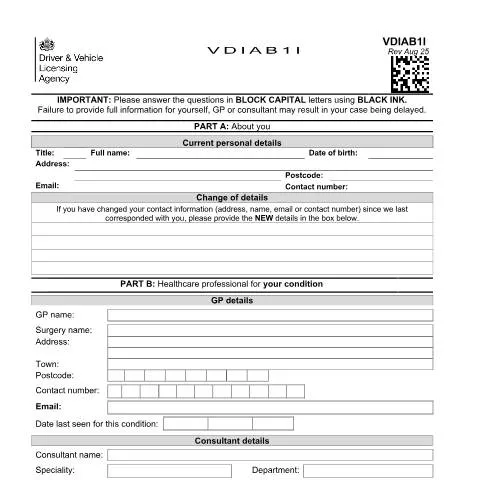
Part A appears straightforward but contains several pitfalls that can delay processing. The requirement for BLOCK CAPITAL letters in BLACK INK isn't mere preference – forms completed in other colours or scripts may be returned unprocessed. This seemingly minor detail reflects DVLA's automated processing systems, where optical character recognition requires specific formatting.
The change of details section proves crucial for maintaining communication continuity. Many applicants overlook this box, assuming DVLA automatically updates from other government databases. However, medical licensing operates independently, and outdated contact information frequently causes significant delays in licence decisions.
Pay particular attention to email addresses – DVLA increasingly communicates electronically, and an incorrect email can mean missing critical correspondence about your licence status. Mobile phone numbers should include the full UK format, as automated systems may struggle with abbreviated entries.
Medical Professional Coordination: Part B's Critical Healthcare Links
Part B establishes the medical oversight framework essential for diabetes licensing decisions. The dual requirement for both GP and consultant details reflects the complexity of diabetes management, where primary care provides ongoing monitoring whilst specialist care addresses complications.
GP information must be current and complete. Surgery mergers, practice relocations, or GP retirements can invalidate provided details, potentially halting your application. The 'date last seen' field requires precision – DVLA medical advisers use this to assess the recency of medical oversight and may request more recent consultations if gaps appear excessive.
Consultant details prove particularly challenging for many applicants. Some diabetic drivers receive care from diabetes specialist nurses rather than consultant physicians, creating confusion about which professional to cite. In such cases, list the consultant who maintains overall medical responsibility, even if day-to-day care comes from other healthcare professionals.
Hospital contact information must include direct department numbers rather than main switchboard numbers. DVLA medical staff need efficient communication channels for verification purposes, and generic hospital numbers often create frustrating delays.
Glucose Management Under Scrutiny: Questions 1-5 Dissected
The insulin treatment question immediately stratifies applicants into different risk categories. Insulin dependency fundamentally alters DVLA's assessment criteria, triggering enhanced monitoring requirements and potential licence restrictions. The start date of insulin treatment becomes crucial for determining the timeline of required medical reviews.
Glucose monitoring questions probe the sophistication of your self-management regime. Continuous Glucose Monitors (CGMs) receive favourable consideration compared to traditional finger-prick testing alone, as they provide more comprehensive glucose trend information. However, DVLA explicitly warns against sending monitoring devices – they require documentary evidence, not physical equipment.
The twice-daily checking requirement establishes minimum monitoring standards for licence retention. Drivers who cannot demonstrate consistent glucose monitoring face licence restrictions or revocation. This isn't merely about occasional checks – DVLA requires evidence of systematic, routine monitoring that enables proactive hypoglycaemia prevention.
| Monitoring Method | DVLA Preference | Documentation Required |
|---|---|---|
| CGM with smartphone app | Highly favourable | Downloaded glucose reports for 4 weeks |
| Traditional glucose meter | Acceptable with proper records | Written logbook or meter memory printout |
| Intermittent checking only | Insufficient for licensing | N/A - licence restrictions likely |
Question 4's driving-specific monitoring requirements reflect real-world safety considerations. The mandate to check glucose before driving and every two hours during extended journeys acknowledges that hypoglycaemia risk increases during prolonged concentration demands. Many drivers underestimate these requirements, assuming general glucose control suffices for driving safety.
Hypoglycaemia Recognition and Management: The Safety Framework
Questions 6-9 form the core safety assessment, evaluating your ability to recognise and respond to hypoglycaemic episodes. Hypoglycaemia awareness represents the single most critical factor in diabetes driving safety – drivers who cannot reliably detect low blood glucose pose significant risks to themselves and other road users.
The warning signs table provided in the form isn't merely informational – it establishes the knowledge baseline DVLA expects from licensed diabetic drivers. Understanding that early symptoms like sweating, shakiness, and hunger can progress to confusion, slurred speech, and unconsciousness demonstrates the medical awareness necessary for safe driving.
Severe hypoglycaemic episodes requiring third-party assistance trigger intensive scrutiny. The form's definition explicitly excludes episodes where help was available but not necessary – this distinction recognises that some diabetic drivers request assistance as a precaution rather than from actual incapacitation.
The awareness scale (1-7) provides nuanced assessment of hypoglycaemia recognition capability. Drivers rating themselves at the lower end face potential licence restrictions, as reduced awareness correlates with increased accident risk. This self-assessment carries significant weight in DVLA's final determination.
Emergency carbohydrate availability while driving isn't optional – it's a licensing requirement. Glucose tablets, drinks, or sweets must be within easy reach, acknowledging that hypoglycaemia can develop rapidly during driving. The specific mention of "fast-acting carbohydrate" reflects medical evidence about optimal treatment approaches.
Vision and Physical Capability Assessment: Beyond Glucose Control
Diabetic retinopathy questions address a frequently overlooked complication that can independently affect driving capability. Retinopathy treatment history – including laser therapy, injections, or surgery – provides DVLA medical advisers with crucial information about vision stability and future risk.
The treatment date requirement enables assessment of recovery time and treatment effectiveness. Recent retinopathy interventions may necessitate temporary driving restrictions until visual acuity stabilises. Some drivers assume successful treatment eliminates concerns, but DVLA requires ongoing monitoring evidence.
Physical capability questions in Question 12 address diabetic complications affecting limb function, particularly diabetic neuropathy or peripheral vascular disease. These complications can impair pedal control, steering precision, or emergency response capability, potentially requiring vehicle modifications or driving restrictions.
Vehicle modification requirements vary significantly between licence categories. Car modifications might include adapted pedals, steering aids, or enhanced mirrors, whilst motorcycle adaptations focus on balance, braking, and control accessibility. The specific modification codes listed in the form correspond to official DVLA categories used in licence endorsements.
Automatic Transmission Requirements and Group 2 Declarations
Question 13's automatic transmission inquiry identifies drivers whose diabetic complications preclude manual gearbox operation. This isn't about preference – DVLA distinguishes between voluntary automatic driving and medical necessity. Drivers with diabetic neuropathy affecting leg function may require automatic-only restrictions to maintain safe vehicle control.
The distinction becomes crucial for professional drivers, where automatic-only restrictions may limit employment opportunities. Bus and lorry drivers face particular challenges, as many commercial vehicles retain manual transmissions, and automatic-only restrictions can effectively end professional driving careers.
For Group 2 licence holders, the declaration section imposes stringent ongoing obligations beyond the initial application. The requirement to "comply with directions of the doctor or consultant" creates legal obligations for continued medical supervision. Failure to maintain regular medical contact can result in licence revocation.
The immediate reporting requirement for "significant changes" places ongoing responsibility on drivers to monitor their condition and communicate with DVLA. This includes changes in treatment, new complications, or altered medical supervision arrangements. The legal framework makes drivers active participants in their ongoing fitness assessment.
Submission Process and Medical Evidence Coordination
Form VDIAB1I represents only one component of a comprehensive medical assessment process. DVLA typically requires supporting evidence from your healthcare providers, potentially including recent HbA1c results, glucose monitoring data, and consultant reports. Coordinating this evidence collection often proves more complex than completing the form itself.
Processing times vary significantly based on medical complexity and evidence availability. Simple cases with straightforward insulin treatment and good glucose control may resolve within 6-8 weeks, whilst complex cases involving complications or recent treatment changes can extend to several months.
During processing, your current licence typically remains valid unless DVLA identifies immediate safety concerns. However, you bear legal responsibility for continued fitness to drive, and must cease driving if your medical condition deteriorates while awaiting DVLA's decision.
The form's revision dates (August 2025, November 2025) indicate ongoing updates to reflect evolving medical understanding and treatment approaches. Using outdated versions can cause processing delays, as medical criteria and evidence requirements change periodically to incorporate new clinical guidance.
Medical Evidence Requirements and Supporting Documentation
When completing form VDIAB1I, providing comprehensive medical evidence stands as one of the most critical aspects of your application. The DVLA requires specific types of documentation to assess your fitness to drive, and understanding these requirements can significantly impact the processing time and outcome of your case.
Your primary medical evidence should come from your diabetes specialist or consultant endocrinologist. A detailed report from your specialist must cover your current treatment regimen, including specific medications, dosages, and any recent changes to your therapy. The DVLA particularly values reports that include your most recent HbA1c levels, typically from the past three months, as these provide crucial insight into your long-term glucose control.
Hospital discharge summaries following any diabetes-related admissions carry considerable weight in the assessment process. If you've experienced diabetic ketoacidosis, severe hypoglycaemia requiring third-party assistance, or any diabetes-related complications affecting your vision or circulation, these episodes must be thoroughly documented. The DVLA medical team examines the frequency, severity, and circumstances of such incidents when determining your driving eligibility.
For drivers using continuous glucose monitoring systems or insulin pumps, technical data from these devices may be requested. Download reports showing glucose patterns, alarm histories, and device reliability over extended periods. Some applicants find it beneficial to include explanatory notes about how they respond to alerts and manage their condition using these technologies, though this should complement rather than replace formal medical reports.
Vision screening results become particularly important for diabetic drivers, as retinopathy can affect driving safety. Recent ophthalmological assessments, including detailed fundus photography results and visual field tests, should be included when relevant. If you've undergone laser treatment or other interventions for diabetic retinopathy, provide comprehensive records of these procedures and their outcomes.
Podiatry reports may be necessary if you've experienced diabetic foot complications that could affect your ability to operate vehicle controls safely. Similarly, if peripheral neuropathy affects your hands or feet, neurological assessments documenting the extent and progression of nerve damage will be required.
When gathering medical evidence, ensure all documents are recent, ideally within the past three to six months. Older reports may be acceptable for establishing your medical history, but current assessments carry more weight in licensing decisions. Always request that your healthcare providers use their official letterhead and include their professional registration numbers, as this adds credibility to the documentation.
Impact on Different Vehicle Categories and Commercial Driving
The implications of reporting diabetes on form VDIAB1I vary dramatically depending on your current licence categories and professional driving requirements. Understanding these distinctions helps you prepare for the specific assessments and potential restrictions that may apply to your situation.
For standard car and motorcycle licences (Groups 1 and 2 categories), the DVLA applies different standards based on your treatment type. Drivers managing diabetes through diet alone typically face the least restrictive requirements, often retaining their full driving privileges with periodic medical reviews. However, you must still report significant changes in your condition, such as the introduction of medication or the development of complications.
Insulin-treated drivers face more stringent requirements, particularly regarding hypoglycaemia awareness and blood glucose monitoring. The DVLA may require evidence of regular blood glucose testing, typically before driving and at intervals during longer journeys. Some insulin users receive licences valid for shorter periods, commonly one to three years, necessitating more frequent medical assessments.
Commercial drivers holding Large Goods Vehicle (LGV) or Passenger Carrying Vehicle (PCV) licences encounter the most restrictive standards. Insulin treatment typically disqualifies drivers from holding vocational licences, though exceptional cases may be considered under the DVLA's Individual Assessment Scheme. This scheme requires extensive medical evidence, including specialist reports, glucose monitoring records, and sometimes practical driving assessments.
Professional drivers whose livelihoods depend on their licences should consider the timing of their VDIAB1I submission carefully. If your condition is well-controlled and stable, gathering comprehensive medical evidence before submitting the form may expedite the decision process. However, delaying reporting beyond the three-month requirement period carries legal consequences.
Taxi and private hire vehicle drivers face additional complications, as local licensing authorities may impose their own medical standards beyond DVLA requirements. Some councils require more frequent medical examinations or additional certifications for diabetic drivers. Check with your local licensing authority about their specific policies, as these can vary significantly between different areas.
Drivers engaged in emergency services, including ambulance drivers, police response drivers, and fire service personnel, may face organisational policies that exceed standard DVLA requirements. These employers often have occupational health departments that conduct their own fitness assessments, which may be more restrictive than general driving licence standards.
For drivers considering transitioning between licence categories, such as upgrading from a standard licence to an LGV licence, diabetes disclosure becomes particularly complex. The medical standards for higher categories are more stringent, and what may be acceptable for a Group 1 licence might not meet Group 2 requirements. Planning such transitions requires careful consideration of your current diabetes management and potential future changes in your condition.
Common Challenges and Resolution Strategies
Navigating the VDIAB1I process often presents unexpected challenges that can delay decisions or create additional complications. Understanding these common issues and their solutions can help you avoid potential pitfalls and ensure smoother processing of your application.
Medical information discrepancies represent one of the most frequent complications. Sometimes, different healthcare providers may have conflicting information about your diagnosis dates, treatment history, or complication status. Before submitting form VDIAB1I, review your medical records across different providers to identify any inconsistencies. If discrepancies exist, request clarification from your primary diabetes care team and ensure all providers have updated, consistent information.
Incomplete or outdated medical evidence frequently causes processing delays. The DVLA medical team may request additional information if your submitted documentation lacks crucial details or appears outdated. To avoid this, contact your diabetes care team well in advance of submitting your form, explaining exactly what information the DVLA requires. Many specialists are familiar with DVLA requirements and can provide appropriately detailed reports.
Communication gaps between different medical specialties can create confusion in your case. If you receive care from multiple providers – perhaps an endocrinologist, ophthalmologist, and podiatrist – ensure each specialist is aware of your DVLA application. Sometimes, coordination between these providers helps create a more comprehensive picture of your overall health status.
Technology-related challenges increasingly affect diabetic drivers using modern glucose monitoring systems. If you use a continuous glucose monitor or insulin pump, technical malfunctions or data gaps might be misinterpreted by DVLA assessors. Maintain detailed logs of any device issues, including how you managed your diabetes during these periods. This documentation demonstrates your ability to safely manage your condition even when technology fails.
Language and terminology barriers can complicate the process, particularly if your medical records contain technical terms or abbreviations that may be misunderstood. Consider requesting that your healthcare providers explain complex medical terminology in plain English when preparing reports for the DVLA. This approach reduces the risk of misinterpretation and ensures clearer communication.
Timing conflicts between medical appointments and DVLA requirements sometimes create pressure to submit incomplete applications. If you cannot obtain all necessary medical evidence within the required timeframe, contact the DVLA to explain your situation. They may provide guidance on submitting partial information while awaiting additional documentation, though this should not become a routine practice.
Appeals and reconsideration processes, while not frequently needed, require specific approaches when diabetes-related driving decisions seem inappropriate. If you disagree with a DVLA decision, gather additional medical evidence that directly addresses their stated concerns. Independent medical assessments from recognised diabetes specialists can provide valuable second opinions, though these assessments must meet DVLA standards and requirements.
Insurance implications following DVLA decisions sometimes create secondary complications. If your licence is modified or restricted, inform your insurance provider immediately, as failure to disclose these changes can invalidate your coverage. Some insurers offer specialist policies for drivers with medical conditions, though premiums may vary based on your specific restrictions or requirements.
Record-keeping challenges affect many applicants, particularly those with long diabetes histories spanning multiple healthcare providers. Develop a comprehensive personal medical file containing copies of all relevant reports, test results, and correspondence. This file becomes invaluable if the DVLA requests additional historical information or if you need to reference previous assessments during future reviews.