Reclaiming Your Vehicle's Historical Identity: When Original Registration Numbers Matter
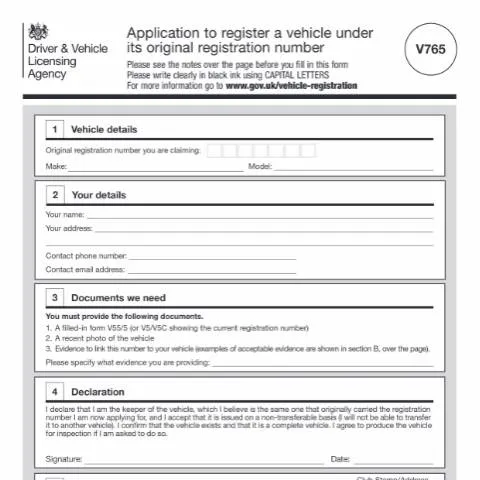
The DVLA form V765 serves a highly specific purpose in the UK vehicle registration system: it enables vehicle owners to restore their car or motorcycle to its original registration number when that number has been lost, replaced, or superseded over the years. This process, known as registering under the original registration number, represents more than mere administrative housekeeping—it's often about preserving historical authenticity, maintaining provenance for classic vehicles, or correcting registration anomalies that occurred decades ago.
Unlike standard vehicle registration procedures, the V765 application addresses situations where a vehicle's current registration differs from the number it carried when first registered with the DVLA or its predecessor authorities. This might occur when age-related registration numbers were assigned later, when vehicles were re-registered after periods off the road, or when administrative errors led to incorrect number assignments. The form essentially allows vehicle keepers to turn back the clock administratively, restoring the registration that reflects their vehicle's true manufacturing heritage.
The Vehicle Owners Club Gateway: Who Can Access This Process
Form V765 operates within a unique framework that distinguishes it from other DVLA applications: it requires involvement from recognised Vehicle Owners Clubs. This isn't merely bureaucratic procedure—it reflects the DVLA's recognition that these specialist organisations possess the expertise and resources necessary to authenticate historical vehicle details and verify original registration claims.
The eligible applicant profile is quite specific. You must be the current registered keeper of the vehicle in question, and your vehicle must fall into one of two categories:
- Never been registered at the DVLA: Vehicles that predate DVLA registration systems or were somehow missed during historical registration processes
- Currently registered under an age-related registration number: Vehicles that received generic age-related plates (typically Q-prefix numbers) when their original registration couldn't be verified at the time
The club involvement requirement means you cannot simply download this form and submit it independently. Instead, you must work through an appropriate Vehicle Owners Club that specialises in your particular make, model, or vehicle type. These clubs maintain lists with the DVLA and have established procedures for handling V765 applications, including the authority to certify supporting documentation.
Club Authentication Process
Vehicle Owners Clubs don't simply rubber-stamp applications. The form includes a dedicated section (Section 5) where club representatives must record their inspection findings, including the year of manufacture verification and whether they recommend acceptance or refusal of the application. This creates a dual verification system—the applicant provides evidence, and the specialist club validates that evidence before forwarding the application to the DVLA.
Documentary Evidence: Building Your Case for Original Registration
The success of a V765 application hinges entirely on the quality and authenticity of supporting evidence. Section 3 of the form outlines three mandatory document categories, but the real complexity lies in understanding what constitutes acceptable proof for each category.
| Document Type | Purpose | Examples |
|---|---|---|
| Filled-in V55/5 or V5C | Current registration status | Current log book showing existing registration number |
| Recent vehicle photograph | Visual verification | Clear image showing current condition and identifying features |
| Original registration evidence | Historical proof of first registration | RF60/VE60 log books, archive records, chassis documentation |
The third category—evidence linking your vehicle to its original registration number—represents the most challenging aspect of most applications. The DVLA accepts several forms of historical documentation:
Primary Historical Evidence
Original style log books (RF60/VE60): These pre-computerisation documents, used before the current V5C system, provide the strongest evidence when they clearly link the chassis number to the original registration. However, many of these documents have been lost over decades of ownership changes.
Archive and library records: Professional automotive archives, manufacturer records, or library collections sometimes contain registration details from official sources. The key requirement is that the archivist must clearly document where the information was sourced and verify its authenticity.
Post-1983 Documentary Evidence
For vehicles manufactured after 1983, the DVLA requires documentary evidence that links the chassis number directly to the registration number. This might include manufacturer build records, first registration certificates, or continuous ownership documentation that bridges any gaps in the registration history.
Importantly, the form warns against using evidence from clubs involved in countersigning the application—this prevents conflicts of interest and ensures independent verification of historical claims.
Navigating the Application Mechanics: From Completion to Submission
Completing form V765 requires precision and attention to detail, particularly given the historical nature of the information involved. The form's structure reflects the complexity of the process, with each section building upon the previous one to create a comprehensive application file.
Vehicle Details Section
Section 1 requires the original registration number you are claiming—not your current registration. This distinction is crucial, as confusion here can lead to application rejection. The make and model fields should reflect the vehicle's original specification, which may differ from current configurations if modifications have occurred over time.
Personal Information and Contact Details
Section 2 captures standard applicant information, but the contact details carry particular importance for V765 applications. The DVLA may need to request additional evidence or clarification during processing, and delays in communication can significantly extend processing times. Email addresses are especially valuable for quick clarification requests.
The Declaration's Legal Weight
Section 4's declaration carries significant legal implications. By signing, you confirm several critical points:
- You are the vehicle's registered keeper
- You're applying for the same vehicle that originally carried the registration
- The application is issued on a non-transferable basis
- You cannot transfer this number to another vehicle
- You agree to produce the vehicle for inspection if requested
This last point deserves emphasis—the DVLA reserves the right to physically inspect vehicles as part of the verification process, particularly for high-value registrations or when documentation raises questions.
Processing Pathways: From Club Approval to DVLA Decision
The V765 process follows a distinctive dual-authority pathway that sets it apart from standard DVLA applications. Understanding this process helps applicants manage expectations and prepare for potential complications.
Initial Club Assessment
Once you complete the form and gather supporting evidence, your chosen Vehicle Owners Club conducts its own assessment. This isn't a formality—clubs can and do refuse to support applications when evidence appears insufficient or questionable. The club's reputation with the DVLA depends on the quality of applications they forward, creating a strong incentive for thorough vetting.
During this phase, clubs may request additional evidence, suggest alternative documentation sources, or recommend postponing the application until stronger evidence becomes available. Some clubs charge fees for this service, though you shouldn't need to join the club merely to access V765 support.
DVLA Processing Timeline
Once the club forwards your application with supporting documentation, the DVLA aims to process V765 applications within six weeks. However, the guidance specifically notes that processing may take longer "before making enquiries," suggesting that complex cases or those requiring additional verification can extend well beyond this timeframe.
During processing, the DVLA may:
- Request additional evidence or clarification
- Contact the supporting club for further information
- Arrange a physical vehicle inspection
- Consult historical records or specialist databases
Understanding Approval Outcomes and Registration Restrictions
Successful V765 applications result in the issue of a new V5C (log book) showing the original registration number, but this outcome comes with specific restrictions and responsibilities that differ from standard vehicle registrations.
Non-Transferable Status
Perhaps the most significant restriction is that registration numbers obtained through V765 applications cannot be transferred to other vehicles. This number becomes permanently linked to your specific vehicle, reflecting the DVLA's position that original registrations represent historical authenticity rather than transferable assets.
This restriction has important implications for vehicle owners who might later consider selling their vehicle or transferring the registration for personal reasons. Unlike standard personalised registrations, V765 numbers stay with the vehicle regardless of ownership changes.
Taxation and Road Use Requirements
The form explicitly states that vehicles must not be used or kept on public roads until properly taxed. This applies even to vehicles that were previously road-legal under different registration numbers. The change in registration creates a new taxation requirement, and owners must arrange appropriate vehicle tax before using the vehicle.
For vehicle taxation purposes, you can either visit the gov.uk/vehicletax website or attend a Post Office branch that handles vehicle tax transactions. The new V5C document will be required to complete this process.
When Applications Face Rejection: Appeals and Alternative Routes
Not all V765 applications succeed, and understanding the rejection process helps applicants prepare stronger cases or explore alternative approaches. The DVLA's decision-making process reflects their responsibility to maintain registration system integrity while accommodating legitimate historical claims.
Common Rejection Reasons
Applications typically face rejection when:
- Supporting evidence fails to establish a clear link between the vehicle and claimed registration
- Documentation appears altered, incomplete, or of questionable authenticity
- The claimed registration number is already allocated to another vehicle
- Vehicle inspection reveals discrepancies with documented details
The Appeals Process
Rejected applicants can appeal DVLA decisions when they believe circumstances weren't properly considered or when new evidence becomes available. Appeals should be directed to:
K & R Team DVLA Swansea SA99 1ZZ
Successful appeals often involve presenting additional evidence that addresses specific concerns raised in the rejection notice, rather than simply resubmitting the same documentation. Working with your supporting Vehicle Owners Club can be valuable during appeals, as they may have experience with similar cases or access to alternative evidence sources.
Data Protection and Privacy Considerations in Historical Registration
Form V765 applications involve processing personal data under specific legal frameworks that govern both current vehicle registration and historical record access. Understanding these privacy protections helps applicants appreciate how their information is handled throughout the process.
The DVLA processes V765 data in accordance with road vehicle law and UK data protection legislation. This legal basis allows them to share information with police and other enforcement bodies when necessary, but also provides specific protections for applicant privacy.
For historical research purposes, the involvement of Vehicle Owners Clubs creates an additional data sharing relationship. Clubs may retain copies of applications and supporting evidence for their own records, particularly when applications establish precedents for similar vehicles or registration patterns.
The DVLA's privacy policy, available at gov.uk/dvla/privacy-policy, provides comprehensive details about data processing rights, retention periods, and contact procedures for privacy-related queries. Given the historical nature of V765 applications, understanding these protections becomes particularly relevant when dealing with valuable or rare vehicles where registration details might have commercial significance.
Statutory Off-Road Notification (SORN) Considerations When Using V765
When registering a vehicle under its original registration number using form V765, the interaction with any existing Statutory Off-Road Notification (SORN) requires careful attention. If your vehicle has been declared off-road through a SORN declaration, you must understand how this affects the V765 process and your ongoing legal obligations.
A SORN declaration remains valid until you either tax the vehicle, transfer ownership, or permanently export it from the UK. When completing form V765 to restore an original registration number, the SORN status typically transfers with the vehicle identity. This means your vehicle will continue to be legally off-road under its original registration number once the V765 application is processed.
However, you cannot drive the vehicle on public roads whilst a SORN is in place, regardless of whether you've successfully restored the original registration number. The DVLA treats the registration number change as an administrative update rather than a change in the vehicle's road-legal status. You must either tax the vehicle or ensure it remains on private land at all times.
If you intend to use the vehicle on public roads immediately after the registration number restoration, you should prepare to tax the vehicle as soon as the V765 application is approved. The DVLA will send you a new V5C registration certificate showing the original registration number, and you can then apply for road tax using the standard online service or by visiting a Post Office that handles vehicle tax.
For vehicles that have been SORN for extended periods, particularly classic or vintage vehicles where V765 applications are common, you may need to arrange an MOT test before taxing the vehicle. Vehicles over three years old require a valid MOT certificate to obtain road tax, and a SORN doesn't exempt you from this requirement when you return the vehicle to road use.
The interaction between insurance and SORN status also requires consideration. Many insurance policies become invalid or require modification when a vehicle is declared off-road. Before driving your vehicle after a successful V765 application, ensure your insurance covers the restored registration number and that the policy is appropriate for road use rather than storage-only cover.
Commercial Vehicle Specific Requirements and Fleet Considerations
Commercial vehicles and fleet operators face additional complexities when using form V765 to restore original registration numbers. The DVLA applies stricter scrutiny to commercial vehicle applications due to the potential for registration number trading and the need to maintain accurate records for taxation and regulatory purposes.
For vehicles exceeding 3,500kg gross vehicle weight, additional documentation may be required beyond the standard V765 requirements. The DVLA may request operator licence details, particularly for Heavy Goods Vehicles (HGVs) where the registration number forms part of the operating authority records. Fleet operators should coordinate V765 applications with their Traffic Commissioner records to ensure consistency across all regulatory databases.
Commercial vehicles subject to the London Low Emission Zone (LEZ) or Ultra Low Emission Zone (ULEZ) charges require particular attention during the registration number restoration process. The emission compliance status is linked to the vehicle identification number (VIN) rather than the registration number, but administrative systems may require updating to reflect the restored registration. Operators should notify Transport for London of any registration number changes to avoid penalty charges or administrative complications.
Fleet management systems often rely on registration numbers as primary identifiers for tracking, maintenance scheduling, and driver allocation. A successful V765 application will require updates across multiple systems, including telematics providers, fuel card companies, and maintenance contractors. Fleet operators should maintain detailed records of the registration number change timeline to ensure all third-party systems are updated promptly.
For vehicles operating under international permits or engaged in cross-border transport, the registration number restoration may affect documentation validity. International Motor Insurance Cards (Green Cards) and Community Licences reference specific registration numbers, and these may require reissuing following a successful V765 application. Operators should factor potential delays in international documentation when planning V765 applications for commercially critical vehicles.
Lease and hire purchase agreements present particular challenges for commercial V765 applications. The registered keeper shown on the V5C must match the applicant for form V765, but commercial vehicles are often registered to finance companies rather than the operating business. In such cases, the finance company must complete the V765 application, requiring coordination between the operator and the legal owner. Some finance agreements specifically prohibit registration number changes, making V765 applications impossible without contractual amendments.
Appeals Process and Dispute Resolution for V765 Applications
When the DVLA refuses a V765 application, applicants have several options for challenging the decision through formal appeals processes. Understanding these procedures can help recover registration numbers that appear eligible but were initially rejected due to administrative errors or misinterpretation of evidence.
The first step in any dispute involves requesting a detailed explanation of the refusal reasons. The DVLA's initial rejection letter typically provides only brief explanations, but you can contact the Vehicle Registration Enquiries team for more comprehensive feedback. This often reveals specific documentation gaps or interpretation issues that can be addressed through additional evidence submission rather than formal appeals.
For disputes involving historical evidence interpretation, the DVLA maintains internal review procedures before external appeals become necessary. You can request a senior examiner review if you believe the original decision was based on incorrect assessment of submitted documentation. This internal review process typically takes 4-6 weeks but can resolve cases where additional expertise in historical vehicle records is required.
The Vehicle and Operator Services Agency (VOSA) Independent Case Examiner handles formal appeals against DVLA decisions, including V765 refusals. However, this route is only available after exhausting the DVLA's internal review procedures. Appeals must be submitted within six months of the original decision and must demonstrate either procedural errors in the application assessment or new evidence not previously considered.
Documentary evidence standards for appeals often differ from initial applications. The Independent Case Examiner may accept evidence types that the DVLA initially rejected, particularly for vintage vehicles where contemporary documentation is scarce. Historical vehicle club attestations, period photographs, and expert witness statements carry greater weight in appeal procedures than in routine applications.
For cases involving registration number disputes between multiple claimants, the DVLA operates specific arbitration procedures. This situation most commonly arises with classic vehicles where ownership history is unclear or where registration numbers were transferred between vehicles in error. The arbitration process requires all parties to submit evidence independently, and the DVLA makes decisions based on the strength of historical documentation rather than current ownership status.
Legal action against DVLA decisions remains possible through judicial review procedures, though this route is expensive and typically reserved for cases involving significant financial interests or fundamental procedural errors. Commercial vehicle operators and classic car dealers occasionally pursue judicial review when registration number values justify the legal costs, but individual vehicle owners rarely find this option cost-effective.
Alternative dispute resolution through industry bodies offers another avenue for V765-related disputes. The Historic and Classic Vehicle Alliance (HCVA) provides mediation services for registration number disputes involving heritage vehicles, while the Society of Motor Manufacturers and Traders (SMMT) offers similar services for commercial vehicle cases. These industry-led procedures often achieve faster resolution than formal appeals while maintaining relationships between applicants and the DVLA.