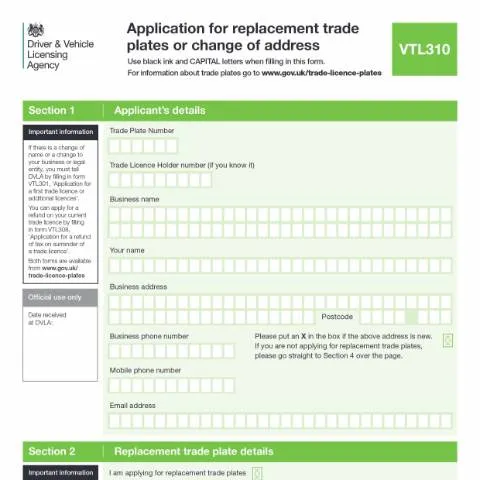
When Trade Plates Go Missing: The VTL310 Replacement Pathway
Trade plates vanish from workshop yards, get damaged in industrial accidents, or simply wear out beyond recognition after years of constant use. For motor traders, vehicle manufacturers, and testing facilities across the UK, losing these essential red-on-white numbered plates can bring business operations to a grinding halt. The VTL310 form represents the official route back to legitimate trading when replacement plates become necessary.
Unlike standard vehicle registration, trade plates operate under a completely different regulatory framework. They're not tied to specific vehicles but rather to trade licences that permit businesses to move unregistered or untaxed vehicles for legitimate commercial purposes. When these plates need replacing, the process involves more than simply ordering new number plates—it requires formal application through DVLA's specialised trade licensing division.
The form serves a dual purpose that often catches applicants off guard. Beyond requesting replacement plates, VTL310 also handles address changes for existing trade licence holders. This means the same document processes both emergency replacements for stolen plates and routine administrative updates when businesses relocate.
Decoding the Trade Plate Ecosystem Before You Apply
Trade plates exist within a complex hierarchy that determines both eligibility and replacement procedures. The system recognises several distinct categories, each with specific operational parameters and replacement protocols.
| Trade Licence Type | Typical Users | Plate Quantity | Replacement Implications |
|---|---|---|---|
| Motor Trader | Car dealers, motorcycle retailers | 2 plates minimum | Must return remaining plates |
| Vehicle Tester | MOT stations, testing facilities | 2 plates standard | Limited to testing purposes only |
| Manufacturer | Vehicle production facilities | Variable allocation | May require production evidence |
| Bicycle Plate Holder | Bicycle manufacturers/dealers | 1 plate typically | Separate fee structure applies |
The Trade Licence Holder number becomes crucial during replacement applications. This unique identifier, distinct from the visible plate numbers, links your business to DVLA's trade licensing database. Many applicants mistakenly provide only the visible plate numbers, causing processing delays when DVLA cannot locate the underlying licence record.
Bicycle plates operate under modified regulations, reflecting their specialised use in cycle manufacturing and retail. These single plates carry different replacement fees and may have restricted usage conditions compared to standard motor trade plates.
Section-by-Section Navigation Through VTL310
Applicant Details: Beyond Basic Contact Information
Section 1 demands precision in business identification that goes beyond simple name and address completion. The Business name field must match exactly the name registered on your original trade licence application. Even minor variations—such as abbreviated terms or different punctuation—can trigger verification delays.
The address section includes a critical checkbox for new addresses. Marking this box incorrectly can route your application through the wrong processing pathway, potentially adding weeks to completion times. If you're genuinely applying for replacement plates at an existing address, leave this box unmarked even if other business details have changed.
Contact information takes on heightened importance for trade plate applications. Unlike standard vehicle licensing, trade plate queries often require immediate clarification of commercial circumstances. Providing both business landline and mobile numbers gives DVLA multiple contact routes when questions arise about your replacement request.
Replacement Details: Documenting Loss or Damage
Section 2 requires careful attention to the circumstances surrounding plate loss or damage. The form distinguishes between four specific scenarios: lost, damaged, destroyed, or stolen plates. Each category triggers different verification requirements and may influence processing times.
For stolen plates, the police crime reference number becomes mandatory. This isn't merely an administrative formality—it connects your application to active police records and helps prevent fraudulent use of your trade licence details. The date field for loss or theft helps DVLA establish timelines and may affect any ongoing investigations.
The requirement to return remaining plates often surprises applicants. If you've lost one plate from a set but still possess others, you must return these along with your application. DVLA issues complete replacement sets rather than individual plates, maintaining security and preventing mismatched combinations.
Understanding the Fee Structure and Payment Mechanics
Trade plate replacement fees follow a structured approach that reflects the different plate combinations available. The current fee structure recognises three distinct scenarios, each with specific costs and plate allocations.
Standard motor vehicle applications attract a £13.50 fee for the basic two-plate set (front and rear). However, businesses requiring bicycle plate coverage alongside motor vehicle plates face a £18.00 charge for the three-plate combination. Bicycle-only operations pay £7.00 for their single plate replacement.
Payment must be made payable to 'DVLA Swansea' specifically. Generic payee designations like 'DVLA' or 'Driver and Vehicle Licensing Agency' may cause processing complications. Postal orders offer the most reliable payment method, as they're less susceptible to damage during transit and provide built-in tracking capabilities.
The form explicitly warns against sending damaged or altered cheques, as these result in automatic application rejection and return. This policy reflects DVLA's security protocols for financial transactions and means any damaged payment instruments require complete resubmission rather than simple correction.
Declaration Requirements and Legal Commitments
The declaration section carries significant legal weight that extends beyond simple form completion. By signing, applicants commit to returning any missing plates if subsequently found—a requirement that remains active indefinitely after replacement issue.
Corporate applicants must specify their signing capacity clearly. Directors, partners, or authorised representatives need to state their role explicitly. Generic signatures without capacity designation can invalidate the entire application, requiring resubmission with proper authorisation documentation.
The date field uses standard UK format (DD/MM/YYYY) and must reflect the actual signing date rather than application preparation or submission dates. Predating or postdating signatures may trigger fraud prevention protocols and application rejection.
Submission Protocols and Processing Expectations
VTL310 applications must be posted to DVLA's Swansea facility with complete supporting documentation. The specific address—DVLA Swansea SA99 1DZ—routes applications directly to the trade licensing division rather than general vehicle services.
Processing typically takes up to four weeks from receipt, though this assumes complete and accurate submission. Applications missing required elements or containing inconsistencies may face significantly longer processing times as DVLA seeks clarification or additional documentation.
Replacement plates and licence confirmation arrive in separate packages for security reasons. This dual-dispatch approach prevents complete licence details from being intercepted in a single postal theft, but means applicants shouldn't expect simultaneous delivery of all replacement materials.
The form specifically mentions returning any remaining plates, including damaged ones, along with the application. This requirement often catches applicants unprepared, particularly when plates are partially damaged but still potentially usable. DVLA's policy ensures complete plate set integrity and prevents unauthorised combinations.
Integration with Broader Trade Licensing Administration
VTL310 sits within a broader ecosystem of trade licensing forms and procedures that interconnect in ways that aren't immediately obvious. Understanding these relationships can significantly impact your replacement strategy and timing.
If your business circumstances have changed significantly since original licence issue—such as ownership transfers, legal entity changes, or substantial operational modifications—you may need to complete VTL301 ('Application for a first trade licence or additional licences') instead of or alongside VTL310. This particularly affects businesses that have undergone corporate restructuring or partnership changes.
Similarly, if you're considering surrendering your trade licence entirely, VTL308 ('Application for a refund of tax on surrender of a trade licence') might be more appropriate than replacement. This decision becomes particularly relevant for seasonal businesses or those experiencing operational difficulties that make ongoing trade licensing unnecessary.
The timing of VTL310 submission can interact with annual trade licence renewals and fee adjustments. Submitting replacement applications close to renewal periods may result in administrative complications, particularly if your licence status changes during processing.
Post-Application Monitoring and Follow-Up Strategies
Unlike many DVLA processes, trade plate replacement doesn't offer online tracking capabilities. This means applicants must rely on postal timelines and proactive communication when delays occur. Understanding DVLA's internal processing sequence helps set realistic expectations and identify when intervention becomes necessary.
Initial processing involves verification of your trade licence status and cross-referencing with any outstanding compliance issues. Businesses with unresolved enforcement actions, outstanding fees, or regulatory concerns may experience extended processing times while these matters are addressed.
If plates haven't arrived within six weeks of application, telephone enquiries become appropriate. However, DVLA's trade licensing division operates through specific contact channels that differ from general vehicle enquiry lines. Using incorrect contact routes can result in prolonged call handling and misdirected enquiries.
The separate dispatch of replacement plates and licence confirmation means tracking both deliveries independently. Receiving plates without corresponding documentation, or vice versa, requires separate follow-up actions to ensure complete licence restoration.
Data protection considerations under UK GDPR mean that enquiries about application status must come from authorised business representatives. DVLA may request additional verification before discussing application details, particularly for corporate applicants or complex business structures.
Common Scenarios Requiring VTL310 Applications
Understanding when to use form VTL310 helps streamline your application process and ensures you select the correct replacement option. The most frequent scenarios involve physical damage to trade plates during routine business operations, particularly for vehicle recovery specialists who handle damaged or non-roadworthy vehicles daily.
Motor dealers frequently require replacements when trade plates are damaged during vehicle transportation or storage. Weather exposure, accidental impact during loading procedures, or wear from frequent mounting and dismounting can render plates illegible or structurally compromised. The DVLA considers plates unfit for use when registration numbers become unclear, reflective surfaces deteriorate significantly, or mounting holes become enlarged beyond secure fitting specifications.
Theft represents another common circumstance, particularly affecting businesses with multiple depot locations or those storing trade plates in less secure environments. When reporting stolen trade plates, you must provide a police crime reference number on form VTL310, demonstrating that formal theft reporting has occurred. This requirement prevents unauthorised duplicate applications and maintains the integrity of the trade licensing system.
Business expansion scenarios often necessitate additional trade plates beyond your original allocation. Growing dealerships, expanding vehicle recovery operations, or companies diversifying into different vehicle categories may require supplementary plates. However, VTL310 specifically covers replacement situations rather than increases to your licensed allocation, which requires separate DVLA procedures.
Administrative errors during initial licensing can also prompt VTL310 applications. Incorrect registration marks, wrong vehicle category designations, or clerical mistakes in business details may require corrective action through replacement procedures. These situations typically involve returning incorrect plates alongside your VTL310 application, allowing DVLA to issue corrected versions.
Seasonal businesses, such as those specialising in classic car restoration or agricultural vehicle maintenance, may discover deteriorated trade plates after extended storage periods. Corrosion, UV damage, or pest-related damage during inactive periods can compromise plate integrity, requiring replacement before resuming operations.
Trade Plate Categories and Specific Replacement Requirements
Different trade licence categories carry distinct replacement procedures and documentation requirements when using form VTL310. Understanding these variations ensures your application includes appropriate supporting evidence and meets category-specific criteria.
Motor trader licences, covering vehicle sales, repairs, and modifications, represent the most common trade licence category. VTL310 applications for motor trader plates typically require evidence of ongoing business activities, such as recent VAT returns, business insurance certificates, or trading accounts. The DVLA may request additional documentation if your business circumstances have changed significantly since initial licensing, particularly regarding premises, business structure, or operational scope.
Vehicle tester licences for MOT stations or independent vehicle inspectors have specific requirements when replacing plates. Your application must demonstrate continued authorisation to conduct vehicle testing, including valid MOT tester credentials and appropriate facility approvals. Changes to testing equipment, premises modifications, or staff qualifications may trigger additional verification procedures during replacement processing.
Manufacturer licences for vehicle production or modification businesses require detailed documentation of manufacturing capabilities and regulatory compliance. VTL310 applications must include evidence of continued production activities, quality assurance procedures, and any relevant type approval documentation. Manufacturers working with specialist vehicle categories, such as agricultural machinery or commercial vehicles, may need category-specific certifications.
Recovery operator licences have particular requirements reflecting the specialised nature of vehicle recovery operations. Replacement applications typically require evidence of continued recovery vehicle licensing, appropriate insurance coverage for recovery activities, and compliance with roadside assistance regulations. Recovery operators working with dangerous goods vehicles or specialist equipment may need additional safety certifications.
Research and development licences for automotive testing and development require sophisticated documentation during replacement procedures. Your VTL310 application must demonstrate ongoing research activities, appropriate testing facilities, and compliance with vehicle development regulations. Changes to research scope, testing methodologies, or development partnerships may require additional verification procedures.
Import/export dealer licences carry specific requirements related to international vehicle movements and customs procedures. Replacement applications must include evidence of continued import/export activities, appropriate customs documentation, and compliance with international vehicle standards. Brexit-related changes to import/export procedures may affect documentation requirements for these licence categories.
Processing Times and Expedited Procedures
DVLA processing times for VTL310 applications vary significantly based on application complexity, documentation completeness, and current workload pressures. Standard replacement applications typically process within 10-15 working days from receipt of complete documentation, though this timeframe can extend during peak periods or when additional verification becomes necessary.
Applications involving stolen trade plates generally require extended processing times due to additional security checks and verification procedures. The DVLA cross-references police crime reports, conducts database searches for suspicious activity patterns, and may coordinate with law enforcement agencies. These enhanced security measures typically add 5-10 working days to standard processing times, though complex cases involving organised theft may require several weeks.
Incomplete applications represent the primary cause of processing delays. Missing signatures, inadequate supporting documentation, or unclear photocopies can trigger return procedures, effectively restarting the processing timeline. The DVLA operates a strict documentation policy, returning incomplete applications rather than requesting additional information, which emphasises the importance of thorough preparation before submission.
Urgent replacement requirements, such as those affecting business-critical operations, may qualify for expedited processing through direct contact with DVLA trade licensing departments. However, expedited procedures are not guaranteed and typically require compelling business justification, such as contracted delivery commitments or time-sensitive vehicle movements. The DVLA evaluates urgent requests case-by-case, considering factors such as business impact, alternative arrangements, and documentation completeness.
Seasonal variations significantly affect processing times, with applications submitted during summer months typically experiencing longer delays due to increased vehicle-related activity. The period following the March and September vehicle registration changes often sees elevated application volumes, potentially extending processing times by several days. Planning replacement applications outside peak periods can improve processing speed and reduce business disruption.
Electronic submission options, where available, can marginally improve processing times by eliminating postal delays and reducing manual handling requirements. However, trade licence applications still require physical documentation verification, limiting the time advantages of electronic submission. The DVLA continues developing digital services, though comprehensive online trade licensing remains under development.
International applications, particularly those involving businesses with overseas operations or foreign-registered entities, require extended processing times due to additional verification procedures. Cross-border documentation validation, international database checks, and coordination with foreign authorities can add several weeks to processing times. Brexit-related changes continue affecting international application procedures, with EU-based businesses experiencing particular complexity.