International Operations: When Your Heavy Trailer Needs Official Recognition Abroad
Operating abnormal load trailers across international borders requires more than just standard registration documents. When your heavy haulage business expands beyond UK shores, or when clients demand proof of your trailer's compliance with British standards, the Certificate of Keeper of Trailer becomes an essential document. This DVSA-issued certificate serves as official validation of your trailer's specifications, weight limits, and technical compliance—credentials that foreign authorities and international clients increasingly require.
The certificate transforms what might otherwise be viewed as merely a UK-registered trailer into a formally documented piece of heavy transport equipment with verified specifications. For operators moving oversized loads through European ports, working on international infrastructure projects, or partnering with foreign logistics companies, this document bridges the gap between domestic registration and international recognition.
Technical Validation: What the DVSA Certificate Actually Certifies
The Certificate of Keeper of Trailer represents far more than basic ownership verification. It constitutes a comprehensive technical passport that documents every critical specification of your abnormal load trailer. The DVSA validates dimensions ranging from platform heights and deck configurations to precise axle spacings and coupling distances—measurements that directly impact load planning and route feasibility.
Weight certifications form the certificate's core value proposition. The document officially records three distinct weight categories: UK Construction and Use Regulations limits, manufacturer design weights, and Special Types General Order (STGO) ratings where applicable. This tri-level certification system provides foreign authorities with clear understanding of your trailer's capabilities under different operational scenarios.
| Specification Category | Certified Details | International Relevance |
|---|---|---|
| Dimensional Data | Length, width, height variations; deck configurations | Route planning and clearance calculations |
| Axle Configuration | Number, spacing, steering capabilities, wheel arrangements | Bridge loading and road surface compatibility |
| Weight Limits | Gross, axle, and coupling weights across regulatory frameworks | Load planning and permit applications |
| Suspension Systems | Type, adjustment range, load distribution characteristics | Dynamic loading assessments |
The certificate's technical precision extends to suspension documentation, recording whether your trailer features rigid, independent, or self-tracking axles, plus any power steering configurations. For modular trailers, separate certificates detail each possible configuration, ensuring comprehensive coverage of your equipment's versatility.
Special Considerations for Extendible and Modular Systems
Operators of extendible trailers receive certificates documenting minimum and maximum dimensions—crucial for international operations where route surveys must account for variable configurations. The DVSA requires separate applications for each distinct modular configuration, with sequential numbering ensuring clear identification of specific setups.
Application Process: Navigating the DVSA's Comprehensive Requirements
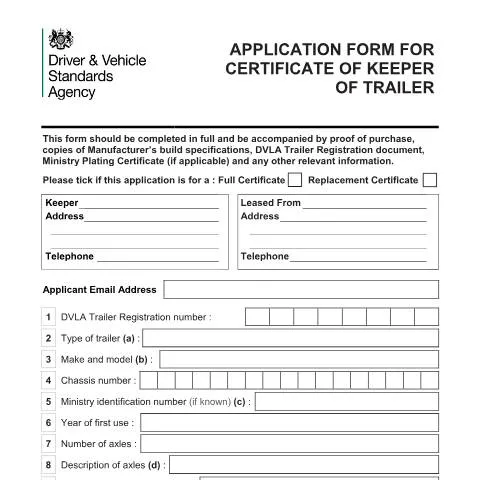
Securing a Certificate of Keeper of Trailer demands meticulous preparation and comprehensive documentation. The DVSA Form 0248 serves as your gateway to certification, but success depends heavily on the supporting evidence you provide alongside the completed application.
Essential documentation begins with your DVLA Trailer Registration document—the foundational proof of legal ownership and domestic compliance. However, the DVSA's requirements extend far beyond basic registration, demanding manufacturer's build specifications that detail your trailer's engineered capabilities and design parameters.
Documentary Evidence Requirements
- Proof of purchase: Establishes ownership chain and acquisition legitimacy
- Manufacturer's build specifications: Technical drawings, capacity charts, and engineering certifications
- DVLA Trailer Registration document: Current registration proving legal status
- Ministry Plating Certificate: Required where applicable for weight verification
- Additional technical documentation: Any supplementary evidence supporting your application
The application form itself demands precision across 24 detailed sections, from basic identification numbers through complex dimensional measurements. Chassis numbers, Ministry identification numbers, and precise axle specifications require careful verification against manufacturer documentation to avoid processing delays.
Payment Options and Processing Preferences
The DVSA accommodates three distinct payment methods, each suited to different operational patterns. Postal applications accept cheques or postal orders made payable to the Driver and Vehicle Standards Agency, while electronic submissions trigger email-based credit card payment arrangements.
Regular users benefit significantly from pre-funded accounts, which streamline repeated applications and reduce processing times. Setting up a pre-funded account requires designated delegates with signing authority, but the operational efficiency gains prove substantial for busy heavy haulage operations.
Replacement Certificates and Error Corrections
Lost or damaged certificates need not halt international operations indefinitely. The DVSA's replacement certificate process follows identical documentation requirements to original applications, with applicants simply selecting the "Replacement Certificate" option on Form 0248.
Replacement scenarios commonly arise from certificates damaged during international transport, lost in overseas operations, or required in multiple copies for concurrent projects. The DVSA treats replacement applications with equal thoroughness to original submissions, maintaining the same technical validation standards.
Error corrections present more complex challenges, particularly when discrepancies emerge between certified specifications and actual trailer configurations. Such situations typically require fresh applications with corrected documentation rather than simple amendments, emphasising the importance of initial accuracy.
Addressing Technical Discrepancies
When foreign authorities question certified specifications, operators must work through the DVSA's technical review process. This may involve additional manufacturer documentation, independent measurements, or updated engineering assessments depending on the nature of the discrepancy.
International Recognition and Cross-Border Compliance
The Certificate of Keeper of Trailer's international utility varies significantly across different jurisdictions and operational contexts. European Union member states generally recognise DVSA certification as evidence of British compliance standards, though specific acceptance depends on bilateral agreements and local regulatory frameworks.
Port authorities frequently demand certified documentation before allowing abnormal load trailers to enter their facilities or use specialised loading equipment. The certificate provides instant credibility and technical reference points that expedite customs clearance and operational approvals.
International project work, particularly in infrastructure development and industrial construction, increasingly requires documented equipment specifications for insurance, safety, and contractual compliance. The DVSA certificate serves as independent third-party validation of your trailer's capabilities and limitations.
Sector-Specific Applications
Wind energy projects across Europe routinely specify DVSA-certified trailers for blade and nacelle transport, recognising British heavy haulage standards as benchmark requirements for complex logistics operations.
Oil and gas sector operations, particularly in offshore support roles, value the certificate's precise weight and dimensional data for crane operations, vessel loading, and platform logistics planning. The documented suspension specifications prove particularly valuable for dynamic loading calculations.
Operational Considerations and Maintenance Requirements
Certificate validity extends indefinitely provided your trailer's specifications remain unchanged from those originally certified. However, significant modifications—whether dimensional alterations, suspension upgrades, or axle reconfigurations—necessitate fresh certification to maintain accuracy and legal validity.
Configuration changes trigger recertification requirements, particularly for modular systems where operators add or remove sections. The DVSA requires separate certificates for each distinct configuration, meaning fleet modifications can generate substantial administrative overhead.
Regular specification verification ensures ongoing certificate accuracy, though the DVSA places responsibility for configuration monitoring squarely on operators' shoulders. Maintaining detailed modification records and manufacturer correspondence supports future recertification efforts and demonstrates ongoing compliance commitment.
Fleet Management Implications
Large fleet operators often maintain certified configuration matrices documenting all possible trailer combinations and their corresponding certificate requirements. This systematic approach prevents operational disruptions when international projects demand specific technical capabilities or regulatory compliance.
The certificate's role in insurance and contractual arrangements means that specification accuracy carries financial implications beyond mere regulatory compliance. Incorrect or outdated certifications can void coverage or breach contract terms, making ongoing accuracy maintenance a commercial imperative.
Strategic Value in Heavy Haulage Operations
Beyond regulatory compliance, the Certificate of Keeper of Trailer functions as a competitive differentiator in international heavy haulage markets. Certified operators demonstrate professional standards and technical transparency that clients increasingly value when selecting transport partners for complex projects.
The certificate's comprehensive technical data supports sophisticated load planning and route analysis, enabling operators to provide detailed feasibility assessments and risk evaluations. This capability proves particularly valuable in competitive tendering situations where technical precision influences selection decisions.
International partnerships and joint ventures benefit significantly from standardised documentation that transcends linguistic and regulatory barriers. The certificate provides common technical reference points that facilitate collaboration across different operational frameworks and legal systems.
Forward-thinking operators integrate certificate requirements into their fleet acquisition strategies, ensuring new trailers meet certification standards from initial specification through to delivery. This proactive approach eliminates post-purchase complications and accelerates international deployment capabilities.
The DVSA's Customer Service Centre on 0300 123 9000 provides ongoing support for complex applications and technical queries, while the online service portal streamlines submission processes for operators comfortable with electronic documentation. As international heavy haulage markets continue evolving, the Certificate of Keeper of Trailer represents essential infrastructure for operators seeking to maintain competitive advantage across global logistics networks.
Documentation and Certification Requirements for International Operations
When operating your abnormal load trailer internationally, you'll need to maintain comprehensive documentation that satisfies both UK and destination country requirements. The Vehicle Certification Agency (VCA) plays a crucial role in ensuring your trailer meets international standards, particularly for European operations under the Whole Vehicle Type Approval (WVTA) framework.
Your trailer keeper's certificate must be accompanied by a valid Certificate of Conformity (CoC) when crossing borders. This document proves your trailer complies with European Community Whole Vehicle Type Approval regulations, even post-Brexit. The VCA issues these certificates, but you'll need to demonstrate that your trailer meets specific technical requirements including:
- Braking system specifications - Must comply with ECE Regulation 13 for heavy goods vehicles
- Lighting and visibility standards - Including mandatory side marker lamps and reflective tape positioning
- Coupling system certification - Particularly critical for drawbar trailers exceeding 3,500kg
- Suspension and axle configuration - Must meet load distribution requirements for your specific gross vehicle weight
For operations into non-EU countries, requirements vary significantly. The Road Haulage Association maintains updated guidance on bilateral agreements, but you'll typically need additional documentation such as a Carnet de Passages en Douane (CPD) for temporary vehicle importation. This is particularly relevant when transporting abnormal loads to countries like Turkey, Russia, or Middle Eastern destinations.
The Driver and Vehicle Standards Agency (DVSA) requires that your trailer keeper's certificate includes specific endorsements for international use. These endorsements specify the maximum gross vehicle weight authorised for cross-border operations, which may differ from your UK operating limits. You'll need to apply for these endorsements separately, providing evidence of your intended routes and destination country requirements.
Insurance documentation becomes particularly complex for international abnormal load operations. Your standard UK trailer insurance may not provide adequate cover abroad, and some countries require locally-issued insurance policies. The Motor Insurers' Bureau can provide guidance on Green Card requirements, though these are no longer mandatory for EU travel, comprehensive cover verification remains essential for abnormal loads due to their higher risk profile.
Compliance with Special Movement Orders and Route Planning
International abnormal load movements require sophisticated route planning that goes beyond standard GPS navigation. The Highways England (now National Highways) Special Types General Order (STGO) categories that apply to your UK operations don't automatically translate to international standards. Each country maintains its own classification system for abnormal loads, with varying weight limits, dimensional restrictions, and escort requirements.
When planning routes through multiple countries, you must obtain separate movement authorisations for each territory. The European Conference of Ministers of Transport (ECMT) framework provides some standardisation, but bilateral agreements between the UK and individual countries now govern most arrangements post-Brexit. For example, movements into Germany require compliance with the StVO (Straßenverkehrs-Ordnung) regulations, which may impose different axle weight limits than your UK certificate allows.
The timing of your international movements becomes critical due to varying national restrictions. Many European countries prohibit abnormal load movements during peak holiday periods, with France implementing weekend bans from July through August on major routes. Your trailer keeper's certificate should specify these operational limitations, and you'll need to coordinate with multiple national authorities to secure movement windows.
Bridge and infrastructure clearances vary significantly between countries, even on designated heavy goods vehicle routes. The UK's standard 4.95m height limit doesn't apply universally - German autobahns typically allow 4.0m, while some Scandinavian routes permit up to 4.5m. Your certificate documentation must include detailed dimensional specifications that allow border authorities to verify compliance with local infrastructure limits.
Escort vehicle requirements differ markedly between jurisdictions. While UK regulations specify escort requirements based on STGO categories, continental European countries often mandate specific escort vehicle types, operator qualifications, and communication equipment. Your movement planning must account for sourcing appropriately certified escort vehicles in each country, as UK-registered escorts may not meet local requirements.
The European Modular System (EMS) permits longer vehicle combinations in participating countries, but your UK trailer keeper's certificate must explicitly authorise EMS operations. This requires additional technical assessments focusing on vehicle stability, braking performance, and manoeuvrability in extended configurations. Not all abnormal load trailers qualify for EMS operations, particularly those designed for indivisible loads with non-standard weight distributions.
Ongoing Compliance and Periodic Renewal Procedures
Maintaining your abnormal load trailer keeper's certificate for international use requires ongoing compliance monitoring that extends beyond standard UK requirements. The Driver and Vehicle Standards Agency (DVSA) conducts periodic compliance checks that focus specifically on international operation standards, examining whether your trailer continues to meet the technical specifications declared in your original application.
Annual testing requirements become more stringent for internationally-operated trailers. While standard UK trailers require testing at Authorised Testing Facilities (ATFs), international certificates often mandate additional inspections by Vehicle Certification Agency-approved specialists. These inspections focus on components that experience higher stress during international operations, including coupling systems, brake assemblies, and suspension components subjected to varying road surfaces and operating conditions.
Your maintenance records must demonstrate compliance with manufacturer specifications and international standards. The DVSA requires detailed service histories that show adherence to prescribed maintenance intervals, particularly for safety-critical components. This documentation becomes essential during periodic certificate renewals and can affect your eligibility for continued international operation authorisation.
Technological updates can affect your certificate validity, particularly regarding electronic systems. Modern abnormal load trailers increasingly incorporate electronic braking systems (EBS), load monitoring systems, and GPS tracking capabilities. Changes to these systems may require certificate amendments or complete re-certification, depending on the extent of modifications and their impact on the trailer's operating characteristics.
The renewal process typically occurs every five years for abnormal load trailer keeper's certificates, but international endorsements may require more frequent updates. Political changes, updated bilateral agreements, or revised technical standards in destination countries can necessitate certificate amendments outside the standard renewal cycle. The DVSA maintains a notification system for certificate holders, but staying informed about international regulatory changes remains your responsibility as the operator.
Compliance audits by destination country authorities can impact your UK certificate status. If foreign authorities identify non-compliance issues during international operations, they may report these findings to UK authorities through established cooperation mechanisms. Such reports can trigger DVSA investigations that may result in certificate suspension or additional testing requirements.
Record-keeping requirements for international operations are particularly comprehensive. You must maintain detailed logs of all international movements, including route details, load specifications, escort arrangements, and any incidents or delays encountered. This information supports periodic compliance reviews and helps demonstrate your ongoing suitability to hold an international abnormal load trailer keeper's certificate. The DVSA may request these records during routine inspections or following specific compliance concerns raised by international partners.