Understanding the SA110 Tax Calculation Summary: A Critical Component of Your Self Assessment Return
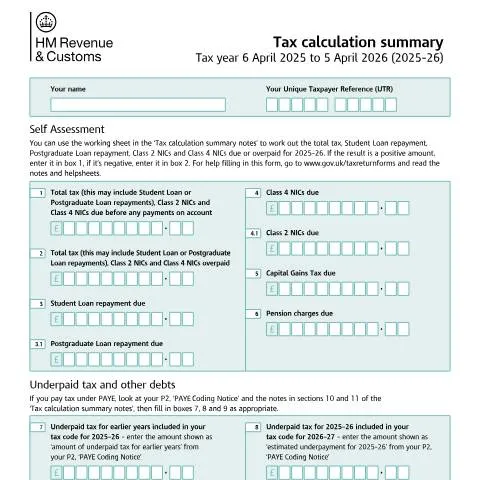
When completing your Self Assessment return for the 2025-26 tax year, the SA110 Tax Calculation Summary form serves as the mathematical backbone of your entire submission to HM Revenue & Customs. This supplementary form, running across two pages (TC 1 and TC 2), captures the complex calculations that determine your final tax position, including any amounts due, overpayments, and forward-looking obligations for the following year.
Unlike the main SA100 return which records your income and circumstances, the SA110 focuses exclusively on the numerical outcomes of your tax computation. It's where theoretical tax liability meets practical payment reality, accounting for everything from underpaid tax carried forward from previous years to advance payments required for 2026-27.
The Mechanics of Tax Calculation: Breaking Down Your Financial Position
The SA110 form operates on a sophisticated system that reconciles multiple streams of tax obligations and credits. The opening section requires you to establish your baseline tax position through boxes 1 and 2, which capture the fundamental calculation: your total tax liability versus any overpayments.
Box 1 consolidates your entire tax burden for 2025-26, potentially including income tax, Student Loan repayments, Postgraduate Loan repayments, Class 2 National Insurance contributions, and Class 4 National Insurance contributions. This figure represents what you owe before considering any payments already made through PAYE or previous Self Assessment instalments.
Box 2 serves the opposite function, capturing situations where your tax payments throughout the year exceeded your actual liability. This commonly occurs when PAYE deductions were based on assumptions that proved conservative, or when you experienced reduced income mid-year without corresponding adjustments to your tax code.
Specialised Payment Categories
The form then disaggregates specific components that require separate tracking:
- Student Loan repayments (Box 3): Calculated at 9% of income above the relevant threshold, varying by plan type
- Postgraduate Loan repayments (Box 3.1): Applied at 6% of income exceeding £21,000 annually
- Class 4 NICs (Box 4): Self-employed National Insurance at 8% between £12,570 and £50,270, then 2% above
- Class 2 NICs (Box 4.1): Fixed weekly rate for self-employed individuals earning above £6,515 annually
- Capital Gains Tax (Box 5): Separate calculation on disposal profits exceeding annual exemption
- Pension charges (Box 6): Annual allowance charges or lifetime allowance penalties
PAYE Integration: Reconciling Employment Tax with Self Assessment
Boxes 7, 8, and 9 address one of the most complex aspects of UK taxation: the interaction between PAYE and Self Assessment systems. These boxes require careful reference to your P2 'PAYE Coding Notice', which HMRC issues when adjustments affect your tax code.
Box 7 captures underpaid tax from earlier years that HMRC has incorporated into your 2025-26 tax code. This typically occurs when previous Self Assessment calculations revealed shortfalls that HMRC opts to collect gradually through PAYE rather than demanding immediate payment. The amount should match exactly what appears on your P2 under 'amount of underpaid tax for earlier years'.
Box 8 looks forward, recording estimated underpayments for 2025-26 that HMRC anticipates collecting through your 2026-27 tax code. This predictive element helps smooth cash flow for taxpayers while ensuring revenue collection continues efficiently.
Box 9 encompasses other outstanding debts that HMRC collects through PAYE, potentially including previous Self Assessment balances, penalty charges, or other tax-related obligations. The P2 coding notice provides the definitive figure for this entry.
Working with PAYE Coding Notices
The P2 document referenced throughout this section contains crucial information formatted in specific ways. The 'amount of underpaid tax for earlier years' appears as a distinct line item, while 'estimated underpayment for 2025-26' typically follows calculations based on your expected income and tax position. These figures aren't arbitrary—they reflect HMRC's assessment of your tax history and projected obligations.
Forward Planning: Payments on Account for 2026-27
The payments on account system represents one of Self Assessment's most sophisticated features, requiring taxpayers to prepay portions of the following year's anticipated tax liability. Boxes 10 and 11 manage this forward-looking obligation, which applies when your previous year's tax bill exceeded £1,000 and more than 80% wasn't collected through PAYE or other deductions.
Standard payments on account equal half of the previous year's income tax and Class 4 National Insurance liability, payable on 31 January and 31 July. However, Box 10 provides an escape mechanism for taxpayers expecting reduced income or tax liability in 2026-27. Ticking this box signals your intention to claim a reduction, with the proposed lower amount entered in Box 11.
Strategic Considerations for Payment Reductions
Claiming reduced payments on account requires careful judgment. While it improves immediate cash flow, underestimating your 2026-27 liability triggers interest charges on the shortfall. Common scenarios justifying reductions include:
- Planned retirement reducing pension contributions and earned income
- Business restructuring affecting profit levels
- Property disposals eliminating rental income
- Changes in investment portfolio reducing dividend income
- Cessation of freelance or consultancy work
Box 17 on page TC 2 requires detailed justification for any reduction claim, and HMRC scrutinises these explanations carefully. Vague or unsupported reasons often trigger enquiries or rejection of the reduction request.
Allowance Transfers and Family Tax Planning
Boxes 12 and 13 address allowance transfers between spouses or civil partners, reflecting the UK tax system's recognition of family units while maintaining individual assessment principles. These provisions can significantly impact overall family tax efficiency when applied correctly.
Blind person's surplus allowance (Box 12) becomes transferable when one spouse or civil partner cannot fully utilise their blind person's allowance against their own income. The 2025-26 allowance of £2,870 can be transferred entirely if unused, or partially if the blind person's income falls below their total allowances.
Married couple's allowance surplus (Box 13) applies exclusively to couples where at least one partner was born before 6 April 1935. This age-related allowance, worth up to £10,375 for 2025-26, provides tax relief at 10% rather than the marginal rate. The surplus transfer mechanism ensures couples maximise this valuable relief regardless of individual income distributions.
| Allowance Type | Eligibility Criteria | Maximum Amount 2025-26 | Relief Rate |
|---|---|---|---|
| Blind Person's Allowance | Registered blind | £2,870 | Marginal rate |
| Married Couple's Allowance | Born before 6 April 1935 | £10,375 | 10% |
Adjustments and Historical Corrections
Boxes 14, 15, and 16 handle the complex territory of inter-year adjustments, where current tax calculations must account for corrections to previous periods. This section frequently applies to specific taxpayer categories with unique computational rules.
Averaging provisions for farmers and creative professionals allow income smoothing across multiple years, potentially requiring adjustments to 2025-26 calculations based on earlier periods. Box 14 captures increases in current year tax resulting from these historical adjustments, while Box 15 records corresponding decreases.
Loss carry-back claims represent another scenario triggering these adjustments. When 2026-27 losses are carried back to 2025-26, the resulting tax reduction doesn't immediately generate a cash refund but creates credits on your Self Assessment account. These credits offset future liabilities, creating a complex interplay between different tax years.
Managing Repayment Claims
Box 16 addresses situations where taxpayers claim repayments from future years against current obligations. This advanced feature requires sophisticated understanding of tax timing rules and typically involves professional advice to implement correctly.
The form explicitly warns that loss carry-backs generate account credits rather than immediate refunds, affecting cash flow planning for taxpayers expecting quick repayment of overpaid tax. Understanding this distinction prevents unrealistic expectations about payment timing.
Completion Strategy and Common Computational Challenges
Successfully completing the SA110 requires systematic approach and attention to supporting documentation. The form references working sheets within the 'Tax calculation summary notes', which provide step-by-step guidance for complex calculations involving multiple income sources and deduction categories.
The distinction between positive and negative amounts in boxes 1 and 2 frequently causes confusion. A positive result indicates tax due, while negative amounts represent overpayments. This seemingly simple concept becomes complex when multiple adjustments, carry-forwards, and credits interact within the calculation.
Documentation Requirements
Accurate completion demands access to several key documents:
- P2 PAYE Coding Notice: Essential for boxes 7, 8, and 9
- P60 or final payslip: Confirms PAYE deductions for the year
- Student Loan annual statements: Verify repayment calculations
- Previous year's SA302 calculation: Determines payments on account requirements
- Bank statements: Evidence of quarterly Class 2 NIC payments
- Investment statements: Support dividend and interest calculations
Professional advisers often recommend completing the SA110 after finalising all other Self Assessment forms, as it synthesises information from across the entire return. This approach minimises errors and ensures consistency between different sections of your submission.
Submission Timing and HMRC Processing
The SA110 forms part of your complete Self Assessment package, subject to the standard 31 January deadline for online submissions or 31 October for paper returns. However, the complexity of calculations involved often makes this form a bottleneck in the completion process, particularly for taxpayers with multiple income sources or complex financial arrangements.
HMRC's processing systems automatically verify calculations across the entire Self Assessment return, with the SA110 serving as a critical checkpoint. Discrepancies between the summary calculations and supporting forms trigger automated queries, potentially delaying processing and requiring amended submissions.
The integration with HMRC's broader systems means SA110 data influences future coding notices, payment schedules, and compliance risk assessments. Accuracy in completion therefore extends beyond immediate tax calculation to affect ongoing administrative efficiency and regulatory attention.
For taxpayers utilising professional assistance, the SA110 often represents the culmination of extensive planning and calculation work. The form's role as a summary document means errors here typically reflect underlying issues in income recording, expense claims, or allowance applications that require comprehensive review to resolve effectively.
Understanding Your Tax Calculation Summary: Line-by-Line Breakdown
The SA110 tax calculation summary presents your tax liability through a structured sequence of calculations that build upon each other. Understanding each section helps you verify the accuracy of your return and identify potential areas for review or amendment.
The summary begins with your total income from all sources, combining employment income, self-employment profits, property rental income, savings interest, dividend income, and any other taxable receipts. This figure forms the foundation of your tax calculation and must include all income received during the tax year, regardless of when you actually received payment for work completed.
From your total income, the calculation deducts your personal allowance and any other allowable reliefs. For most taxpayers, the personal allowance provides the first £12,570 of income tax-free, though this may be reduced if your income exceeds £100,000. The allowance tapers at a rate of £1 for every £2 of income above this threshold, disappearing entirely once your income reaches £125,140.
Additional reliefs might include pension contributions, Gift Aid donations, or trade losses carried forward from previous years. These reliefs can significantly impact your tax liability, and the SA110 shows precisely how each relief affects your calculation. For instance, pension contributions extend your basic rate band, potentially moving some of your income from higher rate tax (40%) down to basic rate tax (20%).
The calculation then applies the appropriate tax rates to your remaining taxable income. The basic rate of 20% applies to income up to £37,700, with higher rate tax of 40% on income between £37,701 and £125,140, and additional rate tax of 45% on income above this threshold. However, these bands may be extended by pension contributions or other qualifying reliefs.
Dividend income receives different treatment, with a £2,000 dividend allowance followed by rates of 8.75% (basic rate), 33.75% (higher rate), and 39.35% (additional rate). Savings income also has its own allowance structure, with basic rate taxpayers receiving up to £1,000 tax-free savings income and higher rate taxpayers receiving £500.
The summary then accounts for any tax already paid through PAYE, dividend tax credits, or payments on account from previous years. This creates either a balance due to HMRC or a refund due to you. Understanding this reconciliation helps you plan for future payments on account and avoid unexpected tax bills.
Managing Payments on Account and Balancing Payments
The SA110 calculation determines not only your current year tax liability but also establishes the payments on account required for the following tax year. This forward-looking element of Self Assessment often catches taxpayers unprepared, particularly those new to the system or experiencing significant income changes.
Payments on account equal half of your previous year's income tax and Class 4 National Insurance contributions, provided this amount exceeds £1,000 and you paid less than 80% of your total tax bill through PAYE or other deductions at source. These payments are due on 31 January during the tax year and 31 July following the tax year end.
For example, if your SA110 shows a total tax liability of £8,000 for the 2023-24 tax year (after deducting any PAYE tax paid), your payments on account for 2024-25 would be £4,000 each, due on 31 January 2024 and 31 July 2024. Any remaining balance for 2023-24 would be due alongside the first payment on account on 31 January 2025.
You can reduce payments on account if you reasonably expect your tax liability to be lower in the current year. This might occur due to reduced income, increased pension contributions, or changes in your business circumstances. However, if your estimate proves too low, HMRC may charge interest on the underpaid amount from the original due dates.
The calculation summary shows the interaction between your balancing payment (the difference between your total tax due and amounts already paid) and your payments on account. This helps you understand the total cash flow impact of your tax obligations and plan accordingly.
Class 4 National Insurance contributions also feature in this calculation for self-employed individuals. These contributions apply at 9% on profits between £12,570 and £50,270, then at 2% on profits above this threshold. The SA110 shows how these contributions integrate with your income tax calculation and affect your overall liability.
Capital gains tax, if applicable, appears separately in the calculation but contributes to your overall payment obligations. The annual exempt amount of £6,000 (for 2023-24) means many taxpayers face no capital gains tax liability, but those exceeding this threshold see rates of 10% or 20% depending on their income tax band, with higher rates applying to residential property gains.
Common Discrepancies and Amendment Procedures
Reviewing your SA110 calculation may reveal discrepancies that require correction through the amendment process. HMRC allows taxpayers to amend their Self Assessment returns within 12 months of the original filing deadline, providing an opportunity to correct errors or include overlooked information.
Frequent discrepancies include missing dividend income, particularly from small shareholdings where dividend vouchers might be overlooked, or incorrect treatment of business expenses. The SA110 calculation reflects exactly how HMRC has processed your submitted information, making it easier to identify where corrections might be needed.
Employment income discrepancies often arise when P60s or P45s show different figures from those used in your calculation. This might occur due to timing differences, corrections made by employers after year-end, or benefits in kind not properly accounted for. The SA110 shows your total employment income figure, which you can reconcile against your employment documentation.
Property income calculations frequently require amendments, particularly regarding allowable expenses or capital allowances claims. The calculation summary shows your net property income after expenses, enabling you to verify whether all legitimate deductions have been claimed. Common oversights include professional fees, insurance costs, or repairs and maintenance expenses.
Pension contribution relief represents another area where amendments might be necessary. The SA110 shows how your contributions have extended your basic rate band or provided relief at source correction. If you've made additional contributions or corrections are needed to contribution amounts, these will flow through to your revised calculation.
To amend your return, you can use HMRC's online services if the changes are straightforward, or submit a paper amendment for more complex corrections. The revised SA110 will show the impact of your amendments on your tax liability and any resulting changes to payments due or refunds owed.
Interest charges may apply if amendments result in additional tax being due, calculated from the original payment due date. Conversely, if amendments result in overpaid tax, HMRC will pay interest on refunds from the date of overpayment. Understanding these implications helps you decide whether to proceed with amendments and plan for any financial consequences.
HMRC's enquiry powers mean they can investigate your return for up to 12 months after submission, or longer in cases of suspected negligence or fraud. The SA110 provides the baseline calculation against which any enquiry adjustments would be measured, making accurate initial submission increasingly important for avoiding later complications and potential penalties.