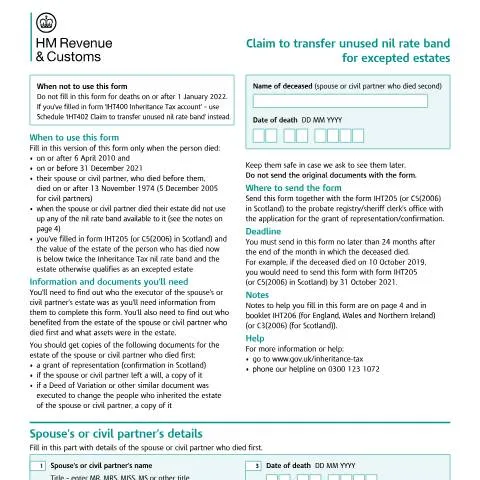
When Inheritance Tax Planning Spans Two Deaths: The IHT217 Transfer Claim
The death of a spouse or civil partner often reveals a complex inheritance tax landscape where careful planning from years earlier can still yield significant benefits. Form IHT217 addresses a specific scenario: claiming the unused nil rate band from a deceased spouse or civil partner who died between 6 April 2010 and 31 December 2021, where their estate was wholly exempt from inheritance tax. This transfer mechanism can effectively double the inheritance tax threshold for the surviving spouse's estate, potentially saving thousands of pounds for beneficiaries.
The form serves as a bridge between two separate deaths, allowing executors to demonstrate that the first spouse's nil rate band remained untouched and should now be added to the current deceased's allowance. However, the eligibility criteria are stringent, and the form includes numerous exit points where executors must abandon this simplified process in favour of the more comprehensive IHT400 and IHT402 procedures.
Eligibility Boundaries: When the Simplified Route Applies
Form IHT217 operates within carefully defined temporal and circumstantial boundaries. The primary deceased must have died between 6 April 2010 and 31 December 2021, with their spouse or civil partner having predeceased them after 13 November 1974 for married couples, or 5 December 2005 for civil partnerships. These dates reflect the legislative evolution of transferable nil rate bands and civil partnership recognition respectively.
The form explicitly excludes deaths from 1 January 2022 onwards, directing such cases to the standard IHT400 inheritance tax account process. This temporal restriction means that executors dealing with recent deaths must navigate the more complex full inheritance tax return system, even when claiming unused nil rate band transfers.
The Excepted Estate Requirement
A fundamental prerequisite involves the current estate qualifying as an excepted estate under form IHT205 (or C5(2006) in Scotland). The combined estate value must fall below twice the inheritance tax nil rate band, creating a mathematical ceiling that varies according to the applicable nil rate band at the time of death. For deaths in 2021, this would typically mean estates valued below £650,000, assuming a full unused nil rate band transfer.
The excepted estate status provides administrative relief for smaller estates, but the IHT217 process adds complexity by requiring detailed investigation into the first spouse's estate circumstances. Executors must verify that the earlier estate genuinely used none of its nil rate band, often requiring extensive historical documentation.
Navigating the Sequential Elimination Questions
Form IHT217 employs a systematic elimination approach through questions 7-13, each designed to identify circumstances that would disqualify the estate from this simplified transfer process. These questions function as gatekeepers, ensuring that only genuinely straightforward cases proceed without full IHT400 scrutiny.
Domicile and Exemption Prerequisites
Question 7 establishes UK domicile for the first deceased, reflecting inheritance tax's territorial scope. Non-UK domiciled individuals face different inheritance tax rules, making their unused nil rate band transfers unsuitable for simplified processing. Question 8 then confirms that the first estate was wholly exempt, typically because assets passed entirely to the surviving spouse, civil partner, or qualifying charities.
The wholly exempt requirement proves crucial yet potentially problematic. Even small non-exempt legacies to children or friends could disqualify the estate from IHT217 processing. Executors must carefully review the first spouse's will and any deeds of variation to confirm complete exemption.
Joint Assets and Gift Complications
Questions 9 and 10 address asset transfers that might have consumed portions of the nil rate band. Joint assets passing to non-exempt beneficiaries, or substantial lifetime gifts exceeding the annual exemption limits, would have utilised the nil rate band even if no inheritance tax was ultimately payable. The £3,000 annual exemption threshold mentioned in question 10 guidance reflects the cumulative effect of regular gift-giving over the seven-year lookback period.
| Disqualifying Factor | Question Number | Common Examples |
|---|---|---|
| Non-UK domicile | 7 | Foreign nationals with overseas permanent homes |
| Non-exempt estate elements | 8 | Legacies to children, friends, or non-qualifying beneficiaries |
| Joint assets to third parties | 9 | Property held as tenants in common passing to children |
| Substantial lifetime gifts | 10 | Regular gifts exceeding annual exemptions over seven years |
| Agricultural/business reliefs | 11 | Family farms or trading businesses receiving relief |
| Gifts with reservation | 12 | Gifted property where donor retained benefits |
| Trust beneficiary status | 13 | Income or capital distributions from existing trusts |
Document Assembly and Historical Investigation
Completing IHT217 requires substantial documentary archaeology, particularly when the first death occurred years or decades earlier. Executors must locate and analyse the original grant of representation (or confirmation in Scotland), the deceased's will, and any subsequent deeds of variation that might have altered the estate's distribution pattern.
Tracking Down Estate Representatives
The form specifically requires information from the first spouse's executor, who may no longer be alive or contactable after many years. This presents practical challenges, particularly when the original executor was elderly at the time of appointment. Executors may need to contact the original probate registry to obtain copies of historical grants and associated documentation.
Professional executor firms and solicitors sometimes maintain better long-term records, but individual executors may have limited documentation retention. The requirement to identify beneficiaries of the first estate adds another layer of complexity, especially when assets were distributed through multiple generations or trust structures.
Will Analysis and Variation Impact
The original will provides the foundation for understanding asset distribution, but deeds of variation executed within two years of death can fundamentally alter the inheritance tax position. These variations might have redirected assets between exempt and non-exempt beneficiaries, potentially affecting the unused nil rate band calculation. Executors must obtain copies of all variation documents to ensure accurate assessment.
Scottish estates operating under different legal frameworks require particular attention to confirmation procedures and potential differences in asset distribution rules. The form acknowledges these jurisdictional variations while maintaining consistent inheritance tax principles across the UK.
Submission Coordination with Probate Procedures
Form IHT217 cannot operate in isolation but must accompany the primary IHT205 (or C5(2006)) submission to the probate registry or sheriff clerk's office. This coordination ensures that the nil rate band transfer claim forms part of the overall estate valuation and probate application process.
Timing and Deadline Management
The 24-month deadline from the end of the month of death creates a firm boundary for claims. Using the form's example, a death on 10 October 2019 would require submission by 31 October 2021. This deadline cannot be extended, making early preparation essential for complex cases requiring extensive historical research.
The deadline applies regardless of probate application timing, meaning that delayed probate proceedings don't automatically extend the nil rate band transfer claim period. Executors facing documentary challenges must prioritise the IHT217 preparation to avoid losing valuable tax relief through administrative delays.
Registry Processing Expectations
Probate registries and sheriff clerk offices process IHT217 submissions alongside the main probate application, but the inheritance tax aspects require HMRC validation. The form specifically instructs against sending original documents, recognising that probate proceedings may require the originals while HMRC needs copies for verification purposes.
Processing times can vary significantly depending on the complexity of the historical estate investigation required. Simple cases with clear documentation may proceed smoothly, while complex situations involving multiple variations or unclear exemption status may trigger additional HMRC enquiries.
Relief Calculations and Transfer Mechanics
The unused nil rate band transfer operates as a percentage rather than a fixed amount, reflecting the different nil rate band levels applicable at each death date. If the first spouse died when the nil rate band was £300,000 and used none of it, the surviving spouse receives a 100% transfer addition to their own nil rate band, regardless of the current band level.
Multiple Transfer Scenarios
While form IHT217 addresses single spouse transfers, the inheritance tax system permits multiple transfers where someone was widowed more than once. Each previous spouse's unused nil rate band can potentially transfer, subject to a maximum combined transfer of 100%. These complex scenarios typically require full IHT400 processing rather than the simplified IHT217 route.
The percentage-based calculation ensures that the relief adjusts appropriately to current nil rate band levels while preserving the original intention of the unused relief. This mechanism prevents inflation from eroding the benefit over time while maintaining proportional relationships between different cases.
Professional Support and Complex Case Management
The form's complexity often necessitates professional assistance, particularly when historical documentation proves incomplete or contradictory. Solicitors specialising in probate work frequently encounter IHT217 situations requiring detailed investigation and careful legal analysis of the first spouse's estate arrangements.
When to Abandon the Simplified Route
The multiple exit points throughout form IHT217 reflect HMRC's recognition that many apparently simple cases involve complications requiring full inheritance tax return processing. Rather than struggling with an inappropriate form, executors should transition to IHT400 and IHT402 procedures when encountering disqualifying factors.
Professional advisers often recommend attempting the IHT217 route initially, given the potential administrative savings, but maintaining readiness to switch to comprehensive IHT400 processing if complications emerge. This pragmatic approach maximises the chances of securing simplified processing while ensuring compliance with inheritance tax requirements.
Record Keeping and Future Compliance
Form IHT217 submissions create permanent records linking two separate deaths for inheritance tax purposes. HMRC may subsequently enquire into either estate, making comprehensive record retention essential for both the current executors and future estate administrators.
The requirement to retain copies of all supporting documentation reflects the interconnected nature of spouse nil rate band transfers. Future HMRC enquiries might examine the validity of the original exemption claims or the accuracy of the transfer calculations, necessitating access to complete historical records.
Successful IHT217 processing provides significant tax relief while establishing precedents for future inheritance tax planning. The form represents a valuable bridge between historical estate planning decisions and current tax optimization, demonstrating how careful documentation and procedural compliance can preserve substantial financial benefits across multiple generations.
Specific Scenarios Where IHT217 Claims Become Complex
Whilst the IHT217 form appears straightforward on its surface, certain circumstances can significantly complicate the transfer of unused nil rate band. Understanding these scenarios is crucial for executors to avoid potential delays or challenges from HMRC.
Multiple Marriages and Civil Partnerships
When the deceased had more than one marriage or civil partnership, determining which spouse or civil partner's unused allowance can be transferred becomes intricate. The IHT217 form requires specific details about each relationship, including exact dates of marriage, civil partnership formation, divorce, dissolution, or death.
For instance, if someone was widowed in 1995, remarried in 2000, and their second spouse died in 2015, the executor must establish whether any nil rate band was used in the first spouse's estate and calculate the remaining transferable amount accordingly. HMRC may request additional documentation, including death certificates, marriage certificates, and potentially the first spouse's probate records.
The complexity increases when dealing with overseas marriages or civil partnerships, particularly those that weren't recognised under UK law at the time they occurred. Same-sex marriages performed abroad before the Marriage (Same Sex Couples) Act 2013 may require careful legal analysis to determine their status for inheritance tax purposes.
Estates Involving Agricultural or Business Property Relief
Properties qualifying for Agricultural Property Relief (APR) or Business Property Relief (BPR) can create complications when completing the IHT217. These reliefs can effectively reduce the chargeable value of an estate, potentially affecting whether the estate qualifies as 'excepted' and whether any nil rate band was actually utilised.
Consider a farming estate valued at £800,000 where agricultural land worth £400,000 qualifies for 100% APR. The chargeable estate becomes £400,000, well within the nil rate band threshold. However, if the relief is later challenged or reduced following an HMRC investigation, the estate's status could change retrospectively, affecting the IHT217 claim.
Executors must carefully document the basis for any relief claims and consider whether the estate's qualification as 'excepted' might be disputed. Professional agricultural or business valuations may be necessary to support relief claims, even for estates that appear straightforward initially.
Gifts Made Within Seven Years of Death
Potentially exempt transfers (PETs) made within seven years of death can transform an apparently simple excepted estate into a complex inheritance tax calculation. The IHT217 form requires disclosure of all gifts exceeding £3,000 in any tax year within the seven-year period preceding death.
Tracking these gifts often proves challenging, particularly when the deceased kept incomplete records. Executors must investigate bank statements, family communications, and potentially interview beneficiaries to establish a complete gift history. Even seemingly innocent transfers, such as paying grandchildren's school fees or contributing to family weddings, may constitute chargeable gifts if they exceed annual exemption limits.
The seven-year rule operates on a sliding scale of taper relief, meaning gifts made between three and seven years before death may attract reduced inheritance tax rates. However, calculating these reductions requires precise timing and valuation, potentially affecting whether any nil rate band remains available for transfer to the surviving spouse.
Documentation Requirements and Evidence Gathering
Successfully completing an IHT217 claim requires meticulous documentation. HMRC's acceptance of the claim depends heavily on the quality and completeness of supporting evidence provided by executors.
Essential Primary Documents
The foundation of any IHT217 claim rests on obtaining certified copies of key documents. Death certificates for both spouses must be official copies issued by the General Register Office or equivalent authority. Marriage or civil partnership certificates similarly require official certification, particularly important when the ceremony occurred decades ago or in different jurisdictions.
Wills and probate documents for the first spouse's estate provide crucial evidence about how their nil rate band was utilised. If the first spouse died intestate, letters of administration serve the same function. These documents must clearly show the estate's value and any inheritance tax paid or exemptions claimed.
Bank statements and financial records spanning the period around the first spouse's death help establish the estate's composition and value. Investment portfolios, property valuations, and pension documentation may be necessary to demonstrate that the estate fell within the nil rate band threshold.
Reconstructing Historical Financial Information
When the first spouse died many years ago, reconstructing accurate financial information can prove challenging. Banks may have limited records retention periods, and investment companies may have merged or ceased trading. Executors often need to approach multiple financial institutions with formal requests for historical account information.
Property valuations from decades past require careful adjustment for inflation and market changes. HMRC may accept contemporary estate agent valuations, insurance assessments, or local authority rateable values as evidence of historical property worth. However, these valuations must be supported by clear documentation showing their basis and methodology.
Pension records present particular challenges, as pension schemes may have changed administrators or merged with other providers. The Pension Tracing Service can help locate lost pension schemes, but obtaining detailed benefit statements may require formal legal requests and significant time investment.
Overseas Assets and Complex Structures
Estates involving overseas assets require additional documentation complexity. Foreign property valuations must often be converted to sterling using exchange rates current at the date of death. Tax treaties between the UK and other countries may affect whether foreign assets are subject to UK inheritance tax, potentially impacting nil rate band utilisation.
Trust structures, particularly those established many years ago, require careful analysis to determine their inheritance tax implications. Discretionary trusts may have different tax treatment than interest in possession trusts, and changes in trust law over time can affect historical tax calculations.
Executors dealing with offshore investments or foreign bank accounts must navigate additional reporting requirements and may need to obtain certificates of tax residence or domicile status to support their IHT217 claims.
Common Pitfalls and How to Avoid Them
Experience shows that certain mistakes occur repeatedly when executors attempt to complete IHT217 forms without proper preparation or professional guidance. Understanding these common pitfalls can save significant time and avoid potential disputes with HMRC.
Timing and Deadline Management
One of the most frequent errors involves misunderstanding the relationship between IHT217 submission timing and other probate deadlines. Whilst excepted estates don't require full IHT400 submissions, the IHT217 claim must still be submitted within strict timeframes to avoid interest charges on any inheritance tax subsequently found to be due.
Executors often assume that because an estate appears to be excepted, they have unlimited time to claim unused nil rate band. However, HMRC's acceptance of the excepted estate status depends partly on the accuracy of information provided in supporting documentation. If subsequent investigation reveals errors or omissions, the estate may lose its excepted status retroactively.
The interaction between IHT217 claims and grant of probate applications requires careful coordination. Some probate registries may delay grant applications if inheritance tax calculations appear incomplete or if there are outstanding queries about nil rate band transfers.
Valuation Errors and Omissions
Undervaluing estate assets represents a significant risk, particularly for properties in volatile markets or unique items lacking clear comparables. Executors may be tempted to use conservative valuations to ensure the estate remains within excepted limits, but HMRC expects valuations to reflect genuine market value at the date of death.
Joint assets present particular valuation challenges. Property owned as joint tenants automatically passes to the surviving owner by survivorship, but the deceased's share must still be valued for inheritance tax purposes. Bank accounts in joint names may have complex ownership arrangements that affect their inheritance tax treatment.
Personal chattels often receive insufficient attention during estate valuations. Whilst household contents may seem insignificant individually, collections of artwork, jewellery, antiques, or other valuables can aggregate to substantial sums. HMRC may challenge estates where personal property valuations appear unrealistically low.
Record-Keeping and Communication Failures
Poor record-keeping during the estate administration process can undermine even well-prepared IHT217 claims. Executors should maintain detailed logs of all correspondence with HMRC, including telephone conversations, email exchanges, and formal written communications.
Family disputes or disagreements about estate administration can complicate IHT217 claims, particularly when beneficiaries provide conflicting information about the deceased's financial affairs or gift history. Clear communication protocols and formal documentation of decisions help prevent such disputes from derailing the inheritance tax process.
Executors who fail to keep beneficiaries informed about nil rate band transfer claims may face challenges later if additional information comes to light. Regular updates and requests for relevant information should be documented formally to demonstrate due diligence in estate administration.