Navigating the CT600J: A Key Document in Tax Transparency
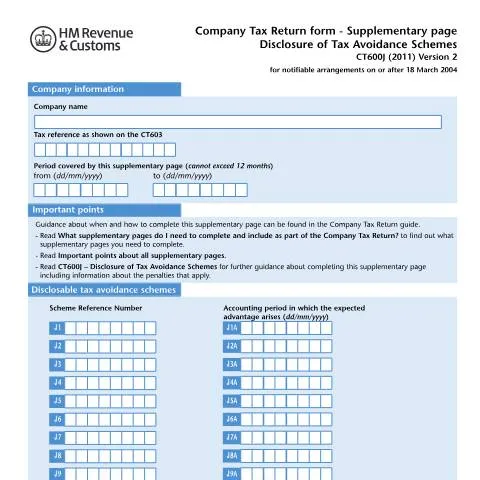
The CT600J (2011) Version 2 form is a crucial element in the United Kingdom's tax landscape, specifically focused on the disclosure of tax avoidance schemes by companies. This document plays a vital role in maintaining transparency and ensuring compliance with HM Revenue & Customs (HMRC) regulations. Each company, when engaged in disclosable tax avoidance schemes, is required to complete this supplementary page alongside their Company Tax Return. What does the submission of this document involve, and how can it affect your business?
The Underlying Purpose: Why the CT600J Matters
The disclosure of tax avoidance schemes through the CT600J form is necessary to inform HMRC about specific tax arrangements that fall under the category of notifiable schemes. This is essential to foster transparency in the UK tax system. By reporting these schemes, companies contribute to the larger framework of tax compliance, helping to detect and deter aggressive tax avoidance.
- Tax Compliance: Filing the CT600J is part of a company's obligation to report any tax schemes that may be considered avoidance.
- Legal Framework: The need for this disclosure arises from legislation aimed at preventing tax avoidance across the UK.
- Penalties for Non-compliance: Companies that fail to disclose relevant schemes may face financial penalties and additional scrutiny from HMRC.
Understanding Company Profiles Subject to the CT600J
Not all companies are required to fill out the CT600J form. The necessity to disclose depends on various factors, including the nature of the tax avoidance schemes involved. Understanding which companies must submit this form can prevent potential pitfalls.
- Large Corporations: Often the primary entities that engage in complex tax schemes.
- Small and Medium Enterprises (SMEs): May also be impacted if they use specific tax avoidance arrangements.
- Partnerships: In some cases, partnerships with significant tax avoidance schemes must disclose under the same regulations.
Identifying Disclosable Tax Avoidance Schemes
Companies must determine whether their arrangements qualify for disclosure. Here are some key identifiers:
- Arrangements that offer a tax advantage.
- Entities structured to reduce their tax liability significantly.
- Any scheme designed to exploit loopholes in tax legislation.
Completing the CT600J Form: A Step-by-Step Guide
Filling out the CT600J requires meticulous attention to detail to ensure compliance with HMRC's expectations. Below is a breakdown of the key sections of the form that need your focus.
Company Information
The first section asks for basic company details:
- Company Name: Enter the legal name of your entity.
- Tax Reference: Use the reference number as shown on the CT603.
Period Covered
Your disclosure must not exceed a 12-month period. Specify the start and end dates in the format of dd/mm/yyyy:
| Field | Example |
|---|---|
| Start Date | 01/04/2022 |
| End Date | 31/03/2023 |
Disclosure of Tax Avoidance Schemes
In this section, you will need to list the specific disclosable tax avoidance schemes by providing a unique Scheme Reference Number. Each scheme portion must correspond to the accounting period in which the expected tax advantage arises:
- Scheme Reference Number: Assign a reference number to each scheme you are reporting.
- Accounting Period: Document the relevant period for each scheme's benefit.
Understanding the Consequences of Filing (or Not Filing)
Completing the CT600J isn't merely a formality; it has tangible consequences for your business. The act of failing to disclose can result in serious repercussions.
Potential Penalties
Companies that neglect to file the CT600J or provide inaccurate information may incur significant penalties. HMRC employs a penalty framework that aims to encourage disclosure:
- Financial Penalties: Non-disclosure can lead to fines, the amount of which is determined based on the severity of the omission.
- Increased Scrutiny: Past failures can lead to closer examination of future filings.
Tracking Your CT600J Submission: What Comes Next?
Once you've submitted your CT600J, it's essential to track the status of your disclosure. HMRC provides avenues for companies to follow up on their submissions effectively.
Follow-Up Procedures
Here are some steps to take:
- Acknowledgment: Ensure you receive an acknowledgment of your submission from HMRC immediately.
- Responding to Queries: Be prepared to provide additional information or clarification if HMRC reaches out.
The CT600J in the Broader Tax Compliance Framework
The CT600J does not exist in isolation; it is part of a more extensive tax compliance framework that includes several forms and supplementary pages. Understanding its place in this ecosystem is crucial for corporate governance.
- Company Tax Return (CT600): The CT600J is a supplementary form to this primary tax return.
- Other Supplementary Pages: Companies may need to complete additional forms based on their financial activities.
- HMRC Oversight: HMRC regularly reviews submissions to ensure compliance with tax laws.
Avoiding Common Pitfalls in the Submission Process
While completing the CT600J, there are several pitfalls that individuals and companies frequently encounter. Staying aware of these can help ensure your submission is successful.
Common Errors to Watch Out For
- Incorrect Dates: Ensure that the period covered does not exceed 12 months.
- Misplaced Information: Double-check company information aligns with HMRC records.
- Incomplete Scheme References: Ensure that all disclosable schemes are reported accurately.
Conclusion: The Importance of Proactive Disclosure
In an era where tax compliance is more scrutinized than ever, the CT600J form serves as an essential tool for companies to disclose tax avoidance schemes transparently. By understanding its nuances, completing it accurately, and submitting it on time, businesses not only protect themselves from penalties but also contribute to a more robust tax system. The world of corporate taxes can be complex, but through careful navigation of the CT600J process, companies can safeguard their interests and build trust with HMRC.
Understanding the Framework of Corporation Tax Avoidance Schemes
The disclosure of tax avoidance schemes in the UK is governed by specific regulations aimed at increasing transparency and compliance among corporations. The main piece of legislation is the Finance Act, which mandates that certain types of tax avoidance schemes must be reported to HM Revenue & Customs (HMRC). This obligation is in place to combat tax avoidance activities that undermine the fairness of the tax system. The process begins with understanding what qualifies as a tax avoidance scheme, which is typically characterised by arrangements that aim to achieve a tax advantage that is not consistent with the intention of the law.
The CT600J form (Corporation Tax: disclosure of tax avoidance schemes) serves as the primary tool for corporate entities to fulfil their reporting obligations. Companies must submit this form if they have used a tax avoidance scheme that falls under the ‘Disclosure of Tax Avoidance Schemes’ (DOTAS) regime. Notably, the schemes subject to disclosure are assigned specific reference numbers by HMRC, known as DOTAS scheme reference numbers. These identifiers play a crucial role in ensuring that HMRC can track and assess the effectiveness of various schemes over time. Companies are encouraged to keep thorough records and documentation related to their use of such schemes, as HMRC may request additional information to substantiate disclosures made on the CT600J form.
The Penalties for Non-Compliance and the Importance of Timely Disclosure
Non-compliance with the disclosure requirements can lead to significant penalties. HMRC has the authority to impose financial penalties on companies that fail to report their use of tax avoidance schemes. The penalty structure can be quite severe, with fines that can range from £5,000 up to £1 million depending on the particulars of the case. Furthermore, if a company is found to have made misleading or inaccurate disclosures, additional charges can be levied. Therefore, it is paramount for businesses to ensure they understand their obligations under the law and to seek professional advice when necessary to avoid pitfalls.
Timely disclosure, specifically, is critical. The CT600J form must be filed as part of the Corporation Tax return, which is typically due 12 months after the end of the accounting period. Companies must be vigilant about keeping track of these deadlines, as late submissions can incur further penalties. Moreover, any changes in tax legislation or HMRC guidelines should be closely monitored, as these can influence the reporting landscape and requirements. Companies may also want to employ tax advisors or legal professionals who specialize in tax law to navigate the intricacies of tax avoidance schemes and ensure compliance with all relevant statutory obligations.
Disclosures and the Impact on Corporate Reputation
Disclosing tax avoidance schemes can have wider implications beyond mere compliance; it can significantly affect a company’s reputation. In an era where corporate social responsibility and ethical business practices are in the spotlight, being associated with tax avoidance strategies can tarnish a company's image. Stakeholders, including customers, investors, and employees, are increasingly scrutinising the tax practices of companies. Transparency in tax matters, particularly in the context of avoiding compliance with tax obligations, can serve as a litmus test for a corporation's ethical stance.
Companies should consider the reputational risks associated with tax avoidance schemes and weigh these against the potential financial benefits. The backlash from public opinion can lead to loss of customer trust, decreased sales, or even calls for boycotts. Consequently, there is a growing trend among businesses to adopt transparent tax strategies that align with public expectations and regulatory requirements. This shift is not only beneficial in maintaining a positive corporate image but also crucial in fostering long-term sustainability and compliance with evolving tax laws.
Furthermore, companies that proactively engage in responsible tax practices often find that they can enhance their relationships with regulators and the public alike. By demonstrating a commitment to ethical tax behaviour, businesses can set themselves apart from competitors, positioning themselves as leaders in corporate responsibility within their respective industries.