When Trust and Estate Capital Gains Tax Obligations Meet Complex Asset Disposals
For trustees and personal representatives managing estates with significant asset portfolios, the SA905 supplementary form represents one of HMRC's most detailed capital gains tax reporting requirements. This eight-page supplement to the trust and estate tax return captures every disposal from residential property to cryptoassets, demanding meticulous record-keeping and precise calculations across multiple asset categories.
The complexity emerges not merely from the breadth of assets covered, but from the intricate interplay between different disposal types, relief claims, and loss utilisation strategies. Unlike individual capital gains reporting, trust and estate disposals often involve vulnerable beneficiary elections, connected person transactions, and sophisticated loss management across multiple tax years dating back to 1995-96.
What distinguishes SA905 from simpler capital gains forms is its dual-track structure: residential property disposals receive dedicated treatment on pages TC1-TC3, whilst all other assets—from listed securities to valuable antiques—flow through separate computational pathways that ultimately converge in the final liability calculation.
The Trustee and Personal Representative Landscape
SA905 serves two distinct but overlapping communities within the UK's trust and estate administration framework. Trustees file this form when their trust has disposed of chargeable assets during the tax year, regardless of whether gains or losses resulted. The threshold isn't monetary—any disposal triggers the reporting obligation, even if reliefs eliminate the final tax charge.
Personal representatives of deceased estates face different timing pressures. They must complete SA905 for disposals occurring during the administration period, typically spanning from death until final distribution to beneficiaries. This can extend across multiple tax years, creating complex loss utilisation opportunities as earlier years' unused losses carry forward to offset later gains.
The form's scope extends beyond traditional UK-resident trusts. Non-resident trusts with UK residential property disposals must navigate the form's residential property sections, whilst mixed trusts with both UK and overseas assets require careful segregation between UK-chargeable and non-UK disposals.
| Trust Type | SA905 Requirement | Special Considerations |
|---|---|---|
| Discretionary trust (post-1978) | Mandatory for any disposal | Multiple trust rules apply (box 5.18) |
| Disabled person's trust | Mandatory for any disposal | Enhanced annual exempt amount |
| Estate in administration | Required during admin period | Probate values as base cost |
| Non-resident trust | UK residential property only | Limited relief availability |
Particular complexity arises for vulnerable beneficiary trusts, where special capital gains tax treatment allows trustees to claim relief reducing the trust's tax rate to match the beneficiary's personal rate. This election, referenced throughout SA905's relief columns, requires careful coordination with beneficiary circumstances and can significantly impact the computational flow.
Decoding the Asset Classification Matrix
SA905's most distinctive feature lies in its granular asset categorisation system, where each disposal receives a specific letter code that determines its computational pathway through the form. Understanding these classifications proves crucial for accurate completion, as misclassification can route transactions through incorrect relief and loss utilisation mechanisms.
Residential property disposals split between UK properties (code R) and non-UK residential assets (code N). This distinction carries profound implications beyond mere geographical classification. UK residential property disposals benefit from the full range of UK capital gains reliefs, whilst non-UK residential property faces restricted relief availability and different loss utilisation rules.
The cryptoasset classification (code C) reflects HMRC's evolving approach to digital assets. These disposals require separate identification within the 'other assets' category, with specific boxes (5.9A and 5.10A) capturing cryptoasset gains and losses respectively. The segregation assists HMRC's monitoring of this rapidly expanding asset class whilst maintaining computational consistency with traditional asset categories.
Listed securities (code Q) encompass shares traded on recognised stock exchanges, unit trusts, and similar instruments. The definition extends beyond obvious cases to include certain overseas securities and depositary receipts, requiring trustees to evaluate each holding against HMRC's detailed guidance.
Unlisted shares and securities (code U) capture private company shareholdings, partnership interests, and similar equity investments. These often involve connected party transactions requiring special disclosure and computational treatment, particularly where the trust holds significant stakes in family companies.
Navigating the Residential Property Computational Framework
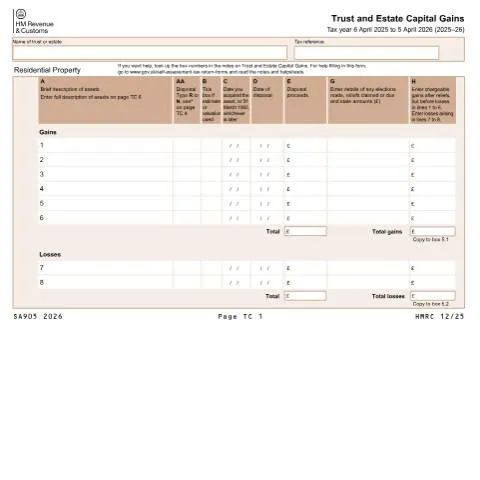
Pages TC1 and TC3 of SA905 establish a self-contained computational system for residential property disposals, reflecting the UK's heightened focus on property investment taxation. The framework operates independently from other asset categories until the final integration stage, allowing for distinct relief applications and loss utilisation strategies.
Each residential property disposal demands comprehensive data capture across eight columns. Column A requires a brief description that must balance brevity with sufficient detail for HMRC identification purposes. "London flat" proves inadequate, whilst "2-bedroom flat, 15 Maple Court, SW1A 1AA" provides appropriate specificity without excessive detail.
The acquisition date entry (column C) incorporates the fundamental "31 March 1982 rule"—where assets held before this date use 31 March 1982 as the deemed acquisition date for computational purposes. This rule simplifies calculations whilst eliminating pre-1982 gains from the charge to tax, though trustees must still maintain evidence of actual acquisition dates for compliance purposes.
Column B's estimate/valuation tick box carries significant compliance implications. Ticking this box signals to HMRC that disposal proceeds, acquisition costs, or enhancement expenditure rely on estimates rather than definitive figures. Such estimates must rest on reasonable bases—professional valuations, comparable transactions, or documented market evidence—and trustees should retain supporting documentation anticipating potential HMRC enquiries.
Disposal proceeds (column E) extend beyond simple sale receipts to encompass market value where transactions occur between connected parties, deemed disposal proceeds for gifts, and insurance receipts where assets are destroyed or damaged. The computational complexity increases where part-disposals occur, requiring apportionment calculations that SA905's format struggles to accommodate within its column structure.
Managing the Other Assets Computational Pathway
Page TC2 handles all non-residential property disposals through an identical column structure, but the underlying computational principles diverge significantly. Unlike residential property's streamlined approach, other assets navigate a complex web of reliefs, each with distinct eligibility criteria and computational mechanics.
Business Asset Disposal Relief (formerly Entrepreneurs' Relief) provides the most significant tax advantage for qualifying disposals, reducing the effective capital gains tax rate to 10% on lifetime gains up to £1 million. Qualifying disposals must satisfy stringent ownership and activity tests, typically requiring at least two years' ownership of trading company shares or business assets immediately before disposal.
The relief's interaction with trust structures creates particular complexity. Personal representatives can claim the relief where the deceased satisfied the qualifying conditions, but trustees face more restrictive rules. The relief generally remains unavailable to discretionary trusts, though specific provisions exist for trusts where beneficiaries have worked in the underlying business.
Investors' Relief targets qualifying unlisted trading company shares held for at least three years, offering a 10% tax rate on gains up to £10 million lifetime limit. The relief's relatively recent introduction (2016) means fewer trusts currently benefit, but its generous lifetime allowance makes it increasingly relevant for trust portfolios with significant unlisted equity holdings.
Column G's relief details require precise monetary quantification. Vague entries like "Business Asset Disposal Relief claimed" prove insufficient—trustees must specify "Business Asset Disposal Relief: £45,000" to demonstrate the exact relief amount claimed. Where multiple reliefs apply to single disposals, each relief requires separate identification and quantification.
Loss Utilisation Strategy Across Multiple Tax Years
SA905's loss management framework operates across a complex temporal landscape, distinguishing between current year losses, losses from 1996-97 onwards, and pre-1996-97 losses subject to different utilisation rules. This historical stratification reflects successive changes in capital gains tax legislation, creating opportunities for sophisticated loss planning whilst demanding meticulous record-keeping.
Current year losses (those arising in 2025-26) receive priority treatment, automatically offsetting against current year gains before any brought-forward losses come into play. The form's structure in boxes 5.20-5.23 captures this automatic offset, with unused current year losses either transferring to beneficiaries or carrying forward to future years.
Brought-forward losses from 1996-97 onwards (box 5.24) can offset against any type of capital gain, providing maximum flexibility for loss utilisation planning. However, these losses must be used in chronological order—1996-97 losses before 1997-98 losses, and so forth—preventing cherry-picking of loss vintages to optimise tax positions.
Pre-1996-97 losses (box 5.27) face more restrictive utilisation rules, generally only offsetting against gains of the same type. These "clogged losses" require careful matching against appropriate gain types, with trustees needing to maintain detailed records of the original loss categories to ensure compliant utilisation.
| Loss Category | Utilisation Priority | Restrictions |
|---|---|---|
| Current year (2025-26) | First against current gains | Automatic offset |
| 1996-97 onwards | Second, chronological order | Against any gain type |
| Pre-1996-97 | Third, by matching | Same type gains only |
| Connected person losses | Special rules apply | Same connected person only |
Connected Person Transactions and Clogged Loss Complications
SA905's treatment of connected person transactions reflects HMRC's concern about artificial loss creation within family and trust structures. Where disposals occur between connected parties—including trustees and beneficiaries, or trustees and settlors—special rules prevent loss utilisation against unconnected party gains.
The connected person definition extends beyond obvious family relationships to encompass complex trust relationships. Trustees connect to beneficiaries, settlors, and their respective families, whilst companies connect to their shareholders above certain thresholds. These relationships can create unexpected connected status, particularly where multiple trust structures interrelate.
Clogged losses arising from connected person transactions can only offset against gains from disposals to the same connected person. This restriction prevents artificial loss creation through below-market transfers followed by loss claims against unrelated gains. The computational complexity increases where trustees deal with multiple connected parties across different tax years.
Box 5.22 requires trustees to identify clogged loss utilisation, whilst the tick box on page TC5 signals any clogged loss involvement to HMRC's processing systems. Failure to identify connected status can result in incorrect loss utilisation and potential penalties where HMRC later discovers the connections through their relationship mapping processes.
The form's transaction counting requirements (boxes showing R, N, Q, U, L, O, C codes) assist HMRC's risk assessment processes whilst providing data for policy development. High transaction volumes in particular categories may trigger additional scrutiny, particularly for cryptoasset dealings or frequent property transactions suggesting commercial activity rather than investment holding.
Integration with the Broader Self Assessment Architecture
SA905 operates as a supplementary form within the trust and estate self assessment framework, with its computational outputs feeding directly into the main SA900 trust and estate return. The integration points occur at specific boxes where SA905 totals transfer to corresponding SA900 entries, creating a unified tax computation across all income and gains.
The annual exempt amount allocation between residential and other property gains (boxes 5.8 and 5.16) requires strategic consideration. For 2025-26, most trusts receive a £6,150 annual exempt amount, though disabled person's trusts benefit from the full individual allowance of £12,300. The allocation between gain categories can optimise the overall tax position where different rates apply.
Capital losses carried forward (boxes 5.29 and 5.30) automatically transfer to the following year's SA905, creating a perpetual record of unused losses within HMRC's systems. However, trustees must maintain independent records as HMRC's systems may not capture all loss details, particularly regarding loss categorisation and connected person restrictions.
The form's submission follows the standard self assessment timetable, with 31 January representing the final deadline for both paper and online submissions. However, trustees should aim for earlier submission where significant tax liabilities arise, as payment deadlines align with submission deadlines rather than providing additional payment time.
HMRC's processing involves both automated validation and selective manual review. High-value transactions, significant relief claims, or unusual transaction patterns may trigger enquiry procedures extending beyond the normal one-year enquiry window. Comprehensive record-keeping and clear form completion provide the best defence against prolonged HMRC investigations whilst demonstrating compliance intent should disputes arise.