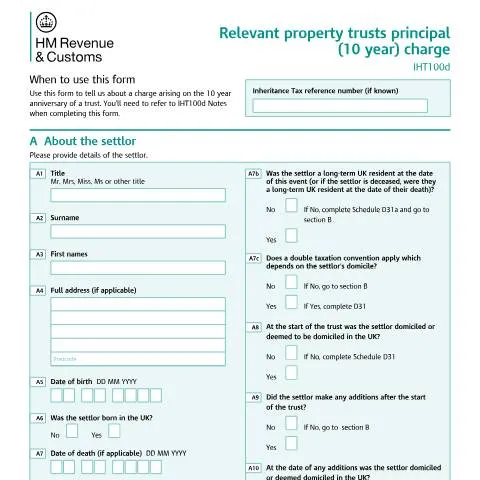
The Complexity Behind Trust 10-Year Anniversary Charges
When a trust reaches its tenth anniversary, trustees often discover they're stepping into one of the most intricate areas of UK tax law. The IHT100d form represents HMRC's mechanism for capturing the periodic charge that applies to relevant property trusts every decade. This charge isn't merely an administrative formality—it's a substantial tax event that can significantly impact trust assets and require careful navigation of complex valuation rules, relief claims, and domicile considerations.
Unlike straightforward inheritance tax calculations on death, the 10-year charge operates on a sophisticated sliding scale that takes into account the trust's entire history, the settlor's circumstances, and the current composition of trust assets. The form itself spans multiple pages and can trigger numerous supplementary schedules, each addressing specific asset types or circumstances that affect the final tax liability.
Identifying When the IHT100d Becomes Your Responsibility
The 10-year anniversary charge applies specifically to relevant property trusts, which encompasses most discretionary trusts and many other trust structures that don't qualify for special treatment under inheritance tax legislation. Trustees must complete the IHT100d if their trust was established on or after 27 March 1974 and contains relevant property at the anniversary date.
The timing calculation proves more nuanced than simply counting ten years from the trust's creation. HMRC requires the charge date to be calculated from the precise date the trust commenced, not from the end of the tax year or any rounded period. For trusts created through a will, this typically means ten years from the date of death, whilst lifetime trusts trigger the anniversary from the date the trust deed was executed and assets transferred.
Settlor Status and Its Cascading Effects
Section A of the form demonstrates how the settlor's circumstances fundamentally shape the entire filing process. The settlor's domicile status, both at the trust's commencement and at any subsequent addition dates, determines which schedules must be completed and potentially affects the scope of chargeable assets.
Trustees must navigate several critical decision points regarding the settlor's status. If the settlor died before 6 April 2025, or if the chargeable event occurred before this date, different rules may apply. The form specifically asks whether the settlor was a long-term UK resident—a concept that extends beyond simple domicile and requires careful analysis of the settlor's residential history over the 15 years preceding the relevant date.
| Settlor Circumstance | Required Schedule | Impact on Charge |
|---|---|---|
| Non-UK domiciled at trust commencement | D31 | May limit chargeable assets to UK property |
| Non-long-term UK resident | D31a | Potential exclusion of certain overseas assets |
| Double taxation treaty applicable | D31 | May provide relief or exemptions |
| Additions made after trust commencement | Various | Each addition assessed separately for domicile |
Decoding the Asset Categorisation Matrix
Section E presents trustees with a comprehensive breakdown of trust assets, but the distinction between columns A and B carries profound implications for both tax liability and payment options. Column A captures assets where inheritance tax must be paid immediately and cannot be spread over instalments, whilst Column B identifies assets eligible for instalment payment arrangements.
The categorisation isn't always intuitive. Control holdings of shares—where the trust holds more than 50% of voting rights—typically qualify for instalment treatment, as do land and buildings. However, minority shareholdings in listed companies fall into Column A, requiring immediate payment despite potentially substantial values.
Valuation Principles and Professional Requirements
Asset valuations must reflect market value at the specific anniversary date, not approximate or rounded figures. For certain assets, particularly unlisted shares and property, trustees typically need professional valuations. The form doesn't explicitly state this requirement, but HMRC's acceptance of declared values often depends on supporting professional opinions, especially for significant assets.
Household and personal goods require particular attention. While many trustees assume these items carry minimal value, HMRC expects realistic market valuations for items such as antiques, artwork, or jewellery. The £6,000 exemption that applies to inheritance tax on death doesn't extend to trust charges, meaning every item potentially contributes to the tax liability.
Navigating the Supplementary Schedule Landscape
Section D's checkbox system can trigger up to nine additional schedules, each adding layers of complexity to the filing process. The decision tree isn't sequential—multiple schedules often apply simultaneously, and completing one may reveal the need for others.
Schedule D32 for stocks and shares becomes mandatory for most trusts holding investment portfolios. This schedule requires detailed information about each holding, including acquisition dates, costs, and dividend entitlements. For trusts with extensive portfolios, this schedule alone can run to dozens of pages.
Agricultural relief claims through Schedule D37 require not only property details but also evidence of agricultural use for the preceding two years. Business relief claims via Schedule D38 demand comprehensive business information and may trigger HMRC enquiries into the underlying commercial activities.
International Complications
Trusts with overseas assets face particularly complex filing requirements. Schedule D39 must detail foreign assets, but trustees must also consider whether double taxation agreements provide relief. The interaction between UK inheritance tax charges and foreign tax liabilities can significantly affect the ultimate tax position.
Non-UK domiciled settlors add further complexity through schedules D31, D31a, and D31b. These schedules don't simply exclude foreign assets—they require detailed analysis of the settlor's residential and domicile history, potentially spanning decades of documentation.
Liability Calculations and Relief Claims Strategy
Section F's treatment of liabilities and reliefs represents the final major component affecting tax liability. Liabilities must be allocated between Column A and Column B assets, reflecting the security arrangements and payment priorities established in the trust deed.
Relief claims require substantial documentation and strategic consideration. Agricultural relief at 100% can eliminate tax liability entirely, but qualifying requires detailed evidence of agricultural use and may restrict future flexibility in asset management. Business relief operates similarly, but the 'wholly or mainly' tests for business property can prove contentious.
The Instalment Election Decision
Box E21's simple yes/no question about instalment payments carries significant implications. Electing instalment treatment spreads tax payments over ten annual instalments but triggers interest charges on outstanding amounts. Trustees must balance cash flow considerations against the total cost of the extended payment period.
The instalment option doesn't apply automatically—trustees must actively elect this treatment and specify how many instalments they're paying immediately. This flexibility allows for hybrid approaches where some instalments are paid upfront to reduce interest exposure whilst preserving cash flow for remaining payments.
Submission Processes and HMRC Interactions
Unlike many modern tax forms, the IHT100d primarily operates through postal submission, though HMRC increasingly encourages digital communication for supporting documentation. The form must reach HMRC within 12 months of the anniversary date, but earlier submission often proves advantageous for cash flow planning.
HMRC's processing typically involves initial administrative checks followed by more detailed review of valuations and relief claims. Queries aren't uncommon, particularly for substantial estates or complex asset structures. Trustees should anticipate potential correspondence and ensure supporting documentation remains readily accessible.
Payment Timing and Penalties
Tax payments follow different deadlines from form submission. Generally, payment must accompany the form submission, though instalment elections modify this requirement. Late payment triggers both interest charges and potential penalties, with HMRC's penalty regime becoming increasingly stringent.
The interaction between form deadlines and payment requirements can create cashflow challenges, particularly for trusts holding illiquid assets. Trustees may need to arrange borrowing or consider asset disposals to meet payment obligations whilst maintaining the trust's long-term objectives.
Professional Support and Strategic Considerations
The IHT100d's complexity typically necessitates professional assistance, particularly for trusts with substantial assets or international elements. Tax advisers, solicitors, and valuers each contribute specialist expertise, but coordination between professionals becomes crucial for accurate and timely completion.
Strategic planning around anniversary dates can significantly impact tax liabilities. Asset disposals before anniversary dates remove items from the charge, whilst strategic additions immediately after anniversaries maximise the period before the next charge. However, such planning must align with broader trust objectives and beneficiary needs.
The form serves not merely as a tax return but as a comprehensive snapshot of trust assets and management. HMRC increasingly uses this information for broader compliance monitoring, making accuracy and completeness essential beyond the immediate tax calculation. Trustees who maintain detailed records and engage professional support typically navigate the process more efficiently whilst minimising compliance risks.
Understanding the 10-Year Anniversary Charge Mechanism
The 10-year anniversary charge represents a fundamental pillar of the UK's trust taxation framework, designed to ensure that wealth held in discretionary trusts doesn't escape Inheritance Tax indefinitely. This periodic charge applies to the value of trust property at each 10-year interval from when the trust was established, creating what HMRC terms "relevant property charges."
The calculation methodology differs significantly from standard Inheritance Tax computations. Rather than applying the full 40% rate, the 10-year charge uses a maximum rate of 6% of the trust's value above the nil-rate band. However, this headline rate can be substantially reduced depending on the settlor's circumstances when the trust was created and any distributions made during the preceding decade.
HMRC applies what's known as the "effective rate" calculation, which considers the hypothetical tax that would have been payable if the settlor had made an outright gift of the trust property at the time of settlement. This rate is then applied to the trust's current value, but crucially, it's capped at 30% of the lifetime rate that would apply to an individual—hence the 6% maximum (30% of 20%).
The timing of when trusts were established significantly affects the charge calculation. Trusts created before 27 March 1974 benefit from more generous treatment, as they're deemed to have had their first 10-year anniversary on 1 April 1983. This historical quirk means some very old trusts may have different anniversary dates than might be expected from their actual creation date.
For trusts with mixed property types, including both UK and overseas assets, the calculation becomes more complex. Each category of property may be subject to different reliefs or exemptions, and trustees must carefully segregate values when completing form IHT100d. Agricultural property relief and business property relief can substantially reduce the chargeable value, but these reliefs must be actively claimed and properly evidenced.
Navigating Complex Trust Structures and Multiple Anniversaries
Modern trust arrangements often involve sophisticated structures that can complicate the 10-year anniversary charge process. When dealing with multiple connected trusts created by the same settlor, HMRC's "related settlement" provisions may apply, potentially affecting the rate of tax charged across all connected arrangements.
Sub-trusts created from distributions of capital from a main trust inherit the anniversary date of the parent trust, not the date of their own creation. This means trustees managing multiple tiers of trusts must maintain meticulous records of anniversary dates across potentially dozens of related settlements. Form IHT100d must accurately reflect these relationships, as incorrect reporting can trigger lengthy HMRC enquiries.
Pilot trusts—small initial settlements designed to use up the settlor's nil-rate band—require particular attention at their 10-year anniversaries. While the initial charge may be minimal due to the low value, subsequent additions to these trusts can create significant complications for future anniversary calculations. Trustees must ensure they correctly report all additions made to pilot trusts throughout the 10-year period.
International elements add another layer of complexity. Trusts with non-UK resident trustees or beneficiaries may benefit from double taxation treaty provisions, but these must be specifically claimed on form IHT100d. The residence status of trustees at the anniversary date determines the scope of UK taxation, and recent changes to the deemed domicile rules affect how overseas assets are treated for Inheritance Tax purposes.
Excluded property trusts, typically established by non-UK domiciled individuals, may find their status changes if the settlor becomes deemed domiciled under the 15-year rule. This can bring previously exempt overseas assets within the scope of the 10-year charge, requiring careful analysis of the settlor's residence and domicile history.
Managing Valuation Challenges and Professional Requirements
Accurate valuation of trust assets represents one of the most critical aspects of completing form IHT100d correctly. Unlike probate valuations, which reflect open market value at death, anniversary valuations must consider the specific restrictions and rights affecting trust property. Discounts for minority holdings in private companies or restrictions on the sale of trust assets can significantly impact the chargeable value.
Trustees often struggle with valuing illiquid assets such as unquoted shares, intellectual property, or unique collectibles. HMRC expects professional valuations for significant assets, and the Shares and Assets Valuation division may challenge valuations that appear optimistic. Recent case law has clarified that trustees must consider all relevant factors affecting value, including any arrangements between the trust and connected parties.
The interaction between anniversary charges and ongoing trust distributions creates additional valuation complexities. If trustees make significant distributions shortly before or after an anniversary date, HMRC may scrutinise whether the timing was designed to minimise tax liabilities. The "associated operations" provisions can potentially recharacterise such arrangements for tax purposes.
Strategic Considerations and Professional Compliance
Forward planning around 10-year anniversaries often involves sophisticated tax mitigation strategies that must be carefully documented when completing form IHT100d. Trustees may consider making distributions before anniversary dates to reduce the chargeable value, but such strategies require careful analysis of the exit charge provisions that apply to distributions from discretionary trusts.
The interaction between anniversary charges and exit charges creates a complex web of tax consequences that trustees must navigate. Distributions made within the 10-year period are subject to exit charges calculated by reference to the rate applied at the most recent anniversary. This means that minimising the anniversary charge through pre-anniversary distributions may have implications for future distribution planning.
Professional trustees and family offices increasingly use sophisticated modelling software to project the long-term tax consequences of different strategies around anniversary dates. However, form IHT100d requires trustees to report actual circumstances, not projected scenarios, and HMRC takes a dim view of arrangements that appear artificial or contrived.
The growing use of insurance arrangements to fund Inheritance Tax liabilities adds another dimension to anniversary planning. Whole-of-life policies written in trust can provide liquidity to meet anniversary charges, but trustees must ensure such arrangements are properly structured and documented. HMRC may challenge insurance arrangements that don't demonstrate genuine commercial substance.
Recent regulatory changes affecting trust registration and reporting have increased the administrative burden on trustees approaching anniversary dates. The Trust Registration Service requires detailed information about trust arrangements, and discrepancies between TRS filings and IHT100d submissions can trigger HMRC enquiries. Trustees must ensure consistency across all reporting obligations.
The penalties for late filing or incorrect completion of form IHT100d have become increasingly severe. HMRC's approach to trust compliance has hardened significantly, with automatic penalty assessments for late filings and detailed enquiries into valuations and calculations. Professional indemnity insurance for trustees has become essential, given the potential exposure to both tax liabilities and penalties.
Trustees dealing with multiple jurisdictions must also consider the impact of international tax reforms, including the OECD's Common Reporting Standard and various bilateral exchange of information agreements. Information reported on form IHT100d may be shared with overseas tax authorities, potentially triggering additional compliance obligations in other countries where the trust has connections.