When Foreign Domicile Reshapes Your Inheritance Tax Obligations
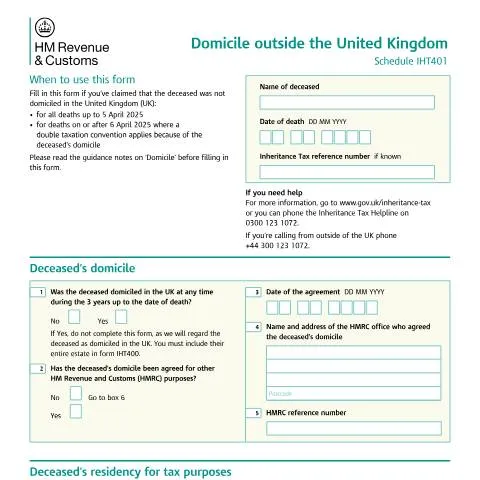
The death of a loved one who spent their final years abroad can trigger complex inheritance tax implications that catch many families unprepared. While most estates follow the standard IHT400 process, those involving individuals who established their primary residence outside the UK face an entirely different set of rules and requirements. Form IHT401 serves as the critical gateway for claiming non-UK domicile status, potentially reducing inheritance tax liability significantly by excluding foreign assets from HMRC's reach.
This specialised schedule becomes essential when the deceased's connection to the UK had weakened sufficiently to establish domicile elsewhere. However, HMRC scrutinises these claims rigorously, requiring detailed evidence of the deceased's intentions, movements, and ties. The stakes are considerable: successfully proving foreign domicile can exclude substantial overseas assets from inheritance tax, while failing to substantiate the claim brings the entire worldwide estate into the UK tax net.
The form operates within strict temporal boundaries. For deaths occurring up to 5 April 2025, it applies to all claims of non-UK domicile. From 6 April 2025 onwards, its use becomes more restricted, applying only where double taxation conventions remain relevant due to the deceased's domicile status. This timeline reflects significant changes to UK inheritance tax rules affecting non-domiciled individuals.
The Three-Year Rule and Its Decisive Impact
Before diving into the complexities of proving foreign domicile, executors must navigate the preliminary hurdle that can instantly disqualify their claim. The three-year rule represents HMRC's most immediate filter: if the deceased was domiciled in the UK at any point during the three years preceding their death, they are automatically treated as UK domiciled for inheritance tax purposes, regardless of their actual residence or intentions at the time of death.
This rule operates as an absolute barrier. There are no exceptions, no appeals to circumstances, and no consideration of the deceased's subsequent actions or declarations. If the deceased was UK domiciled on any single day within those crucial three years, form IHT401 becomes irrelevant, and the entire worldwide estate must be included in form IHT400.
The implications extend beyond simple timing. Individuals who moved abroad but maintained UK domicile for tax planning purposes, those who returned briefly to the UK for family reasons, or those whose domicile status remained unclear during this period all fall within this net. Even a temporary return to UK domicile for strategic reasons—perhaps to benefit from certain tax provisions—can trigger this rule.
| Scenario | Three-Year Impact | Form Required |
|---|---|---|
| UK domicile until 2019, died 2023 | Rule triggered | IHT400 only |
| Foreign domicile since 2018, died 2024 | Rule not triggered | IHT400 + IHT401 |
| Brief UK domicile return in 2022, died 2024 | Rule triggered | IHT400 only |
Leveraging Previous HMRC Agreements and Precedents
When HMRC has previously agreed the deceased's domicile status for other tax purposes, this creates a valuable precedent that can significantly streamline the IHT401 process. These prior determinations—whether for income tax, capital gains tax, or other inheritance tax matters—carry substantial weight in current assessments, though they don't guarantee automatic acceptance.
The form requires specific details of any previous agreements: the exact date of the determination, the HMRC office that made the decision, and the reference number. This information allows HMRC to retrieve the full file and understand the reasoning behind the original decision. However, circumstances may have changed since the previous determination, and HMRC retains the right to reassess based on new evidence or altered circumstances.
Previous agreements prove particularly valuable when they involved detailed scrutiny of the deceased's circumstances. If HMRC previously accepted foreign domicile after extensive investigation, including examination of the deceased's intentions, ties, and residence patterns, this creates a strong foundation for the current claim. Conversely, agreements made without detailed investigation or based on limited information may carry less weight.
Executors should gather all documentation related to previous domicile determinations, including correspondence, supporting evidence submitted, and the reasoning provided by HMRC. This background information helps present a consistent narrative and demonstrates the continuity of the deceased's circumstances and intentions.
UK Residence Patterns and Their Domicile Implications
The deceased's UK residence history for income tax purposes provides crucial evidence for domicile determination, but the relationship between residence and domicile remains complex and nuanced. Form IHT401 requires detailed information about UK residence during the six years before death, but HMRC's analysis extends much further, potentially examining the entire 20-year period preceding death.
Residence and domicile serve different purposes in tax law. An individual can be UK resident for income tax while maintaining foreign domicile for inheritance tax, or vice versa. However, patterns of residence provide important clues about the deceased's intentions and connections, which form the heart of domicile determination.
Continuous UK residence over many years suggests strong ties and potentially an intention to remain, supporting UK domicile claims. Conversely, minimal UK residence or clear patterns of residence elsewhere support foreign domicile arguments. However, HMRC looks beyond simple day-counting to understand the quality and purpose of residence periods.
Analysing Residence Patterns
- Business-driven residence: Extended UK stays for work purposes may carry less weight for domicile than personal or family-motivated residence
- Seasonal patterns: Regular returns to the UK during specific seasons might indicate retained emotional ties or convenience rather than domicile intentions
- Healthcare-related residence: UK residence for medical treatment, while practical, doesn't necessarily indicate domicile intentions
- Family-driven residence: Stays to be near UK-resident family members often carry more weight in domicile analysis
The form requires executors to provide comprehensive details of residence periods, including the specific tax years involved. This information must align with any previous tax returns or residence determinations, as inconsistencies can undermine the domicile claim.
Constructing the Deceased's Life Narrative
The heart of form IHT401 lies in painting a comprehensive picture of the deceased's life, intentions, and connections. HMRC requires extensive biographical information that goes far beyond basic facts to understand the deceased's mindset and motivations. This narrative approach recognises that domicile determination involves assessing subjective intentions alongside objective facts.
The biographical section demands meticulous attention to detail. Starting with birth location and nationality, the form builds a chronological picture of the deceased's movements and affiliations. However, birth circumstances don't determine final domicile—individuals can abandon their domicile of origin and acquire a new domicile of choice through their actions and intentions.
Educational and employment history carries particular weight because these factors often drive initial moves abroad and can indicate long-term intentions. A career-driven move to Hong Kong followed by decades of work and family life there tells a different story than a brief overseas assignment with planned return to the UK. HMRC examines not just where the deceased worked, but the nature of their roles, the duration of commitments, and evidence of career development in the claimed domicile country.
Critical Evidence Categories
- Physical presence patterns: Detailed records of visits to the UK, including duration, accommodation, and purpose
- Intention indicators: Written statements, will provisions, insurance arrangements, and other documents revealing future plans
- Social and family connections: Where close family members live, social circles, club memberships, and community involvement
- Financial ties: Banking relationships, investment patterns, pension arrangements, and property ownership
UK visits require particularly careful documentation. HMRC scrutinises not just frequency and duration, but accommodation choices and visit purposes. Staying in hotels suggests different intentions than maintaining a UK residence. Visits for specific events like family celebrations indicate different ties than extended stays for business or healthcare.
Special Considerations for Female Deceased Persons
Form IHT401 includes specific provisions for women who married before 1 January 1974, reflecting historical legal principles that treated married women's domicile as dependent on their husband's domicile. These rules, while outdated, continue to affect inheritance tax determinations for estates of women from earlier generations.
The legal principle of dependent domicile created complex situations. A woman who established clear intentions to live permanently in one country might have been legally domiciled elsewhere due to her husband's domicile. Conversely, a woman with strong UK ties might have acquired foreign domicile through marriage, even without personal connection to her husband's domicile country.
The form requires comprehensive information about the deceased's husband, including his birth location, nationality, and employment history during the marriage up to 1 January 1974. This information helps HMRC understand the legal domicile rules that applied during the relevant period and their impact on the deceased's domicile status.
For women with multiple marriages before 1974, the analysis becomes more complex, requiring examination of each husband's circumstances and the timing of marriages and divorces. The form accommodates these complications by requesting information about all relevant husbands during the critical period.
Post-1974 developments matter significantly. After dependent domicile rules ended, women could acquire independent domicile through their own actions and intentions. A woman who remained in her husband's domicile country after 1974 but developed clear intentions to make it her permanent home could acquire domicile of choice in that country, separate from the historical dependent domicile.
Estate Distribution and Double Taxation Implications
The final section of form IHT401 bridges the gap between domicile determination and practical inheritance tax consequences. Understanding how the estate will be distributed under the law of the claimed domicile country helps HMRC assess both the validity of the domicile claim and the tax implications of accepting it.
Different legal systems handle estate distribution in varying ways, and these differences can significantly impact inheritance tax calculations. Some countries grant surviving spouses automatic inheritance rights that might exceed UK spousal exemption limits, while others follow forced heirship rules that could affect tax planning strategies.
Professional advice from lawyers in the domicile country becomes crucial. HMRC expects executors to obtain expert guidance on local succession laws and attach this advice to form IHT401. This requirement reflects the complexity of international estate administration and HMRC's need to understand foreign legal principles that might affect UK tax calculations.
| Asset Location | UK Domiciled | Foreign Domiciled | Double Taxation Treaty Impact |
|---|---|---|---|
| UK property | UK IHT applies | UK IHT applies | May provide relief mechanisms |
| UK investments | UK IHT applies | UK IHT applies | Potential for treaty relief |
| Foreign property | UK IHT applies | No UK IHT | Treaty may allocate taxing rights |
| Foreign investments | UK IHT applies | No UK IHT | Complex treaty interactions possible |
Double taxation conventions add another layer of complexity, potentially providing relief even when UK inheritance tax would otherwise apply. These treaties vary significantly in their provisions, with some offering complete exemptions for certain asset types while others provide credit mechanisms for foreign taxes paid.
Foreign Tax Considerations
The interaction between UK inheritance tax and foreign death duties requires careful analysis. Some countries impose inheritance or estate taxes on UK assets of their residents, creating potential double taxation that treaties may or may not address adequately. Form IHT401 requires disclosure of expected foreign tax liabilities to help HMRC understand the full tax picture.
Executors must consider timing differences between tax systems, varying valuation methods, and different exemption structures. Some countries tax inheritance at the beneficiary level rather than the estate level, creating mismatches with UK inheritance tax principles that can complicate treaty relief claims.
Submission Strategy and Evidence Compilation
Successfully completing form IHT401 requires more than simply filling in boxes—it demands a strategic approach to evidence compilation and presentation that supports the domicile claim convincingly. HMRC's assessment process involves experienced officers who understand the nuances of domicile law and the common patterns in both genuine and questionable claims.
Documentation quality often determines success or failure. Contemporary evidence carries more weight than retrospective statements, and independent sources trump self-serving declarations. Bank statements showing consistent foreign residence, employment contracts demonstrating long-term commitments, and property purchases indicating permanent settlement all provide objective evidence of intentions.
The narrative thread connecting different pieces of evidence matters as much as individual documents. HMRC looks for consistency between stated intentions and actual behaviour, progression of ties over time, and logical explanations for any apparent contradictions. A coherent story supported by contemporaneous evidence creates a compelling case for foreign domicile.
Timing considerations affect both form completion and submission strategy. While form IHT401 accompanies the main inheritance tax return, executors often benefit from gathering domicile evidence early in the estate administration process. Some evidence becomes harder to obtain over time, particularly from foreign sources or elderly witnesses who knew the deceased's intentions.
Professional support proves invaluable for complex cases involving substantial foreign assets, unclear residence patterns, or previous HMRC disputes. Specialists in international estate planning understand HMRC's assessment criteria and can help present evidence in the most persuasive format while avoiding common pitfalls that undermine otherwise valid claims.