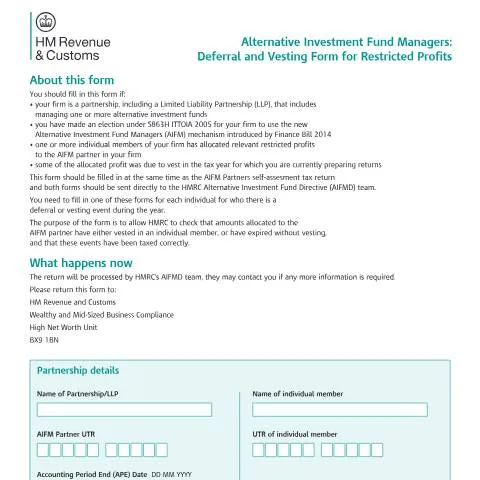
Understanding the HNWU11 Form: A Vital Tool for Investment Partnerships
In the intricate world of alternative investments, understanding the precise documentation required for compliance can make all the difference. The Alternative Investment Fund Managers: Deferral and Vesting Form for Restricted Profits (HNWU11) is a critical document for partnerships managing alternative investment funds. This form facilitates the process of reporting and ensuring that allocated profits are appropriately taxed, particularly when they relate to vesting or deferral events.
The Role of HNWU11 in Profit Management
The HNWU11 form is not just an administrative requirement. It serves as a mechanism through which the HM Revenue & Customs (HMRC) verifies that profits allocated to an Alternative Investment Fund Managers (AIFM) partner have been correctly taxed. The completion of this form is essential for compliance with the Income Tax (Trading and Other Income) Act 2005, particularly section S863H, which allows firms to opt into the AIFM taxation mechanism introduced by the Finance Bill 2014.
Key Situations for Submission
- Your firm is a partnership, including a Limited Liability Partnership (LLP), managing one or more alternative investment funds.
- Election under S863H ITTOIA 2005 has been made, allowing usage of the AIFM mechanism.
- Members of your firm allocated restricted profits to the AIFM partner.
- Allocated profits are due to vest in the current tax year you are preparing tax returns for.
This form is crucial for maintaining transparency and ensuring compliance with UK tax regulations, ultimately protecting both investors and the firm from potential penalties.
Filing the HNWU11: Methods and Requirements
Filing the HNWU11 can be done through various channels, each with its nuances. Understanding these channels will ensure that you choose the most efficient method for your partnership.
Online Submission
Submissions can be made through HMRC’s online services. This method is often preferred due to its convenience and real-time processing capabilities. When filing online:
- Ensure that you have registered for HMRC online services.
- Gather all necessary information beforehand to streamline the process.
- You will receive immediate confirmation once your form is submitted.
Paper Submission
While online submission is encouraged, some firms may prefer or require filing on paper. This method, while less efficient, is still a valid option. When choosing to submit via post:
- Complete the form accurately.
- Mail the completed form to the address specified by HMRC:
Paper submissions may take longer to process, so it is advisable to allow for extra time to avoid missing deadlines.
Decoding the HNWU11: Line by Line Guidance
This form comprises several sections, each requiring specific and precise information. A thorough understanding of each line is essential to mitigate errors that could lead to compliance issues or undue penalties.
Partnership Details
This section captures the basic details about the partnership, including:
- Name of Partnership/LLP: Enter the full legal name of your partnership.
- AIFM Partner UTR: Provide the Unique Taxpayer Reference number for the AIFM partner.
- Accounting Period End (APE) Date: Indicate the end date of the accounting period as per your financial records.
Member Information
Next, you’ll need to provide details about each individual member involved:
- Name of Individual Member: The full name of the member allocated the profits.
- UTR of Individual Member: The Unique Taxpayer Reference for this member.
Allocated Restricted Profits
In this critical section, you will detail the restricted profits allocated to the AIFM partner:
| Field | Description |
|---|---|
| 1. Restricted Profit Allocated to AIFM Partner | Specify the amount of restricted profit allocated. |
| 2. Tax Payable by AIFM Partner | Indicate the tax due based on the allocated profits. |
| 3. Tax Paid by AIFM Partner | Note the actual tax paid. |
| 4. Net Amount | Calculate the net profit after tax deductions. |
| 5. Cash | Detail cash amounts related to the profit. |
| 6. Instrument | Describe any instruments associated with the profits. |
Vesting and Deferral Details
The next part deals with profits that have vested or are deferred. This is crucial for compliance and tax assessments:
- Originating APE: Record the Accounting Period End that these amounts originate from.
- Date Vested: Specify the date the profits vested.
- Amount Due to Vest: Enter the total amount due to vest on vested profits.
Each of these fields must be completed accurately to ensure that HMRC can track and verify the taxation of these profits correctly. Mistakes or omissions may lead to significant repercussions for both the firm and its members.
Who Should Complete the HNWU11?
The HNWU11 form primarily concerns partners in investment management firms, particularly those involved in alternative investment funds. However, understanding the profile of those who must fill out this form is essential for compliance.
Typical Scenarios of Participants
Generally, individuals who are part of the following groups will need to fill out the HNWU11:
- Partners in a Limited Liability Partnership managing an alternative investment.
- Individuals who have been allocated restricted profits under the AIFM scheme.
- Members of partnerships who have made elections under S863H ITTOIA 2005.
Exceptions to Consider
While the form is targeted towards certain individuals, there are exceptions:
- Members who do not receive allocated profits due to varying partnership agreements may not need to file this form.
- Individuals whose profits are not restricted or have not made the requisite elections under S863H may also be exempt.
Understanding who is affected by this form ensures compliance and reduces the risk of filing unnecessary documents, saving time and resources.
Consequences of Filing (or Not Filing) the HNWU11
As with any official documentation, the consequences surrounding the HNWU11 can be significant. Timely and accurate filing is crucial.
Rights Granted by Proper Submission
Filing the HNWU11 correctly ensures that:
- Your partnership is recognized by HMRC as compliant with the AIFM taxation framework.
- Members are correctly taxed on their profits, mitigating the chances of disputes with HMRC.
- Future filings and assessments proceed smoothly, as accurate records are maintained.
Potential Penalties for Non-Compliance
Failing to submit the HNWU11 on time can lead to various penalties, including:
- Financial penalties based on unreported profits.
- Increased scrutiny from HMRC, leading to potential audits.
- Delays in processing tax returns for affected members.
Securing compliance by submitting the HNWU11 is not just about fulfilling a requirement; it’s about establishing a transparent and accountable partnership structure.
The Legal Framework Surrounding the HNWU11
The HNWU11 form operates within a broader legal context that governs the taxation of alternative investment funds in the UK. Understanding this framework is essential for partners navigating this complex landscape.
Legislation and Regulations
Key legislative texts that inform the requirements around the HNWU11 include:
- Income Tax (Trading and Other Income) Act 2005: This act defines the taxation framework for trading income and relevant elections, including those under S863H.
- Finance Act 2014: This act introduced the AIFM mechanism, setting the stage for how profits are managed and taxed within partnerships.
- Data Protection Act 2018: This act governs the handling of personal data within the context of tax filings, ensuring confidentiality and compliance with GDPR.
This legislative context underscores the importance of the HNWU11 form as a tool for both tax reporting and adherence to regulatory standards.
Ensuring Compliance with Practical Steps
To navigate the requirements of the HNWU11 successfully, consider the following practical steps:
- Prepare Early: Gather all necessary information ahead of time to avoid last-minute errors.
- Stay Informed: Regularly consult with tax advisors familiar with the AIFM framework to ensure compliance with any changes in legislation.
- Double-Check Entries: Review each section of the HNWU11 before submission to minimize the risk of mistakes.
By adhering to these practices, partnerships can enhance their compliance posture and ensure their filings are accepted smoothly by HMRC.
Final Thoughts on the HNWU11 Form
In the complex landscape of alternative investment fund management, the HNWU11 form plays a crucial role in ensuring that profits are allocated, taxed, and reported accurately. For partnerships involved in managing these investments, understanding the form and its implications is non-negotiable. By being proactive and diligent in completing and submitting this form, firms can protect themselves from potential penalties and foster a more robust, compliant operation.
Understanding the HNWU11 Form: Key Elements and Definitions
The HNWU11 form is primarily used by Alternative Investment Fund Managers (AIFMs) in the UK to report their deferred profits and profits subject to vesting. It is crucial for high-net-worth individuals and investment managers to grasp the underlying terminology and the specific reporting requirements associated with this form.
One of the essential aspects of the HNWU11 is the definition of 'restricted profits.' These are profits that cannot be immediately distributed to partners or shareholders due to various regulatory reasons, including compliance with the Financial Conduct Authority (FCA) guidelines. AIFMs often find themselves navigating complex regulatory frameworks, which dictate how and when profits can be distributed. Understanding these restrictions is imperative for accurate reporting and compliance.
Moreover, the term 'vesting' refers to the process by which an individual earns the right to receive an asset or a benefit over time. For AIFMs, this often relates to carried interest—profit shares that fund managers receive after investors have been compensated. The vesting schedule for carried interest is critical for tax implications, as these profits are treated differently than general income.
To complete the HNWU11 effectively, AIFMs must provide detailed information regarding their profit deferrals and vesting schedules, including the total amount of deferred profits, the rationale behind deferrals, and the expected timeline for vesting. This thoroughness ensures that the HM Revenue & Customs (HMRC) can adequately monitor compliance and assess tax liabilities.
Common Pitfalls in Completing the HNWU11 Form
Despite the importance of the HNWU11 form, many AIFMs encounter challenges when completing it. Understanding these common pitfalls can significantly enhance accuracy and compliance. One frequent issue is the lack of comprehensive documentation regarding deferred profits. Proper record-keeping is vital—AIFMs must maintain up-to-date records of profit calculations, deferrals, and associated documentation to defend against potential HMRC inquiries.
Another common mistake is failing to fully comprehend the vesting schedules for carried interest. AIFMs often underreport or misclassify profits due to a lack of clarity about when they are entitled to receive certain profits, leading to discrepancies in tax liability. It is essential to consult financial advisors or tax specialists familiar with the nuances of AIFM regulations to ensure that vesting schedules are accurately reported.
Furthermore, some AIFMs neglect to consider the implications of the Data Protection Act 2018 and the UK GDPR when submitting the HNWU11 form. Since the form requires sharing personal data related to financial performance and profit distribution, it is vital to ensure that all data processing complies with the legal requirements regarding sensitivity and security of personal information.
In addition to these pitfalls, AIFMs should also be cautious about deadlines. The HNWU11 must be submitted as part of the annual reporting process, coinciding with the tax year that runs from 6 April to 5 April. Missing this deadline can result in penalties and additional scrutiny from HMRC, emphasizing the need for meticulous planning and adherence to submission schedules.
The Importance of Professional Advice for AIFMs
Navigating the complexities of the HNWU11 form can be overwhelming for Alternative Investment Fund Managers. Given the potential financial impact and regulatory scrutiny associated with deferred profits and vesting schedules, seeking professional advice is highly recommended. Engaging with tax advisors or legal experts who specialize in alternative investments can provide valuable insights into best practices for compliance.
Professional advisors can assist in evaluating the implications of the Data Protection Act 2018 and ensure that all personal data shared in the HNWU11 form is handled appropriately. They can also offer guidance on the nuances of profit reporting, helping AIFMs develop strategies to optimize their tax positions while remaining compliant with HMRC regulations.
Moreover, the landscape for AIFMs is continually evolving. Regulatory changes, market conditions, and tax laws can all influence the way profits are reported and taxed. Keeping abreast of these changes is vital for AIFMs, and professional advisors can provide ongoing support to adapt to new regulations effectively.
In conclusion, while the HNWU11 form is a crucial component of compliance for AIFMs, the complexities involved necessitate a diligent approach. Understanding the form's requirements, avoiding common pitfalls, and seeking professional counsel can empower AIFMs to navigate the intricacies of profit deferral and vesting successfully.