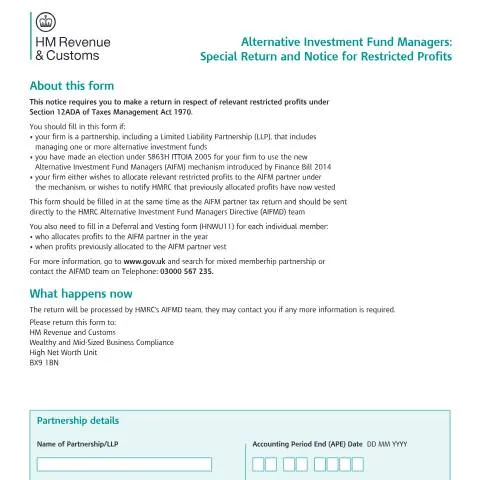
Navigating the HMRC HNWU10: A Guide for Alternative Investment Fund Managers
For partnerships managing alternative investment funds, the Alternative Investment Fund Managers: Special Return and Notice for Restricted Profits (HNWU10) document is a crucial administrative tool that ensures compliance with UK tax regulations. Understanding how to effectively utilize this notice not only streamlines the reporting process but also mitigates risks associated with inaccurate filings. This guide elucidates the content, purpose, and application of the HNWU10, providing clarity for fund managers on the procedural nuances inherent within.
Understanding the Context of HNWU10
The HNWU10 notice is positioned within the framework of the Taxes Management Act 1970 and is specifically tailored for partnerships, including Limited Liability Partnerships (LLPs), that manage one or more alternative investment funds. The foundational regulation is underpinned by the election made under Section 863H of the Income Tax (Trading and Other Income) Act 2005 (ITTOIA) to engage with the new Alternative Investment Fund Managers (AIFM) mechanism established by the Finance Bill 2014.
Key Reasons for Filing the HNWU10
- Allocation of Restricted Profits: Partnerships are required to report relevant restricted profits allocated to the AIFM partner.
- Notification of Vested Profits: The notice also serves to notify HMRC when previously allocated profits have vested.
- Compliance Requirement: Filing this notice is essential to ensure compliance with UK tax laws, avoiding potential penalties.
Step-by-Step: Filing the HNWU10
Successfully navigating the process necessitates a thorough understanding of each component required in the HNWU10. Below is a structured approach to complete and submit this notice:
1. Gather Necessary Information
Before initiation, ensure all pertinent details are available:
- Partnership Details: Name of the partnership and AIFM Partner Unique Taxpayer Reference (UTR).
- Accounting Period: Clearly define the Accounting Period End (APE) date in the format DD MM YYYY.
2. Calculate Allocations
Each member's restricted profits allocation must be accurately defined:
| Name of Individual Member | Amount of Restricted Profit Allocated | Tax Payable by AIFM Partner | Tax Paid by AIFM Partner | Amount Vested to Individual | Amount of Tax Credit Payable | Total |
|---|---|---|---|---|---|---|
| [Member Name] | [Amount] | [Tax Payable] | [Tax Paid] | [Amount Vested] | [Tax Credit] | [Total] |
3. Complete the HNWU10 Notice
While the document itself is structured, accuracy is paramount:
- Declaration Section: The representative AIFM partner must declare the correctness of the information provided.
- Signature and Date: Ensure that the form is signed and dated appropriately to validate the submission.
Potential Pitfalls: Misinterpretations and Missteps
Misinterpretations can lead to significant compliance issues. Here are common misconceptions:
Overlooking Required Filings
Filing the HNWU10 must coincide with the AIFM partner tax return. Failing to submit concurrently can trigger delays and penalties from HMRC.
Incorrect Profit Allocation Reporting
Each individual's allocation must be accurately calculated based on the partnership’s financial agreements; failing to do so can lead to erroneous tax obligations.
The Interconnectedness of HNWU10 with Other Documents
Understanding how the HNWU10 interacts with other forms can enhance compliance:
Deferral and Vesting Form HNWU11
Alongside the HNWU10, the Deferral and Vesting form (HNWU11) is essential for each individual member who allocates profits to the AIFM partner and when those profits vest. It provides detailed insights into the timing and conditions of profit allocations, ensuring HMRC has a clear view of profit distributions.
What to Expect After Submission
After filing the HNWU10, the HMRC's Alternative Investment Fund Managers Directive (AIFMD) team will process the return. Here's what to anticipate:
- Processing Time: HMRC may contact the partnership if additional information is necessary to clarify or support the submitted data.
- Compliance Follow-Up: Ensure ongoing communication is maintained with HMRC to address any queries promptly.
Final Thoughts on Effective Usage of HNWU10
Understanding and effectively using the HNWU10 notice is critical for partnerships involved in alternative investment management. By ensuring accuracy in reporting, maintaining compliance, and being aware of interconnected requirements such as the HNWU11, fund managers can navigate the complexities of UK tax obligations with confidence.
In a landscape marked by regulatory changes, staying informed and proactive is essential. Regularly consult the HM Revenue & Customs website and engage with the AIFMD team for up-to-date information and guidance tailored to specific situations, ensuring seamless compliance and operational efficacy.
Understanding the Regulatory Framework for Alternative Investment Fund Managers (AIFMs)
Alternative Investment Fund Managers (AIFMs) in the UK operate under a complex regulatory framework governed primarily by the Financial Services and Markets Act 2000 (FSMA) and the Alternative Investment Fund Managers Directive (AIFMD). AIFMs are firms that manage one or more alternative investment funds (AIFs), which can include hedge funds, private equity funds, and real estate funds. The AIFMD aims to provide a comprehensive regulatory environment that ensures transparency, investor protection, and a level playing field for all fund managers across the EU and beyond.
AIFMs must be authorised by the Financial Conduct Authority (FCA) and comply with various operational requirements, including risk management, liquidity management, and reporting obligations. One critical aspect of this regulatory regime is the requirement for AIFMs to maintain a detailed understanding of their funds' performance, particularly in regard to taxation. The Special Return and Notice for Restricted Profits (HNWU10) is essential in helping AIFMs ensure compliance with UK tax obligations while managing their funds effectively.
It's worth noting that the overall compliance burden can vary significantly depending on the size of the AIFM, the types of funds managed, and the jurisdictions involved. Smaller AIFMs may benefit from simplified reporting processes, while larger firms may have elaborate structures in place to monitor and report on a more extensive portfolio of AIFs.
Impact of Special Return (HNWU10) on High-Net-Worth Individuals
The Special Return and Notice for Restricted Profits (HNWU10) is particularly relevant for high-net-worth individuals (HNWIs) who invest in alternative investment funds. The HNWU10 is a specific tax return that allows these investors to report certain types of income, particularly that derived from their investments in AIFs, which may be categorised as restricted profits. This return is crucial for ensuring that HNWIs fulfil their tax obligations while potentially benefiting from reliefs and exemptions available under UK tax laws.
One of the primary considerations for HNWIs when completing the HNWU10 is the need to differentiate between various types of income. Income from AIFs can fall into different categories, such as dividends, interest, or capital gains, each of which has its own tax implications. Furthermore, the nature of the investment—whether it’s a direct investment in an AIF or through a complex structure such as a partnership—can significantly affect reporting requirements and tax liabilities.
Additionally, the HNWU10 provides an opportunity for high-net-worth individuals to claim reliefs that may reduce their overall tax burden. Given the intricacies of UK tax law, it's vital for HNWIs to meticulously assess their investment structures and income types to ensure compliance while maximising their tax advantages. For instance, specific tax reliefs may apply to capital gains realised from long-term investments, which can be particularly beneficial for investors in private equity funds.
Practical Steps for AIFMs in Filing HNWU10 Returns
For AIFMs responsible for filing the Special Return (HNWU10), understanding the intricacies of the filing process is paramount. The following practical steps outline a streamlined approach to ensure compliance:
Data Gathering: The first step involves collecting all relevant data regarding the fund and the income it has generated. This includes reviewing financial statements, investor reports, and any distributions made during the tax year. A robust data management system can facilitate this process and ensure accuracy.
Categorising Income: Once data is gathered, it’s crucial to categorise income correctly. AIFMs must identify which portions of income fall under restricted profits and ensure that they are reported accurately on the HNWU10 return. This may involve working closely with accountants or tax advisors who are familiar with the specific taxation rules governing alternative investments.
Identifying Reliefs and Exemptions: AIFMs should also explore potential reliefs that may be applicable to their funds. This requires a thorough understanding of the current tax landscape, including any changes resulting from new legislation or guidance issued by HM Revenue & Customs (HMRC).
Filing the HNWU10: The final step is to complete and submit the Special Return (HNWU10) by the required deadline. It’s essential to ensure that all data is accurate and that sufficient evidence is available to support any claims made in the return.
Post-Filing Review: After submission, AIFMs should conduct a review of their filing process to identify any areas for improvement in future submissions. Regular audits and compliance checks can help detect any discrepancies early, ensuring ongoing adherence to HMRC requirements.
By following these practical steps, AIFMs can navigate the complexities of the HNWU10 return and ensure compliance with UK tax regulations, ultimately supporting the financial wellbeing of high-net-worth investors.