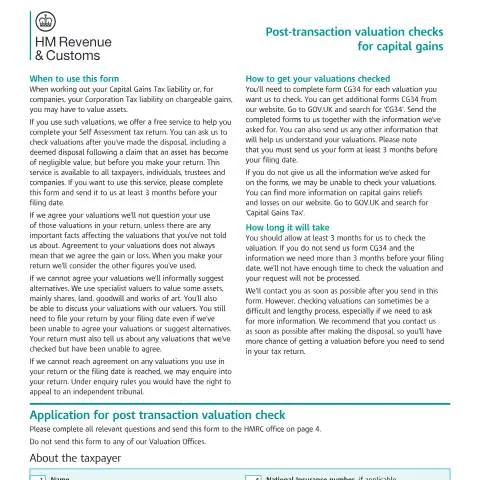
Understanding HMRC's Strategic Approach to Asset Valuation Disputes
Capital gains calculations often hinge on accurate asset valuations, yet these determinations frequently become contentious between taxpayers and HM Revenue & Customs. The CG34 form represents HMRC's proactive solution to this perennial challenge, offering taxpayers a pre-emptive validation service that can prevent lengthy enquiries and tribunal appeals. Rather than waiting for disputes to emerge during return processing, this mechanism allows individuals, trustees, and companies to secure HMRC's agreement on valuations before filing deadlines arrive.
The significance of this service extends beyond mere convenience. When valuations involve complex assets like unquoted shares, goodwill, or specialist property, disagreements can trigger formal enquiries lasting months or years. The CG34 process transforms this adversarial dynamic into a collaborative validation exercise, where HMRC's specialist valuers work with taxpayers to establish agreed figures before returns are submitted.
This approach particularly benefits those dealing with deemed disposals following negligible value claims, connected party transactions, or March 1982 rebasing valuations where historical evidence may be scarce. The three-month minimum processing requirement demands early engagement, fundamentally altering how sophisticated taxpayers approach disposal planning.
Navigating the Three-Month Processing Corridor
The CG34 system operates within rigid temporal constraints that demand strategic timing from taxpayers. HMRC requires forms to arrive at least three months before filing dates, creating a narrow window for those with January self-assessment deadlines or companies approaching their Corporation Tax return dates.
For individuals, this means CG34 submissions must reach HMRC by 31 October for the following January deadline. Companies face more complex calculations, as their filing dates depend on accounting period ends and the nine-month or twelve-month filing windows. A company with a 31 December year-end must submit CG34 forms by 30 June the following year to meet the standard nine-month filing deadline.
The three-month processing window represents HMRC's realistic assessment of valuation complexity. Specialist assets may require external expert input, comparable transaction research, or detailed financial analysis. Share valuations often involve scrutinising three years of accounts, while goodwill assessments may require industry-specific expertise. Land valuations can demand site inspections and local market analysis.
| Taxpayer Type | Standard Filing Deadline | Latest CG34 Submission | Recommended Submission |
|---|---|---|---|
| Individual (Self Assessment) | 31 January | 31 October (previous year) | 30 September (previous year) |
| Company (9-month deadline) | 9 months after period end | 6 months after period end | 4-5 months after period end |
| Trust/Estate | 31 January | 31 October (previous year) | 30 September (previous year) |
HMRC acknowledges that complex valuations may exceed the three-month window, particularly when additional information requests emerge during processing. The guidance emphasises contacting HMRC "as soon as possible after making the disposal" to maximise processing time and avoid deadline pressures.
Decoding Asset-Specific Valuation Requirements
The CG34 form accommodates four distinct asset categories, each demanding specific information and documentation. Understanding these requirements prevents delays and ensures HMRC's valuers receive sufficient detail for accurate assessments.
Share Valuations: Beyond Basic Company Details
Share valuations require comprehensive company identification including registration numbers, share classes, and specific shareholding details. Crucially, taxpayers must provide per-share valuations rather than total holding values, recognising that minority discounts or control premiums may apply depending on the shareholding percentage.
The requirement for three years of accounts reflects HMRC's need to assess trading performance, asset backing, and earnings trends. Unquoted share valuations often involve weighted combinations of asset, earnings, and dividend yield methodologies, requiring detailed financial analysis. Companies with volatile trading patterns or significant non-trading assets may require additional explanatory information.
Goodwill: Capturing Business Transfer Complexity
Goodwill valuations present particular challenges where business incorporations or transfers occur. The form specifically addresses these scenarios, requiring details of both the transferring business and recipient company. This reflects the complexity of separating goodwill from other business assets and establishing arm's length values for connected party transactions.
Professional practices, retail businesses, and manufacturing concerns each present distinct goodwill characteristics. Customer relationships, location advantages, supplier arrangements, and workforce expertise contribute differently across sectors. HMRC's specialist valuers consider industry-specific factors, comparable transaction evidence, and earnings multipliers appropriate to each business type.
Land and Property: Capturing Interest Complexity
Property valuations extend beyond simple market values to encompass complex ownership structures and tenancy arrangements. The form requires detailed interest descriptions, recognising that freehold, leasehold, and various property rights demand different valuation approaches.
Existing tenancies significantly impact valuations, with rent-regulated properties, commercial leases, and agricultural tenancies each presenting distinct considerations. Development potential, planning constraints, and environmental factors may also influence values. HMRC's property valuers consider comparable sales evidence, investment yields, and development appraisals as circumstances require.
Distinguishing CG34 from Alternative HMRC Valuation Routes
The CG34 process operates alongside several other HMRC valuation mechanisms, each serving distinct purposes within the tax system. Understanding these alternatives prevents inappropriate form selection and ensures efficient processing.
Pre-transaction clearances differ fundamentally from CG34's post-transaction approach. While advance clearances provide certainty before disposals occur, they require hypothetical scenarios and may not reflect actual transaction circumstances. CG34 addresses completed transactions where real disposal terms provide concrete valuation parameters.
Inheritance Tax valuations follow separate procedures through HMRC's Inheritance Tax division, typically involving form IHT400 and related schedules. While some assets may require valuation for both Capital Gains Tax and Inheritance Tax purposes, the methodologies and deadlines differ significantly. Death estate valuations often involve different valuation dates and may include related property provisions absent from CGT calculations.
Stamp Duty Land Tax valuations operate under distinct rules, particularly for connected party transactions or non-monetary consideration. The Land Transaction Return (SDLT1) process involves different timescales and may produce valuations that differ from CGT purposes, especially where SDLT anti-avoidance provisions apply.
Annual Tax on Enveloped Dwellings (ATED) valuations serve specific charge calculations and may not align with disposal valuations for CGT purposes. Properties subject to ATED may require separate professional valuations for charge calculation purposes, distinct from any CG34 submissions for subsequent disposals.
Mandatory Documentation: Building Compelling Valuation Cases
The CG34 submission requirements extend well beyond the form itself, demanding comprehensive supporting documentation that enables HMRC's specialist valuers to assess proposed figures accurately. The mandatory documentation varies significantly between taxpayer types and asset categories.
Capital Gains Calculations: Foundation Documents
All taxpayers must provide detailed capital gains calculations showing their disposal computations and estimated tax liabilities. For individuals and trustees, this includes Capital Gains Tax liability estimates for the relevant tax year. Companies must demonstrate Corporation Tax liability calculations on chargeable gains for the appropriate accounting period.
Partnership disposals require individual partner calculations, reflecting each partner's share of gains and their respective tax positions. This complexity increases where partners have different tax years or varying capital contribution histories affecting their gain allocations.
These calculations must demonstrate how proposed valuations integrate with acquisition costs, improvement expenditure, and available reliefs. Incomplete calculations may result in processing delays while HMRC seeks clarification on computational methodologies or relief applications.
Professional Valuation Reports: External Expert Input
Where taxpayers have commissioned professional valuations, complete reports must accompany CG34 submissions. These reports provide HMRC's valuers with detailed methodological explanations, comparable evidence, and professional reasoning supporting proposed figures.
HMRC's internal specialists may challenge professional valuation methodologies, particularly where unusual approaches or limited comparable evidence exist. The quality and comprehensiveness of professional reports significantly influence processing timescales and outcome likelihood.
Historical Cost and Improvement Evidence
Acquisition cost documentation and improvement records provide crucial context for valuation assessments. Original purchase documentation, legal completion statements, and improvement invoices establish the capital base from which gains are calculated.
For assets held since before March 1982, establishing historical costs may prove challenging, making rebasing valuations particularly important. Contemporary documentation from the 1980s may be scarce, requiring alternative evidence such as insurance valuations, mortgage documentation, or professional records from that period.
Specialist Valuation Teams: HMRC's Internal Expertise
HMRC deploys specialist valuation teams across different asset categories, each bringing sector-specific expertise to CG34 assessments. Understanding these internal structures helps taxpayers appreciate processing approaches and potential outcomes.
The Shares and Assets Valuation (SAV) team handles unquoted share valuations, applying established methodologies for minority interests, control premiums, and marketability discounts. Their approach typically involves earnings-based methods for trading companies and asset-based approaches for investment entities, with significant judgment required for hybrid situations.
Property valuations fall to specialist surveyors within HMRC's Valuation Office Agency, bringing Royal Institution of Chartered Surveyors (RICS) qualified expertise to land and building assessments. Their approach emphasises comparable transaction evidence while considering specific property characteristics and market conditions at valuation dates.
Goodwill and intangible asset valuations often require cross-disciplinary input, combining accounting expertise with industry knowledge. HMRC's approach typically focuses on earnings-based methodologies, considering customer retention rates, competitive advantages, and industry-specific factors affecting business value.
Works of art and collectibles involve specialist external expertise, with HMRC accessing museum curators, auction house specialists, and academic experts as required. These valuations often depend on attribution, condition, provenance, and market trends in specific collecting areas.
Processing Outcomes and Taxpayer Rights
The CG34 process produces several possible outcomes, each carrying different implications for subsequent tax return filing and potential enquiry procedures. Understanding these outcomes enables appropriate response strategies.
Agreed Valuations: Securing HMRC Acceptance
Where HMRC agrees proposed valuations, taxpayers receive written confirmation providing significant protection against future challenges. This agreement covers the specific valuations submitted but does not extend to other aspects of capital gains calculations such as acquisition costs, improvement expenditure, or relief claims.
The protection operates unless taxpayers have withheld material facts affecting valuations. This caveat requires careful consideration of disclosure completeness, particularly where complex ownership structures, related transactions, or unusual circumstances might influence values.
Agreed valuations bind HMRC during normal return processing but do not prevent enquiries into other computational aspects. Taxpayers retain responsibility for accurate gain calculations, appropriate relief claims, and compliance with reporting requirements.
Alternative Valuations: Negotiating Middle Ground
Where HMRC cannot accept proposed valuations, they offer informal alternative suggestions based on their specialist assessment. These alternatives provide negotiation starting points and may indicate the valuation range HMRC considers acceptable.
Taxpayers retain discretion over whether to accept suggested alternatives or maintain their original positions. The CG34 guidance emphasises discussion opportunities with HMRC valuers, enabling dialogue about methodological differences and supporting evidence.
Rejection of alternative suggestions does not preclude their use in tax returns, but increases enquiry likelihood and may influence any subsequent tribunal proceedings where burden of proof considerations apply.
Unresolved Disagreements: Enquiry Implications
Where agreement cannot be reached within processing timescales, taxpayers must file returns using their preferred valuations while disclosing the unresolved CG34 disagreement. This disclosure requirement ensures HMRC awareness of valuation disputes and may influence enquiry selection processes.
Subsequent enquiries benefit from CG34 processing evidence, with both parties' positions clearly established and supporting arguments documented. This preparation may expedite enquiry resolution or provide clearer frameworks for tribunal proceedings where settlement proves impossible.
The independent tribunal appeal route remains available where enquiry procedures fail to resolve disagreements. CG34 processing evidence often forms substantial parts of tribunal submissions, with professional valuation evidence and HMRC specialist opinions providing competing expert testimony.
Strategic Integration with Disposal Planning
Sophisticated taxpayers increasingly integrate CG34 procedures within broader disposal planning strategies, using the service to optimise tax positions and manage compliance risks effectively. This strategic approach requires early engagement and careful coordination across multiple advisory disciplines.
Large shareholding disposals may benefit from phased approaches where initial CG34 submissions establish valuation principles applicable to subsequent tranches. This approach provides consistency across multiple disposal events while managing annual exemption utilisation and tax rate considerations.
Connected party transactions particularly benefit from CG34 validation, given HMRC's enhanced scrutiny of non-arm's length dealing. Securing advance valuation agreement removes significant compliance uncertainty and may facilitate more aggressive tax planning where appropriate reliefs apply.
Business restructuring projects involving multiple asset transfers can utilise coordinated CG34 submissions to establish consistent valuation approaches across related transactions. This coordination ensures coherent tax planning and reduces the risk of inconsistent treatment across different disposal events.
The three-month processing requirement necessitates integration with disposal timescales, particularly where completion deadlines or regulatory requirements constrain transaction timing. Professional advisers increasingly recommend CG34 engagement as standard practice for significant disposals involving valuation complexity.