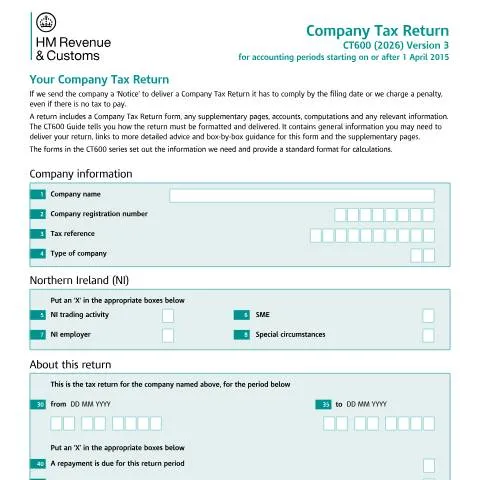
Understanding the CT600: When Companies Must Submit Their Annual Tax Declaration
Every limited company operating in the UK faces a critical administrative milestone each year: the submission of their Corporation Tax return. The CT600 Company Tax Return serves as the comprehensive declaration that determines a company's tax liability and ensures compliance with HMRC's stringent reporting requirements. This document goes far beyond a simple tax calculation—it represents a detailed financial snapshot that can trigger investigations, determine eligibility for reliefs, and establish the foundation for future tax planning.
The CT600 form operates on a mandatory disclosure principle, meaning companies cannot simply ignore it if they believe no tax is due. HMRC issues a formal "Notice to deliver a Company Tax Return" to companies that must comply, regardless of their profit or loss position. This notice creates a legal obligation with specific deadlines and penalty structures that can quickly escalate for non-compliant businesses.
Companies typically receive this notice because they've been flagged in HMRC's systems through various triggers: Companies House filings, PAYE registrations, VAT returns, or previous Corporation Tax activity. Even dormant companies may receive notices if their status appears unclear to the authorities, making the CT600 a universal concern for UK corporate entities.
Decoding Corporate Profiles: Which Businesses Face CT600 Obligations
The CT600's reach extends across virtually all UK corporate structures, but the complexity varies dramatically depending on the company's profile and activities. Standard limited companies represent the most straightforward case, completing the main CT600 form alongside their statutory accounts and tax computations.
However, specific business types trigger additional reporting requirements through supplementary forms. Close companies with loans to participators must complete form CT600A, detailing any financial arrangements with shareholders or directors that could constitute benefits in kind. Insurance companies face the specialised CT600D requirements, whilst charities and Community Amateur Sports Clubs navigate the CT600E pathway with its unique exemptions and restrictions.
| Company Type | Core Form | Additional Requirements | Key Considerations |
|---|---|---|---|
| Trading Company | CT600 | Accounts + computations | Full profit/loss disclosure |
| Investment Company | CT600 | Detailed investment income | Management expenses relief |
| Group Company | CT600 + CT600C | Group relief claims | Transfer pricing implications |
| Northern Ireland Trader | CT600 + CT600G | Regional profit allocation | Different Corporation Tax rates |
Companies operating across multiple jurisdictions face particularly complex requirements. Those with Northern Ireland trading activities must complete form CT600G to benefit from the region's reduced Corporation Tax rate, requiring careful apportionment of profits between territories. Meanwhile, multinational groups encounter transfer pricing obligations and controlled foreign company rules that demand extensive documentation and specialist calculations.
Special Circumstances and Exemption Scenarios
The CT600 framework acknowledges that not all companies fit standard patterns. Small and medium enterprises (SMEs) benefit from simplified reporting requirements and exemptions from certain transfer pricing rules, marked by ticking the appropriate boxes in the company information section. Companies qualifying for SME status can avoid the detailed transfer pricing documentation requirements that burden larger corporations.
Dormant companies present a unique scenario where the CT600 may still be required despite no active trading. HMRC's definition of dormancy for Corporation Tax purposes differs from Companies House requirements, meaning companies must carefully assess whether they've had any taxable activities, including investment income, property rentals, or capital gains on asset disposals.
Navigating the Financial Disclosure Framework
The CT600's financial sections demand meticulous attention to detail, with each figure potentially triggering specific compliance obligations or relief opportunities. The turnover declaration in box 145 serves as more than a simple revenue figure—it determines various thresholds for audit requirements, transfer pricing exemptions, and research and development credit eligibility.
Trading profits calculations require companies to reconcile their statutory accounting profits with tax-adjusted figures, accounting for disallowable expenses, capital allowances, and timing differences. This process often reveals the complexity of UK tax law, where accounting standards and tax rules diverge significantly on issues like depreciation, provisions, and revenue recognition.
Investment Income and Capital Gains Complexities
Non-trading income streams create additional reporting layers within the CT600 framework. Investment income from loan relationships must be carefully categorised between trading and non-trading activities, with different rules applying to each classification. Non-trading deficits can be carried forward indefinitely but face restrictions on how they can be utilised against future profits.
Capital gains calculations require companies to maintain detailed records of asset acquisitions, improvements, and disposals. The indexation allowance, frozen for disposals after December 2017, creates historical computation challenges for long-held assets. Companies must also consider substantial shareholding exemptions that can eliminate capital gains on qualifying business disposals.
The interaction between different income streams and reliefs within the CT600 can create unexpected tax positions. Companies showing accounting losses may still face Corporation Tax liabilities due to disallowable expenses or timing differences, whilst profitable companies might eliminate their tax charge through available reliefs and allowances.
Mastering Relief Claims and Loss Utilisation Strategies
The CT600's relief sections offer sophisticated tax planning opportunities that can significantly impact a company's tax position. Trading losses provide flexible relief options, allowing companies to carry losses back one year, carry them forward indefinitely, or surrender them to group companies through group relief arrangements.
Management expenses relief, available to investment companies and companies with investment activities, can create or enhance losses that offset against total profits. This relief covers costs of managing investments and can include director fees, professional costs, and office expenses directly attributable to investment management activities.
Group Relief Optimisation Techniques
Companies within group structures can optimise their tax positions through strategic group relief claims documented in form CT600C. Current year losses can be surrendered between group companies, whilst carried-forward losses face more restrictive rules requiring continuity of ownership and business activities.
- Current year group relief allows immediate loss utilisation across group companies
- Carried-forward group relief requires careful planning around ownership changes
- Consortium relief enables partial loss sharing based on ownership percentages
- Cross-border group relief may apply to EU subsidiaries under specific conditions
The complexity increases when groups include overseas companies or operate across different industries. Transfer pricing rules ensure that intra-group transactions reflect arm's length terms, potentially limiting artificial loss creation or profit shifting arrangements.
Supplementary Forms: Addressing Specialised Business Activities
The CT600 series extends beyond the main form through fourteen supplementary schedules addressing specific business circumstances and tax reliefs. Each supplementary form targets particular activities or structures that require detailed disclosure beyond the standard Corporation Tax framework.
Form CT600A addresses close company loan arrangements, capturing potential benefit-in-kind charges when companies lend money to participators at preferential rates. These arrangements can trigger both Corporation Tax charges on the company and income tax implications for the borrowing individuals, making accurate disclosure crucial for avoiding unexpected liabilities.
Research and Development Incentives Through CT600L
Companies claiming research and development reliefs must complete form CT600L, providing detailed breakdowns of qualifying expenditure and project descriptions. The SME R&D scheme offers enhanced deductions of 230% for qualifying costs, whilst the Research and Development Expenditure Credit (RDEC) provides cash benefits for larger companies and certain collaborative projects.
Creative industries benefit from specialised reliefs documented through form CT600P, covering film, television, video games, theatre, and orchestra productions. These reliefs can provide significant cash flow benefits through enhanced deductions and payable credits, but require detailed production cost analysis and cultural test compliance.
| Supplementary Form | Business Activity | Key Benefits | Common Pitfalls |
|---|---|---|---|
| CT600L | R&D Activities | 230% SME deduction | Qualifying expenditure definition |
| CT600P | Creative Industries | Payable tax credits | Cultural test requirements |
| CT600M | Freeports/Investment Zones | Enhanced capital allowances | Geographic and timing restrictions |
| CT600N | Property Development | RPDT compliance | Residential property definitions |
Submission Protocols and Documentation Requirements
HMRC mandates electronic submission for virtually all CT600 returns, with paper submissions accepted only in exceptional circumstances and with prior approval. The online filing system integrates validation checks that identify common errors before submission, but companies must ensure their software produces HMRC-compatible files meeting strict formatting requirements.
The statutory accounts requirement extends beyond simple attachment—companies must ensure their accounts comply with relevant accounting standards and include all necessary disclosures. Abbreviated accounts acceptable for Companies House may not satisfy HMRC's requirements, particularly where detailed analysis of specific income streams or exceptional items is necessary for tax computation purposes.
Computational Documentation Standards
Tax computations must provide clear reconciliation between accounting profits and taxable profits, with sufficient detail to enable HMRC review without additional enquiries. Best practice includes separate schedules for capital allowances, disallowable expenses, and timing differences, with cross-references to supporting accounting records.
Companies using estimated figures must clearly identify these within their returns and provide realistic timelines for submitting final figures. HMRC's tolerance for estimates varies depending on the reason for estimation and the company's compliance history, with some circumstances requiring formal approval before submission.
Compliance Deadlines and Penalty Structures
Corporation Tax return deadlines operate on a rigid twelve-month cycle from the end of the accounting period, with no automatic extensions available. Companies must submit their complete return, including accounts and computations, by this deadline to avoid automatic penalties that begin immediately after the due date.
The penalty regime escalates rapidly for persistent non-compliance. Initial penalties of £100 apply for returns up to three months late, increasing to £200 for returns between three and six months overdue. After six months, penalties become tax-geared, potentially reaching significant amounts for companies with substantial Corporation Tax liabilities.
Payment and Filing Coordination
Corporation Tax payments follow separate deadlines from return filing requirements, creating potential cash flow management challenges. Large companies face quarterly instalment payment obligations that require accurate profit forecasting throughout their accounting periods, whilst smaller companies benefit from nine months and one day payment terms after their period end.
The interaction between filing deadlines and payment obligations can create complex compliance scenarios. Companies discovering additional tax liabilities during return preparation must assess whether late payment penalties and interest charges apply, potentially requiring immediate payments to minimise escalating costs.
Successful CT600 compliance requires integrated planning across accounting, tax computation, and cash flow management. Companies benefit from establishing annual compliance calendars that coordinate these various obligations and identify potential issues well before deadline pressures emerge.
The CT600 framework represents one of the UK's most comprehensive business reporting requirements, demanding technical expertise, careful planning, and systematic approach to compliance. Companies that treat this as merely an annual administrative burden often discover costly errors or missed opportunities that could have been avoided through proper understanding and preparation of their Corporation Tax obligations.
Common Errors and Compliance Pitfalls When Filing CT600
Even experienced finance professionals can encounter significant challenges when completing the CT600, particularly given HMRC's increasingly sophisticated data matching systems and evolving compliance requirements. Understanding the most frequent errors can help companies avoid costly penalties and potential investigations.
Accounting period misalignment represents one of the most fundamental yet overlooked errors. Companies must ensure their CT600 filing period precisely matches their statutory accounts period. This becomes particularly complex for companies changing their accounting reference date or those with periods exceeding 12 months due to dormancy or restructuring. HMRC's systems flag discrepancies between Companies House filings and corporation tax returns, potentially triggering compliance reviews.
Transfer pricing documentation failures pose substantial risks, especially for companies with related party transactions exceeding £2 million annually. The CT600 requires specific disclosure of controlled transactions, yet many companies inadequately document their transfer pricing policies. HMRC expects contemporaneous documentation demonstrating arm's length pricing, including economic analysis and comparable transactions. Companies operating in multiple jurisdictions must also consider country-by-country reporting obligations under OECD guidelines.
Research and development relief claims frequently contain calculation errors or inadequate supporting evidence. The CT600 supplementary pages CT600E require detailed breakdowns of qualifying R&D expenditure, yet companies often struggle to differentiate between qualifying and non-qualifying costs. Software development costs, in particular, require careful analysis to determine whether they constitute qualifying R&D activities or routine business improvements.
Capital allowances calculations present ongoing challenges, particularly following recent legislative changes to structures and buildings allowances and the super-deduction regime's conclusion. Companies must maintain detailed fixed asset registers supporting their CT600 claims, with clear audit trails linking accounting entries to tax computations. Annual investment allowance claims require particular attention to group company interactions and the timing of expenditure recognition.
Digital services tax compliance has introduced additional complexity for companies exceeding the £25 million UK digital services revenue threshold. The CT600 must accurately reflect DST liabilities whilst avoiding double taxation issues with corporation tax. Companies must maintain detailed records of UK user activities and revenue attribution methodologies.
Managing CT600 Compliance Across Group Structures
Group companies face unique CT600 compliance challenges requiring sophisticated coordination and planning strategies. HMRC's focus on large business compliance means group structures receive enhanced scrutiny, particularly regarding profit attribution and loss utilisation across entities.
Group relief claims demand careful coordination between surrendering and claimant companies. The CT600 must include accurate group relief computations with supporting CT600A and CT600B forms. Companies must ensure contemporaneous agreements exist before the filing deadline, with clear documentation of relief amounts and capacity calculations. Late claims face strict time limits, typically requiring filing within two years of the end of the surrendering company's accounting period.
Controlled foreign company (CFC) rules create substantial CT600 complexity for UK companies with overseas subsidiaries. The supplementary pages require detailed analysis of foreign profits, applicable exemptions, and potential CFC charges. Companies must maintain comprehensive documentation supporting their exemption claims, particularly for trading finance and holding company exemptions.
Diverted profits tax considerations affect multinational groups with UK operations potentially subject to the 25% charge. The CT600 must accurately reflect any DPT provisions or payments, requiring detailed substance analysis and documentation of commercial rationale for group structures. Companies must demonstrate genuine commercial activity supporting their tax arrangements.
Loan relationship and derivative contract rules require particular attention in group contexts. The CT600 must accurately reflect intercompany financing arrangements, with detailed analysis of whether transactions meet arm's length standards. Companies must consider the corporate interest restriction rules limiting tax deductions for net interest expenses exceeding £2 million annually.
Loss restriction rules significantly impact group CT600 compliance, particularly following ownership changes or demerger transactions. Companies must carefully analyse whether losses remain available for offset against future profits, considering both the nature of ownership changes and continuity of trade requirements. The CT600 computation must clearly demonstrate compliance with these complex provisions.
Post-Filing Compliance and HMRC Engagement Strategies
Successfully filing the CT600 represents only the beginning of ongoing compliance obligations. HMRC's risk-based approach to corporation tax compliance means companies must maintain robust systems supporting their filed positions whilst preparing for potential enquiries or compliance reviews.
Record keeping obligations extend well beyond the CT600 filing deadline. Companies must retain supporting documentation for at least six years, with digital records requiring appropriate backup and retrieval systems. HMRC increasingly expects sophisticated data analytics capabilities, particularly for large companies subject to enhanced compliance monitoring. Contemporary documentation proves crucial during enquiries, with retrospective preparation often proving inadequate.
Senior accounting officer (SAO) responsibilities create personal liability for designated individuals in qualifying companies. The SAO must provide annual certificates confirming appropriate tax accounting arrangements, with the CT600 serving as key evidence of compliance systems effectiveness. Companies must maintain clear governance structures linking SAO oversight to CT600 preparation and review processes.
Making tax digital initiatives will eventually extend to corporation tax, requiring companies to maintain digital records and file returns through compatible software. Early adoption of digital systems supporting CT600 preparation positions companies advantageously for future compliance requirements whilst improving current process efficiency and accuracy.
Voluntary disclosure strategies become essential when companies identify CT600 errors or omissions post-filing. HMRC's contractual disclosure facility offers reduced penalties for proactive disclosure, yet requires careful consideration of disclosure timing and scope. Companies must balance reputational risks against potential penalty savings when determining disclosure strategies.
Compliance monitoring and benchmarking help companies maintain filing accuracy whilst identifying improvement opportunities. Regular reviews of CT600 positions against industry benchmarks and peer companies can highlight unusual positions requiring additional support or review. Companies should establish formal processes linking CT600 filing to broader tax risk management frameworks.
Appeal and dispute resolution procedures require understanding from the CT600 filing stage. Companies should document their technical positions contemporaneously, anticipating potential HMRC challenges. Alternative dispute resolution mechanisms, including mediation services, offer efficient resolution paths for complex technical disputes arising from CT600 positions.