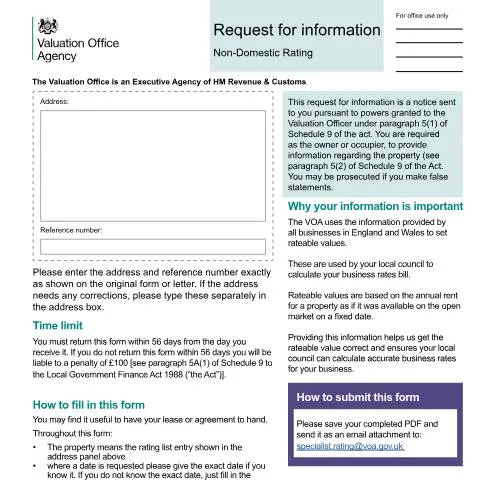
Understanding the Importance of Form VO 6036 in Non-Domestic Rating
The VO 6036 form serves a critical function in the realm of non-domestic rating in the UK. This request for information is initiated by the Valuation Office Agency (VOA), an executive agency of HM Revenue & Customs (HMRC), and it aims to gather essential details regarding the operation and financial activities of properties that fall under business rates. The information collected through this form not only assists in determining the rateable value of a property but also helps local councils accurately calculate business rates, which can significantly impact a business’s financial health. The data is particularly relevant as it reflects the usual market rent a property would command, thus ensuring fairness in how rates are applied.
The Timeline of Submission: Key Dates and Deadlines
Upon receiving a VO 6036 request, recipients are given a strict timeline to comply. Specifically, the completed form must be returned within 56 days from the date of receipt. Failure to meet this deadline could result in a £100 penalty, as outlined in the Local Government Finance Act 1988. It’s crucial for property owners and occupiers to mark their calendars and prioritize the return of this document to avoid unnecessary financial penalties.
- Received Form Date: Day of receipt
- Submission Deadline: 56 days later
- Penalty for Late Submission: £100
What Happens Next? The Review Process
Once the form is submitted, the VOA will review the information provided. This can lead to several outcomes:
- Confirmation of the current rateable value
- Adjustment of the rateable value based on the newly provided information
- Requests for further information if the initial submission lacks detail
Understanding this review process helps businesses prepare for potential follow-up inquiries, ensuring that they can provide additional documentation as required.
Who Needs to Fill Out the VO 6036? Insights Into the Profiles of Affected Parties
The VO 6036 form is primarily aimed at property owners and occupiers of non-domestic properties. This includes a variety of businesses, ranging from retail shops to offices, and even charities. However, there are specific scenarios that may exempt some individuals or entities from this requirement:
- Charities: If a charity occupies the property, special considerations may apply, often leading to zero or reduced business rates.
- Short-Term Lettings: Properties let for short periods may have different reporting requirements due to their transient nature.
- Vacant Properties: If the property is not actively in use, additional forms might be necessary to report its status.
Detailed Scenarios and Exceptions
For property owners or occupiers who may not fall neatly within the typical profile expected by the VOA, it’s essential to consider specific circumstances:
- If a property is partially used for residential purposes, careful delineation of income and use will be needed.
- For any non-standard agreements or peculiar circumstances regarding tenancy, consulting with a property advisor or legal expert may provide clarity on how to report accurately.
Completing the VO 6036: Essential Tips and Common Pitfalls
Completing the VO 6036 form requires careful attention to detail. Some key areas to focus on include:
- Accurate Information: Ensure that all details regarding the property address and reference number are correct.
- Financial Records: Have your lease and financial documents readily available, as well as records of trading receipts and expenditures for the past three financial years.
Property owners should be particularly cautious with the following common pitfalls:
- Providing incomplete financial information, which could lead to miscalculations in the rateable value.
- Failing to respond adequately to all sections of the form, particularly those concerning the use and occupation of the property.
To facilitate smoother processing, consider consulting a financial professional who can assist in preparing the necessary figures and documentation.
Submitting the VO 6036: Navigating the Channels of Submission
Once the form is completed, the next step is submission. The VO 6036 can be returned via various channels, each with its own benefits:
- Email Submission: Save the completed form as a PDF and send it to [email protected] as an attachment. This method often provides a quicker confirmation of receipt.
- Postal Submission: Alternatively, the form can be printed and mailed to the address specified on the original request. This is a more traditional submission method but may lead to delays in processing.
- In-Person Visits: For those who prefer personal interaction, visiting a VOA office might be beneficial, though appointments may be required.
Comparative Analysis of Submission Methods
| Submission Method | Speed of Confirmation | Convenience | Risk of Delay |
|---|---|---|---|
| Fast | High | Low | |
| Postal | Variable | Moderate | High |
| In-Person | Immediate | Variable | Moderate |
What to Do If Your Application Faces Challenges
It’s possible that upon submission, you may encounter issues such as requests for additional information, disputes over submitted data, or even refusals related to incomplete submissions. In such cases, here’s a roadmap to navigate these hurdles:
- Respond Promptly: If the VOA requests more information, respond as quickly as possible to avoid penalties or delays in processing.
- Clarification Requests: If you disagree with any aspect of the VOA's assessment, you have the right to contest it and request a review.
Documenting all communications with the VOA can also be advantageous for reference and tracking the progress of your requests.
What Happens If You Fail to Respond?
Failure to respond within the stipulated timeframe can lead to severe consequences, including hefty penalties and inaccurate rateable values, which could significantly affect your business operations. Therefore, prioritizing timely responses and ensuring that all information is correct and comprehensive is paramount.
The Role of VO 6036 in the Broader Framework of Business Rates
The VO 6036 form serves as a pivotal element within the wider landscape of business rates. The data collected feeds into a complex system that governs how properties are rated and how local councils assess rates. Understanding this role can empower property owners to navigate their obligations better:
- Rateable Value Calculation: The information aids in determining how much a property should be rated for business purposes, impacting the financial liabilities of the occupier.
- Local Council Revenue: Accurate data ensures that local councils can effectively budget and allocate resources based on projected revenue from business rates.
Ultimately, engaging with the VO 6036 form and understanding its implications will place property owners in a stronger position to manage their business rates effectively and avoid unexpected financial burdens.
Understanding VO 6036: What You Need to Know
The VO 6036 form is essential for landlords and property owners in the UK, especially when it comes to providing rental information to local authorities. This form is primarily used for requests related to rental income and the associated expenditure of rental properties. It serves as a means for the Valuation Office Agency (VOA) to assess the rental value and ensure proper taxation under the current legislative framework. Understanding its nuances helps landlords navigate the complexities of rental obligations.
Common Scenarios for Submitting a VO 6036
There are diverse situations in which a landlord may need to submit the VO 6036 form. Understanding these scenarios can help you react promptly and appropriately, ensuring compliance with tax regulations:
- Change in Rental Income: If there’s a significant change in the rental income—either an increase due to market conditions or a decrease due to tenancy changes—it's crucial to submit the VO 6036 promptly. This helps the local authority assess if the changes impact council tax assessments.
- Transition of Use: If a property transitions from residential to commercial use or vice versa, landlords must inform the VOA, as this affects the rateable value, which is reflected in the VO 6036 form submission.
- Multiple Tenancies: For landlords managing multiple properties, submitting a VO 6036 for each property ensures accurate assessment of rental income and associated expenditures. This also assists in calculating appropriate allowances and deductions for tax purposes.
In each of these scenarios, presenting accurate rental receipts and receipts of related expenditure becomes vital for a smooth submission process.
Consequences of Inaccurate or Delayed Submission
Failing to submit the VO 6036 form accurately or within the stipulated timeframe can lead to a variety of administrative issues:
- Potential Fines: If the Valuation Office determines that a landlord has failed to comply with submission requirements, fines may be issued. These fines can accrue quickly, especially if the oversight continues over multiple tax years.
- Impact on Tax Assessments: Incorrect information on the VO 6036 can lead to inaccurate tax assessments, which may result in overpayment or underpayment of taxes. This can have significant financial ramifications for landlords, particularly in terms of cash flow and budgeting.
- Legal Implications: In extreme cases, persistent non-compliance can result in legal action, including litigation. It's crucial to maintain accurate records and timely submissions to avoid these potential pitfalls.
Understanding these consequences can motivate landlords to maintain diligence in their submissions, ensuring that they remain compliant with UK law.