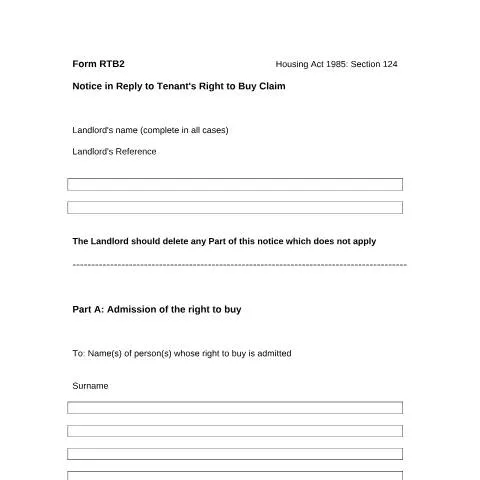
Understanding Your Landlord's Formal Response to a Right to Buy Application
When you submit a Right to Buy claim as a council tenant in England, your local authority landlord must respond within specific timeframes using the standardised RTB2 notice. This crucial document determines whether your application moves forward to the purchase phase or faces rejection, setting the legal framework for what happens next in your homeownership journey.
The RTB2 notice represents more than just administrative correspondence—it's a statutory instrument that carries significant legal weight under Section 124 of the Housing Act 1985. Your landlord cannot simply send an informal letter accepting or declining your claim; they must use this prescribed format to ensure compliance with housing legislation and protect both parties' rights throughout the process.
Understanding the structure and implications of each section within this notice empowers tenants to respond appropriately, whether celebrating an approved claim or challenging an unexpected denial. The document's three-part structure reflects different scenarios your application might encounter, each triggering distinct procedural pathways and timelines.
Decoding the Three-Part Structure of RTB2 Responses
The RTB2 notice operates through a modular system where landlords delete irrelevant sections, leaving only the part that applies to your specific situation. This approach prevents confusion while ensuring legal precision in communicating decisions.
Part A: When Your Right to Buy Gets the Green Light
Part A represents the outcome most tenants hope for—admission of the right to buy. When your landlord completes this section, they're formally acknowledging your eligibility and setting crucial dates that govern the entire purchase process. The notice captures your claim receipt date, which becomes the valuation date for determining your property's market value.
This timing element proves critical because property values fluctuate, and your purchase price reflects the market conditions on your claim date, not when negotiations conclude months later. The landlord commits to providing detailed sale terms within eight weeks for freehold purchases or twelve weeks for leasehold arrangements—a distinction that significantly impacts your future ownership structure.
Part B: Standard Denial Grounds
Part B addresses denials based on general eligibility failures under housing legislation. These rejections typically stem from failing to meet qualifying conditions rather than property-specific exemptions. Common scenarios include insufficient tenancy duration, shared ownership complications, or outstanding possession proceedings.
The landlord must provide comprehensive reasoning with specific statutory references, ensuring transparency about why your application failed. This detailed explanation becomes crucial if you dispute their assessment, as vague or incorrect justifications may indicate grounds for challenge through appropriate channels.
Part C: The Elderly Persons' Dwelling Exception
Part C represents a specialised denial category specifically addressing properties designated for elderly occupation under paragraph 11 of Schedule 5 to the Housing Act 1985. This section applies to dwellings first let before 1st January 1990 that were both designed for elderly residents and initially occupied by someone aged 60 or over.
Unlike Part B denials, Part C rejections trigger specific appeal rights to residential property tribunals, reflecting the potentially contentious nature of determining whether properties truly qualify for elderly designation exemptions.
Critical Timelines and Procedural Implications
The RTB2 notice establishes binding timelines that shape your entire Right to Buy experience. Understanding these deadlines prevents missed opportunities and ensures you can plan effectively for the months ahead.
| Response Type | Next Deadline | Your Action Required |
|---|---|---|
| Part A (Approved) | 8-12 weeks for Section 125 notice | Await detailed sale terms |
| Part B (General denial) | No statutory appeal right | Seek advice if disputing grounds |
| Part C (Elderly dwelling) | 8 weeks for tribunal application | Consider formal appeal process |
For approved claims under Part A, the eight-week countdown begins immediately. Your landlord must deliver the Section 125 notice containing purchase price, discount calculations, and detailed sale terms within this timeframe. Delays beyond these statutory limits may indicate administrative issues requiring gentle but firm follow-up.
The twelve-week extension for leasehold purchases reflects the additional complexity involved in preparing lease terms, service charge arrangements, and shared area responsibilities that don't apply to straightforward freehold sales.
Interpreting Denial Reasoning and Your Response Options
When faced with a Part B denial, the quality and specificity of your landlord's reasoning becomes paramount. Landlords must cite exact statutory provisions and explain how your circumstances fail to meet legislative requirements. Vague statements like "insufficient qualifying period" without supporting detail may indicate procedural errors worth challenging.
Common Denial Grounds and Their Validity
Frequent rejection reasons include failing the two-year minimum tenancy requirement, although this calculation involves complex rules about tenancy transfers, family succession, and breaks in occupation. Your landlord should demonstrate precisely how they calculated your qualifying period, particularly if you've had multiple tenancies or housing transfers within the same local authority area.
Possession proceedings represent another common denial ground, but the landlord must show that current proceedings exist and relate to grounds that would permanently bar Right to Buy eligibility. Historical possession cases that were resolved or withdrawn shouldn't prevent your current application.
The Elderly Dwelling Appeal Route
Part C denials carry automatic appeal rights because determining elderly dwelling status involves subjective judgements about property suitability and letting history. The eight-week tribunal application deadline runs from your RTB2 receipt date, making immediate action essential if you dispute the designation.
Successful appeals often focus on challenging whether properties were truly "particularly suitable" for elderly occupation or whether initial letting arrangements genuinely targeted older tenants. Modern adaptations or changes in surrounding demographics might undermine original elderly designations.
The Valuation Date Lock-In and Its Financial Impact
For approved claims, the RTB2 notice establishes a crucial valuation date lock-in that protects you from subsequent market fluctuations. This mechanism ensures fairness by preventing landlords from delaying the process to benefit from rising property values or rushing sales during market dips.
Your property's market value gets assessed as of your original claim date, regardless of how long negotiations subsequently take. This protection proves particularly valuable in volatile housing markets where prices might shift significantly during the months-long Right to Buy process.
Understanding Discount Calculations
While the RTB2 notice doesn't detail your specific discount entitlement, the valuation date it establishes becomes the foundation for calculating your potential savings. Your qualifying period as a public sector tenant determines discount percentages, with longer tenancies earning higher reductions up to maximum caps.
The interplay between market valuation and discount calculation can create substantial savings, particularly for long-term tenants in areas where property values have risen significantly since their initial occupation.
Coordination with Subsequent Right to Buy Documentation
The RTB2 notice functions as the gateway document that unlocks the next phase of statutory notices in your Right to Buy journey. For approved claims, it directly precedes the Section 125 notice containing detailed purchase terms, creating a seamless progression through the legislative framework.
This coordination ensures that each document builds upon information established in previous notices, preventing contradictions or confusion about key details like valuation dates, property descriptions, or tenant identification. The RTB2 creates the official record that subsequent documents reference and expand upon.
Preparing for the Section 125 Notice
Following RTB2 approval, you should actively prepare for receiving detailed sale terms. This preparation includes researching local property values to assess whether the forthcoming valuation seems reasonable, investigating mortgage options suited to Right to Buy purchases, and considering whether you'll need extended family members as joint purchasers.
The gap between RTB2 approval and Section 125 delivery provides valuable time to address potential complications before they become urgent issues affecting your purchase timeline.
Administrative Signatures and Legal Validity
The RTB2 notice requires authorised signatures from appropriate landlord representatives, typically housing officers or senior administrative staff with delegated authority for Right to Buy decisions. These signatures carry legal weight, making the notice a binding statement of your landlord's position.
Unsigned notices or signatures from unauthorised personnel may create validity questions, particularly if you later dispute the decision. Always verify that the signatory holds appropriate authority within your landlord organisation, especially for denial notices where signature authority becomes crucial for potential challenges.
Record Keeping and Future Reference
Retain your RTB2 notice as a permanent record of your landlord's initial response, as this document may prove essential for resolving disputes, supporting mortgage applications, or evidencing your Right to Buy history for future housing decisions. The notice provides definitive proof of claim dates, decision reasoning, and procedural compliance.
For approved claims, the RTB2 becomes part of your purchase documentation trail, while denied applications may require this evidence if you seek advice about challenging the decision or reapplying after addressing identified issues.
Beyond the Notice: Practical Next Steps for Different Outcomes
Receiving your RTB2 notice marks a pivotal moment requiring different responses depending on the outcome. Approved claims demand preparation for the intensive purchase phase ahead, while denials necessitate careful evaluation of challenge options or alternative housing strategies.
For successful applications, use the breathing space before receiving detailed sale terms to strengthen your financial position, research the local property market, and ensure family members understand their potential roles in the purchase. The months ahead involve complex negotiations where preparation proves invaluable.
Denied applications require swift action if you believe the decision was incorrect. The narrow eight-week window for elderly dwelling appeals leaves little room for delay, while other denial grounds may benefit from seeking specialist housing advice to identify potential challenge routes or application improvements for future attempts.
RTB2 Response Timeframes and Legal Implications for Landlords
The RTB2 notice operates within strict statutory timeframes that carry significant legal consequences for social landlords who fail to comply. Under Section 124 of the Housing Act 1985, landlords must serve their RTB2 response within eight weeks of receiving a valid RTB1 application, though this period can be extended to twelve weeks in exceptional circumstances where additional verification is required.
Missing these deadlines triggers automatic legal presumptions that heavily favour the tenant. If no RTB2 is served within the prescribed period, the landlord is deemed to have admitted the tenant's right to buy, and the purchase price becomes that stated in the original RTB1 application. This can result in substantial financial losses, particularly in areas where property values have risen significantly since the tenant's initial valuation estimate.
The calculation of response time begins from the date the landlord receives the RTB1, not when it was posted by the tenant. This distinction becomes crucial in disputes, as landlords must maintain robust records of receipt dates. Internal postal systems within large housing associations or local authorities can create complications, as the clock starts ticking from when the application reaches the designated housing department, not general reception areas.
For joint tenants, the RTB2 must address each tenant's individual circumstances and eligibility. Where one joint tenant may qualify but another doesn't, the response must clearly explain the legal position and any potential for partial right to buy arrangements. This complexity often requires additional time for verification, making the twelve-week extension period more commonly utilised in such cases.
Landlords facing potential delays should consider serving a preliminary acknowledgment within the initial eight-week period, clearly stating that investigations are ongoing and indicating when a full response will be provided. While this doesn't legally extend the deadline, it demonstrates good faith engagement and can be valuable evidence if disputes arise later.
Complex Eligibility Scenarios and RTB2 Assessment Criteria
The RTB2 assessment process involves intricate eligibility evaluations that go far beyond simple tenancy duration checks. Landlords must examine the tenant's complete housing history, including periods with different social landlords, temporary accommodations, and any breaks in continuous occupation that might affect qualifying periods.
Succession rights present particularly complex scenarios requiring careful RTB2 analysis. When a tenant has inherited their tenancy through succession, the qualifying period calculation must account for both the deceased tenant's occupation and the successor's period. However, certain types of succession may reset the qualifying clock entirely, particularly where the successor was not previously living in the property as their main residence.
Students and temporary residents create additional assessment challenges. A tenant who was a full-time student during part of their occupation period may still qualify, but landlords must verify whether the property remained their principal home throughout their studies. Similarly, tenants who sublet portions of their property or temporarily relocated for work may face eligibility questions that require detailed investigation and clear explanation in the RTB2.
Military personnel and their families often present unique circumstances requiring specialist knowledge. Service families may have extended periods overseas while maintaining their tenancy, and these absences generally don't break the qualifying period. However, the RTB2 must carefully document these circumstances and confirm that the property remained the tenant's intended permanent home.
Shared ownership arrangements and part-ownership scenarios require particularly detailed RTB2 responses. Tenants who previously owned a share in their property through shared ownership schemes may have different qualifying periods and discount entitlements. The response must clearly explain how previous ownership affects current right to buy calculations and whether any clawback provisions might apply.
Age-related eligibility factors also demand careful consideration, particularly for elderly tenants in sheltered housing or those with specific tenancy conditions related to age restrictions. Some older persons' housing schemes may carry exemptions from right to buy, and the RTB2 must clearly explain any such restrictions and their legal basis.
Discount Calculations and Financial Assessments in RTB2 Responses
The RTB2 notice must provide detailed and accurate discount calculations that reflect the tenant's complete qualifying history and current property circumstances. Discount entitlements vary significantly based on tenancy type, with secure tenants of houses receiving different rates compared to flat tenants, and preserved right to buy cases often carrying enhanced discount levels.
Maximum discount caps vary by region and are updated annually, creating ongoing compliance challenges for landlords preparing RTB2 responses. As of recent updates, the maximum discount for houses can reach £102,700 in London boroughs and £76,000 elsewhere in England, though these figures change regularly and must be verified against current government guidance when preparing each response.
The calculation becomes particularly complex where tenants have mixed qualifying periods across different property types. A tenant who lived in a house for five years before transferring to a flat continues accruing qualifying time, but the discount calculation must reflect the different rates applicable to each property type during the respective periods.
Previous right to buy purchases can significantly impact discount entitlements, and the RTB2 must account for any clawback provisions or reduced discount rights stemming from earlier transactions. Tenants who previously exercised right to buy but later returned to social housing may face restricted discount levels or extended qualifying periods before becoming eligible again.
Rural exception sites and designated rural areas often carry additional restrictions that affect both eligibility and discount calculations. Properties in these areas may be subject to local connection requirements or pre-emption clauses that limit resale options, and the RTB2 must clearly explain these restrictions and their impact on the proposed purchase.
The property valuation process requires careful coordination between the RTB2 response and subsequent valuation arrangements. While the RTB2 typically provides an estimated purchase price, landlords must ensure this figure reflects current market conditions and property-specific factors such as recent improvements, planning restrictions, or structural issues that might affect value.
Service charges and maintenance responsibilities often transfer to the purchaser upon completion, and the RTB2 should provide clear information about ongoing financial obligations. This includes annual service charges for communal areas, planned maintenance programs, and any major works contributions that might become due within the first few years of ownership.
Mortgage rescue scheme implications must also be addressed where applicable. Tenants who previously participated in mortgage rescue arrangements may face specific restrictions or requirements that affect their right to buy eligibility, and the RTB2 must clearly explain any such complications and their resolution pathways.