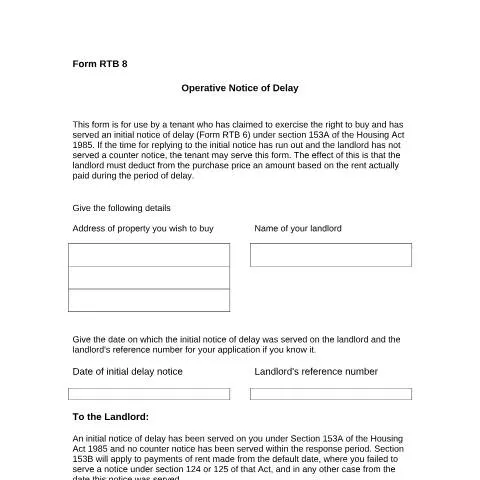
When Landlords Fail to Respond: Understanding the RTB8 Operative Notice of Delay
The Right to Buy process can become a test of patience when landlords drag their feet or simply fail to respond altogether. After you've served an initial notice of delay (RTB6) and your landlord has remained silent beyond the statutory response period, the RTB8 Operative Notice of Delay becomes your next crucial weapon. This document transforms what might seem like bureaucratic limbo into a financial penalty for your landlord—one that directly reduces your purchase price through the rent you continue paying during their delays.
Unlike many housing forms that merely document intentions or requests, the RTB8 carries immediate financial consequences. It activates Section 153B of the Housing Act 1985, ensuring that every pound of rent you pay from the relevant default date gets deducted from your eventual purchase price. Understanding when and how to deploy this notice can mean the difference between absorbing months of additional costs yourself or having your landlord bear the financial burden of their own procrastination.
The Legal Mechanics Behind Rent-to-Purchase Price Conversion
The RTB8 operates on a simple but powerful principle: if your landlord's delays force you to continue paying rent beyond reasonable timeframes, that rent should reduce what you ultimately pay to buy the property. However, the calculation method depends entirely on why you served the initial RTB6 notice in the first place.
When your landlord has failed to serve either a Section 124 notice (admitting your right to buy) or a Section 125 notice (disputing your right), the rent reduction period begins from the date they should have originally responded—not from when you serve the RTB8. This can create substantial retroactive savings, particularly if significant time has elapsed since your original Right to Buy application.
Conversely, if you served the RTB6 for other types of delays—such as failing to provide a valuation or complete necessary legal steps—the rent reduction only applies from the date you serve this RTB8 operative notice. The distinction matters enormously for your financial position, as it determines whether weeks or potentially months of back-rent get credited toward your purchase.
Section 153B Activation Requirements
The legal framework requires three specific conditions before Section 153B takes effect:
- Valid RTB6 service: You must have properly served an initial notice of delay under Section 153A
- Response period expiry: The statutory time limit for your landlord's counter-notice must have passed completely
- Continued non-compliance: Your landlord must still be failing to progress your Right to Buy application
Meeting these conditions transforms your ongoing rent payments from a simple landlord-tenant obligation into a form of enforced purchase installment, with each payment reducing your final buying price pound for pound.
Strategic Timing and the Default Date Calculations
The concept of the "default date" proves crucial for maximizing your financial benefit from the RTB8 process. This date determines when your rent payments begin counting toward purchase price reduction, and it varies significantly based on your landlord's specific failures.
For Section 124 or 125 notice failures, the default date typically falls 4 weeks after your landlord received your original Right to Buy notice (RTB1). This means if you serve an RTB8 several months after your initial application, you could see substantial retroactive rent credits applied to your purchase price.
For other procedural delays, the default date becomes the date you serve the RTB8 itself. While this provides no retroactive benefit, it ensures that future rent payments during continued delays work in your favor rather than simply enriching an unresponsive landlord.
| Type of Delay | Default Date for Rent Reduction | Potential Retroactive Benefit |
|---|---|---|
| No Section 124/125 notice served | 4 weeks after landlord received RTB1 | Yes - potentially months of back-rent |
| Valuation delays | Date RTB8 served | No - only future rent payments |
| Legal completion delays | Date RTB8 served | No - only future rent payments |
| Information provision delays | Date RTB8 served | No - only future rent payments |
Calculating Your Potential Savings
The financial impact can be substantial, particularly for tenants in higher-rent properties or those experiencing lengthy delays. Consider a tenant paying £800 monthly rent whose landlord failed to serve any response notice for six months. Serving an RTB8 could immediately credit £4,800 toward their purchase price, plus ongoing monthly credits until completion.
However, you must continue paying rent as normal throughout this period. The RTB8 doesn't suspend your rental obligations—it simply ensures these payments ultimately benefit you rather than representing pure additional cost during your landlord's delays.
Documentation Requirements and Service Procedures
The RTB8 demands precise completion to achieve its intended legal effect. Unlike some housing forms that allow for minor oversights, errors in the RTB8 can undermine your entire rent reduction claim and potentially restart statutory timeframes.
Essential information requirements include:
- Complete property address exactly as it appears on your tenancy agreement
- Full legal name of your landlord (not just the housing association or council department)
- Precise date you served the initial RTB6 notice
- Your landlord's reference number for your Right to Buy application, if available
- Your signature with full name and date
The form's notes section emphasizes recorded delivery for postal service or obtaining a written receipt for hand delivery. This isn't merely administrative prudence—it's essential legal protection. If disputes arise about service dates or whether the notice was properly delivered, your proof of service becomes crucial evidence for defending your rent reduction claims.
Hand Delivery Versus Postal Service
While both methods remain legally valid, hand delivery offers immediate certainty about service dates, which can be crucial when calculating default dates for rent reductions. However, many social landlords now operate through centralized offices or outsourced management companies, making personal delivery impractical.
Recorded delivery provides verifiable proof of service while accommodating modern landlord structures. The key lies in maintaining comprehensive records: photocopy your completed RTB8, note the exact posting date, retain your recorded delivery receipt, and track the delivery confirmation.
Navigating Landlord Counter-Responses and Disputes
Serving an RTB8 often provokes previously unresponsive landlords into sudden action. This reaction, while ultimately positive for progressing your purchase, can create new complexities requiring careful navigation.
Some landlords may attempt to serve very late Section 125 notices disputing your right to buy, hoping to invalidate your RTB8 and avoid the rent reduction consequences. However, Section 153A specifically addresses this scenario—once the response period for your initial RTB6 has expired without a counter-notice, your landlord cannot simply ignore the financial penalties by belatedly challenging your right.
Other landlords might suddenly accelerate their processes, providing valuations or legal information they'd previously withheld. While this represents the desired outcome, you should ensure that your RTB8's rent reduction provisions remain in effect until your purchase actually completes, not merely until your landlord catches up on overdue paperwork.
When Landlords Claim Administrative Errors
Landlords sometimes argue that their delays resulted from administrative oversights rather than deliberate obstruction, hoping to avoid RTB8 consequences. However, the Housing Act 1985 makes no distinction between intentional and accidental delays—the statutory timeframes apply regardless of your landlord's reasons for missing them.
If your landlord claims they never received your original notices or disputes your service methods, your RTB8 documentation becomes particularly valuable. The form requires you to reference the date of your initial RTB6 service, creating a paper trail that demonstrates your compliance with proper procedures.
Integration with the Broader Right to Buy Timeline
The RTB8 doesn't exist in isolation—it forms part of a carefully structured sequence designed to balance tenant rights with landlord obligations. Understanding how it fits within the broader Right to Buy process helps you use it most effectively.
Your journey typically begins with the RTB1 (Notice of Intention to Exercise Right to Buy), which triggers your landlord's initial response obligations. If they fail to respond appropriately, you progress to the RTB6 (Initial Notice of Delay), giving them a formal opportunity to remedy their failures. Only after this second chance expires without proper response does the RTB8 become available.
This graduated approach means that by the time you're serving an RTB8, you've already demonstrated considerable patience and given your landlord multiple opportunities to comply. The rent reduction provisions recognize this reality, ensuring that your additional costs during extended delays ultimately work in your favor.
Coordination with Valuation and Legal Processes
Even after serving an RTB8, other aspects of your Right to Buy process continue independently. Your landlord must still provide proper valuations, complete legal documentation, and facilitate surveys or inspections. The rent reduction provisions apply regardless of these other ongoing requirements.
This parallel processing can create situations where your purchase price continues declining through rent credits while simultaneously being determined through formal valuation procedures. In such cases, the final purchase price represents the professionally assessed property value minus accumulated rent credits from the default date.
Long-term Financial Implications and Purchase Completion
The RTB8's rent reduction mechanism continues operating until your Right to Buy purchase actually completes, not merely until your landlord catches up on overdue procedures. For tenants experiencing very lengthy delays, this can result in purchase price reductions worth thousands of pounds.
However, you must maintain realistic expectations about the overall financial impact. While rent reductions provide valuable compensation for delays, they don't typically transform an unaffordable property into an affordable one. The mechanism works best as protection against the additional costs of extended processes rather than as a primary affordability tool.
Consider these long-term factors:
- Continued mortgage eligibility as your circumstances change during extended delays
- Property market movements affecting the underlying valuation
- Maintenance responsibilities and costs while remaining a tenant during delays
- Right to Buy discount calculations based on your tenancy length at completion
The rent reduction provisions complement rather than replace other Right to Buy financial benefits. Your statutory discount based on tenancy length continues applying to the final valuation, while RTB8 rent credits reduce whatever purchase price emerges from that calculation.
Planning for Multiple Delay Scenarios
Some Right to Buy applications encounter multiple delay types throughout their progression. You might serve an initial RTB6 for failure to provide Section 124/125 notices, then later need additional delay procedures for valuation problems or legal completion issues.
Each delay type potentially requires separate documentation and may trigger different default date calculations. Maintaining detailed records of all service dates, landlord responses, and ongoing rent payments becomes essential for maximizing your eventual financial benefit and defending your position if disputes arise.
The RTB8 represents more than administrative paperwork—it's a powerful tool for ensuring that landlord delays cost them, not you. By understanding its proper use within the broader Right to Buy framework, you can transform frustrating delays into financial advantages that ultimately reduce your path to homeownership costs.
Calculating the Revised Completion Period After RTB8 Notice
When your local authority serves an RTB8 notice of delay, understanding how the revised completion timeline is calculated becomes crucial for planning your purchase. The Housing Act 1985 provides the framework, but the practical application depends on several factors that many tenants overlook during the excitement of securing their Right to Buy purchase.
The original completion period runs for eight weeks from the date you receive the authority's admission notice (RTB1). However, when delays occur due to circumstances beyond the authority's control, the RTB8 allows them to extend this period. The key principle is that you shouldn't be disadvantaged by delays that aren't your fault, but equally, the authority cannot use this mechanism to indefinitely postpone completion.
Your local authority must specify in the RTB8 notice the exact nature of the delay and provide a realistic revised completion date. Common scenarios include delays in obtaining vacant possession where other tenants occupy parts of the building, complications with leasehold arrangements in mixed-tenure blocks, or issues with title deeds that require legal resolution. Each situation has different implications for how long the delay might reasonably last.
For vacant possession delays, authorities typically add the time needed to resolve housing for displaced tenants, which could range from several weeks to months depending on local housing availability. If structural surveys reveal unexpected issues requiring remedial work before sale, the delay period should reflect realistic construction timescales plus a reasonable buffer for unforeseen complications.
You retain important rights during any extended period. The discount percentage you qualified for remains frozen at the original assessment date, protecting you from any policy changes that might reduce discounts for new applications. Similarly, your mortgage offer validity period may need extending, and most lenders will accommodate this when you provide them with a copy of the RTB8 notice explaining the delay.
If you believe the proposed delay period is unreasonable, you can challenge this through the First-tier Tribunal (Property Chamber). However, tribunals generally defer to local authority assessments unless the delay appears excessive or the justification inadequate. Before pursuing this route, consider whether the additional time might actually benefit your preparation, particularly for arranging final mortgage approvals or planning any immediate renovations.
Impact on Mortgage Applications and Financial Planning
An RTB8 notice of delay creates immediate implications for your mortgage arrangements that require prompt attention to avoid complications later in the process. Most mortgage offers for Right to Buy purchases are valid for six months, but delays can push your completion date beyond this period, potentially requiring a full re-application with updated financial assessments.
Contact your mortgage lender immediately upon receiving the RTB8 notice. Most established lenders familiar with Right to Buy transactions have processes for extending offer validity when delays result from local authority issues rather than borrower circumstances. You'll typically need to provide a copy of the RTB8 notice along with a written explanation of the delay circumstances.
However, extending a mortgage offer isn't automatic. If your financial circumstances have changed since the original application – such as job changes, salary variations, or new credit commitments – your lender may require updated affordability assessments. Interest rates may also have moved since your original application, potentially affecting your mortgage terms even if the loan amount remains unchanged.
For shared ownership Right to Buy purchases, delays can create additional complexity with housing association partners. The housing association's own mortgage arrangements for their retained share may have time-sensitive elements that don't automatically extend alongside your purchase delay. Early communication with all parties helps prevent last-minute complications that could further delay completion.
Consider the financial implications of extended temporary accommodation if you've already given notice on rental property or arranged removal services. Some tenants find themselves in costly bridging arrangements when delays extend beyond their original planning. Review your household budget to ensure you can manage any additional temporary costs without compromising your mortgage deposit or completion funds.
The delay period also provides opportunities for additional financial preparation. You might use the extra time to increase your deposit amount, potentially improving your mortgage terms or reducing monthly payments. Some buyers also use delay periods to shop around for better mortgage deals, particularly if market conditions have improved since their original application.
Keep detailed records of any additional costs incurred due to the delay, such as extended storage fees, temporary accommodation costs, or mortgage arrangement fee extensions. While you cannot generally claim these costs from the local authority, they may be relevant for tax purposes or if you later need to demonstrate financial hardship affecting your ability to complete the purchase.
Managing Delays in Mixed-Tenure and Leasehold Conversions
Right to Buy applications involving conversion from secure tenancy to leasehold ownership present unique challenges that frequently trigger RTB8 delay notices. These situations arise most commonly in blocks of flats, maisonettes, or houses converted into multiple units where the local authority must create new leasehold arrangements or modify existing ones.
When purchasing a flat under Right to Buy, you're typically acquiring a long leasehold interest rather than freehold ownership. The local authority must prepare comprehensive lease documents that define your responsibilities for service charges, maintenance contributions, and building insurance arrangements. This process becomes particularly complex in mixed-tenure blocks where some residents own their flats while others remain tenants, as the lease must balance rights and obligations across different tenure types.
Service charge arrangements require careful calculation and legal documentation. Your lease will specify how costs for communal areas, building maintenance, and management services are apportioned between leaseholders and the authority as landlord for remaining rental units. Delays often occur when authorities need to establish or revise service charge accounting systems to accommodate the new leasehold arrangements.
Building insurance presents another common delay factor. The authority must arrange comprehensive buildings insurance covering the entire property, with costs recoverable through service charges. For older properties or those with previous claims history, obtaining appropriate insurance can take several weeks, particularly if structural surveys reveal issues requiring specialist coverage or higher premiums.
Ground rent calculations, while typically minimal under Right to Buy leases, must be formally documented and integrated with the authority's rent collection systems. Some authorities use delay periods to modernise their leasehold management systems, ensuring they can properly administer ongoing landlord responsibilities after completion of Right to Buy sales.
Fire safety compliance has become an increasingly significant factor in RTB8 delays, particularly following recent building safety legislation. Authorities must ensure that leasehold arrangements properly allocate responsibilities for fire safety measures, emergency procedures, and any remedial works required to meet current standards. This process can extend significantly if building assessments reveal safety issues requiring resolution before sale completion.
Management company arrangements may also require establishment or modification. Some authorities create resident management companies or transfer management responsibilities to external agents when selling flats under Right to Buy. Setting up these arrangements, including appropriate governance structures and financial systems, often requires several months of preparation that wasn't anticipated in the original completion timeline.