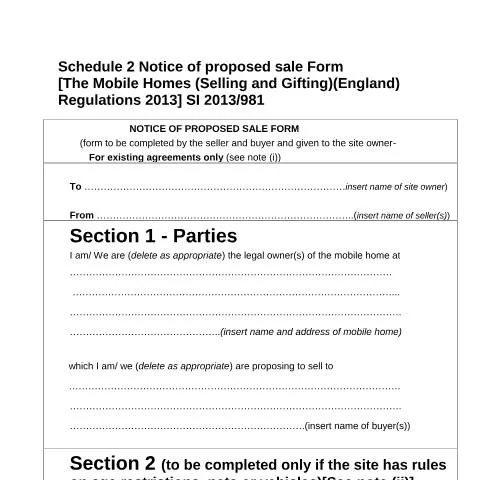
The Critical Notification Bridge Between Seller and Site Owner
When a mobile home owner decides to sell their property on a residential park, they enter a complex regulatory landscape that differs significantly from conventional property transactions. The Notice of Proposed Sale Form serves as the mandatory communication channel between the seller, prospective buyer, and site owner, but only under specific circumstances that many people misunderstand. This document isn't a universal requirement for all park home sales – it applies exclusively to what the legislation terms "existing agreements" under the Mobile Homes Act 1983.
The form operates within a tight 21-day window that can make or break a sale. Site owners who wish to challenge a proposed transaction must act swiftly, whilst sellers navigate the delicate balance between transparency and protecting their commercial interests. Understanding when this form becomes necessary, and how to complete it accurately, can prevent costly delays and legal complications that frequently arise in park home transactions.
Distinguishing Existing Agreements from Modern Park Home Transactions
The fundamental distinction that determines whether this form is required lies in the date and assignment history of the mobile home agreement. This creates two distinct categories of park home ownership that operate under different rules.
Existing agreements are those established on or before 25 May 2013 under section 1(1) of the Mobile Homes Act 1983, provided they haven't been assigned since that critical date. If your agreement falls into this category, you must complete the Notice of Proposed Sale Form and submit it to your site owner before proceeding with any transaction.
However, if your agreement was created on or after 26 May 2013, or was made before that date but has been assigned at least once since 25 May 2013, you're operating under different rules. These agreements can be sold and assigned without requiring notification to the site owner, as outlined in paragraph 7A(2) of Chapter 2 of Part 1 of Schedule 1 to the Mobile Homes Act 1983.
| Agreement Type | Date Created | Assignment History | Notice Required |
|---|---|---|---|
| Existing Agreement | On or before 25 May 2013 | Never assigned since 25 May 2013 | Yes - must use this form |
| Modern Agreement | On or after 26 May 2013 | Not applicable | No notification required |
| Previously Assigned | Before 25 May 2013 | Assigned once or more since 25 May 2013 | No notification required |
Navigating Site Rules and Occupancy Restrictions
Section 2 of the form addresses the most contentious aspects of park home sales: compliance with site-specific rules. These restrictions often become the battleground where sales succeed or fail, and the form requires detailed disclosure across several key areas.
Age-Related Restrictions and Their Complexities
Many residential park sites operate as retirement communities with minimum age requirements, typically 45, 50, or 55 years. The form requires sellers to confirm that proposed buyers have read and understood these rules, but also demands specific disclosure of all persons who would occupy the mobile home as their only or main residence. This extends beyond the primary buyers to include any adult children, relatives, or partners who might live there permanently or semi-permanently.
Site owners can only refuse a sale on age grounds if the proposed occupiers would breach pre-commencement rules or current site rules. However, determining what constitutes someone's "main residence" can be complex, particularly for couples who might maintain multiple properties or adult children who divide their time between locations.
Pet Policies and Animal Declarations
The form requires comprehensive disclosure of any animals the buyer intends to keep on site, including specific details about type, number, and in the case of dogs, the breed. This level of detail reflects the reality that many parks have evolved sophisticated pet policies that go well beyond simple "no pets" rules.
Modern park regulations might permit certain dog breeds while prohibiting others, limit the number of pets per household, or require specific sizes or weights. Some sites allow cats but not dogs, whilst others operate breed-specific restrictions based on insurance requirements or previous incidents. The form's requirement for breed specification acknowledges that site owners need this information to assess compliance accurately.
Vehicle Parking and Site Infrastructure
Vehicle restrictions often reflect the physical limitations of park infrastructure rather than arbitrary rules. The form requires disclosure of parking intentions and vehicle descriptions, recognising that sites may have restrictions on vehicle types, sizes, or numbers based on available parking spaces, access road widths, or weight limitations.
Some parks prohibit commercial vehicles, motorhomes, or caravans, whilst others limit the number of vehicles per pitch. The form deliberately excludes registration numbers, focusing instead on vehicle types and descriptions that allow site owners to assess compliance without unnecessarily invasive detail.
The 21-Day Challenge Window and Its Strategic Implications
The form establishes a critical 21-day period during which site owners must decide whether to challenge a proposed sale through tribunal proceedings. This timeframe creates significant strategic considerations for all parties involved.
Once the completed form is received, site owners have exactly 21 days to both apply to a tribunal for a refusal order and serve notice of that application on the seller. This dual requirement means that simply initiating tribunal proceedings isn't sufficient – the seller must be formally notified within the same 21-day window.
If no application notice is received within this period, sellers can proceed with their transaction without further consultation. Crucially, tribunals cannot consider late applications, making this deadline absolute rather than discretionary. This creates pressure on site owners to make quick decisions based on the information provided in the form.
Limited Grounds for Refusal Orders
The Mobile Homes (Selling and Gifting) England Regulations 2013 strictly limit the grounds upon which site owners can seek refusal orders. These are confined to situations where proposed occupiers would breach pre-commencement rules or site rules relating to:
- Age restrictions affecting the proposed occupier or their intended co-residents
- Keeping prohibited animals or exceeding permitted numbers
- Parking prohibited vehicle types
- Exceeding the permitted number of vehicles
Notably, site owners cannot object on grounds of personal preference, previous disputes, or general concerns about suitability. The law requires specific rule breaches that can be demonstrated through the information provided in the form.
Completing Section 1: Establishing Clear Legal Ownership
The opening section requires precise identification of the legal owners, the property location, and the proposed buyers. While seemingly straightforward, this section can present complications in various ownership scenarios.
Joint ownership situations require all legal owners to be named as sellers, and the form provides space for multiple signatures. This becomes particularly important in cases involving separated couples, inherited properties, or business partnerships where all parties must consent to the sale.
The property description should match the site owner's records exactly, including any pitch numbers, park section identifiers, or specific address formats used within the park. Discrepancies between the form and site records can create delays or challenges to the validity of the notice.
Buyer identification must be complete and accurate, as these details will be used by site owners to assess compliance with site rules and potentially conduct background checks permitted under park regulations.
Documentation Requirements and Evidence Standards
The form operates within a broader framework of documentation that sellers must manage throughout the transaction process. While the form itself is relatively concise, it relies on several underlying documents and processes.
Sellers must provide buyers with copies of all relevant site rules before completing the form, and buyers must confirm they have read, understood, or had these rules explained to them. This creates a paper trail that protects both parties if disputes arise later about rule compliance or awareness.
The signature requirements in Section 3 carry legal weight, with both sellers and buyers confirming that the information provided is truthful, accurate, and up-to-date to the best of their knowledge and belief. This creates potential liability for deliberate misrepresentation or negligent inaccuracies.
Managing Information Updates and Changes
Between completing the form and completing the sale, circumstances might change that affect the accuracy of the information provided. Buyers might change their minds about keeping pets, parking arrangements might be modified, or additional occupiers might be planned.
While the form doesn't explicitly address post-submission changes, the legal requirement for accuracy suggests that material changes should be communicated to site owners, particularly if they might affect compliance with site rules or the basis for any potential refusal order application.
Strategic Timing and Transaction Coordination
The Notice of Proposed Sale Form sits at the intersection of multiple transaction timelines that sellers must coordinate carefully. Estate agent agreements, buyer mortgage arrangements, and legal completion dates all interact with the 21-day challenge period in ways that can create pressure or opportunities.
Experienced sellers often submit the form early in the sales process, allowing the 21-day period to expire before finalising other arrangements. This approach provides certainty about site owner acceptance before buyers commit to surveys, legal fees, or mortgage arrangements.
Alternatively, some sellers prefer to wait until they have a committed buyer with confirmed financing before triggering the 21-day challenge period. This reduces the risk of having multiple pending transactions or dealing with site owner challenges for sales that might not proceed for other reasons.
Interaction with Legal and Financial Processes
The form's requirements can influence broader transaction arrangements in unexpected ways. Mortgage lenders might require confirmation that site owners haven't objected to a proposed sale, making the 21-day period a critical path item for buyer financing.
Legal representatives must understand the form's requirements when drafting sale contracts, particularly regarding conditions precedent and completion timing. Some contracts include specific clauses addressing site owner challenges or make completion conditional on the expiry of the 21-day period without objection.
The form's emphasis on accuracy and truthfulness also creates due diligence obligations for sellers' legal representatives, who must ensure that site rules are properly understood and that buyer declarations are realistic and sustainable.
Practical Implications for Different Stakeholder Groups
The Notice of Proposed Sale Form affects various stakeholders differently, creating distinct strategic considerations and risk profiles for each group involved in park home transactions.
For sellers operating under existing agreements, the form represents both a procedural hurdle and a potential safeguard. While it creates delay and uncertainty, it also provides a structured process for addressing site owner concerns early in the transaction, potentially avoiding more complex disputes later.
Site owners must balance their legitimate interests in maintaining community standards with their limited grounds for objection under the regulations. The form provides them with essential information for making informed decisions within tight timescales, but also constrains their ability to object on broader grounds.
Buyers benefit from the transparency the form creates around site rules and restrictions, but must also navigate the uncertainty of potential site owner challenges. The requirement to confirm rule understanding and compliance creates both protection and responsibility for prospective park home owners.
Legal professionals must understand the form's role within the broader regulatory framework while managing client expectations about timescales, risks, and the limited grounds for site owner objections. The form's specific requirements can influence transaction structuring, contract terms, and risk allocation between parties.
Challenging or Objecting to a Proposed Sale Notice
Residents receiving a notice of proposed sale aren't powerless in the process. The Mobile Homes Act 1983 and subsequent regulations provide several avenues for challenging the sale, particularly if you believe the proposed purchaser isn't suitable or the sale terms disadvantage the site community.
Your primary right lies in questioning the buyer's suitability to manage a residential park home site. This isn't about personal preferences but focuses on their ability to comply with statutory obligations. Key grounds for objection include the proposed owner's lack of experience in site management, insufficient financial resources to maintain essential services, or a history of regulatory breaches at other sites.
The consultation period following the notice is crucial for gathering evidence. Contact other residents to coordinate responses, as collective objections carry more weight than individual complaints. Document any concerns about proposed changes to site rules, maintenance standards, or pitch fee structures that might accompany the ownership change.
If the current site owner hasn't provided adequate information about the buyer, you can request additional details. This might include the purchaser's business plan for the site, evidence of their insurance arrangements, or clarification about their intentions regarding site facilities and services.
For formal challenges, residents typically need to present their case to the local authority's licensing team or, in some cases, through the First-tier Tribunal (Property Chamber). The tribunal can consider whether the proposed sale serves residents' interests and whether alternative arrangements might better protect the community.
Time limits are strict for objections. Most challenges must be submitted within the consultation period specified in the notice, though exceptional circumstances might allow later submissions. Early legal advice from specialists in park home law can help determine the strongest grounds for your case and ensure proper procedural compliance.
Financial Implications and Pitch Fee Considerations
A change in site ownership often triggers significant financial implications for residents, extending far beyond the immediate sale transaction. Understanding these potential changes helps you prepare financially and, where necessary, negotiate better terms with incoming owners.
Pitch fees represent the most immediate concern for most residents. New owners may seek to increase fees to reflect current market rates or fund site improvements, but they must follow strict legal procedures. The Tribunals Service website details the formal process for pitch fee reviews, including mandatory consultation periods and residents' rights to challenge unreasonable increases.
Service charges merit particular scrutiny during ownership transitions. New owners might restructure these charges, potentially separating previously included services like grounds maintenance, security, or communal facility upkeep. Review your current site agreement carefully to understand which services are guaranteed and which might become optional extras under new management.
Insurance arrangements frequently change hands with site ownership. While buildings insurance for your home remains your responsibility, site insurance covering communal areas and third-party liability might shift to different providers or coverage levels. Ensure you understand any changes to excess payments or claim procedures that might affect you.
Utility connections and billing arrangements can also change. Some new owners prefer direct billing relationships with residents, while others maintain bulk purchasing agreements that might offer better rates. Factor these potential changes into your household budgeting, particularly if you're on a fixed income or benefit arrangements.
Capital improvements often accompany ownership changes, potentially leading to special assessments or mandatory contributions from residents. While major improvements can enhance property values, they also create immediate financial pressures. New owners must follow consultation procedures for significant expenditure, giving residents opportunities to input on priorities and payment schedules.
Consider seeking independent financial advice if the proposed sale involves complex arrangements like lease extensions, shared ownership schemes, or resident buyout options. These alternatives might offer long-term security but require careful evaluation of their financial implications and legal commitments.
Legal Documentation and Record-Keeping During Transition
The period surrounding a park home site sale generates substantial paperwork that residents must carefully manage to protect their interests. Proper documentation becomes essential evidence if disputes arise during or after the ownership transition.
Start by organizing all existing site-related documents, including your original pitch agreement, site rules, service charge statements, and correspondence with the current owner. Create copies of everything, storing originals safely while keeping working copies accessible for reference during the transition period.
The notice of proposed sale itself requires careful preservation. Note the exact date you received it, how it was delivered, and whether it contains all required information. Any deficiencies in the notice might provide grounds for challenging the sale timeline or requesting additional consultation periods.
Document all communications during the consultation period meticulously. This includes meetings with the proposed new owner, discussions with other residents, and any promises or commitments made about future site management. Email exchanges should be saved with full headers showing dates and times, while verbal conversations should be confirmed in writing promptly.
Site condition surveys become particularly important during ownership transitions. Photograph or video record the current state of communal areas, access roads, utility connections, and any maintenance issues. This documentation protects residents if the new owner later claims pre-existing problems were caused by resident actions or neglect.
Financial records deserve special attention during this period. Keep detailed records of all payments to the current owner, including pitch fees, service charges, and deposits. Ensure you receive proper receipts and maintain bank records showing payment dates and amounts. This documentation becomes crucial if payment responsibilities transfer mid-period or if deposits need transferring to the new owner.
Consider engaging a solicitor experienced in park home law to review key documents and advise on your rights throughout the process. While legal costs require careful consideration, professional guidance often prevents more expensive problems later. Many park home residents' associations can recommend specialists or negotiate group rates for legal consultations.
Maintain a chronological file of all developments related to the sale, including newspaper announcements, planning applications, licensing submissions, or tribunal proceedings. This comprehensive record helps track the sale's progress and ensures you don't miss critical deadlines for submissions or objections that might affect your rights as a resident.